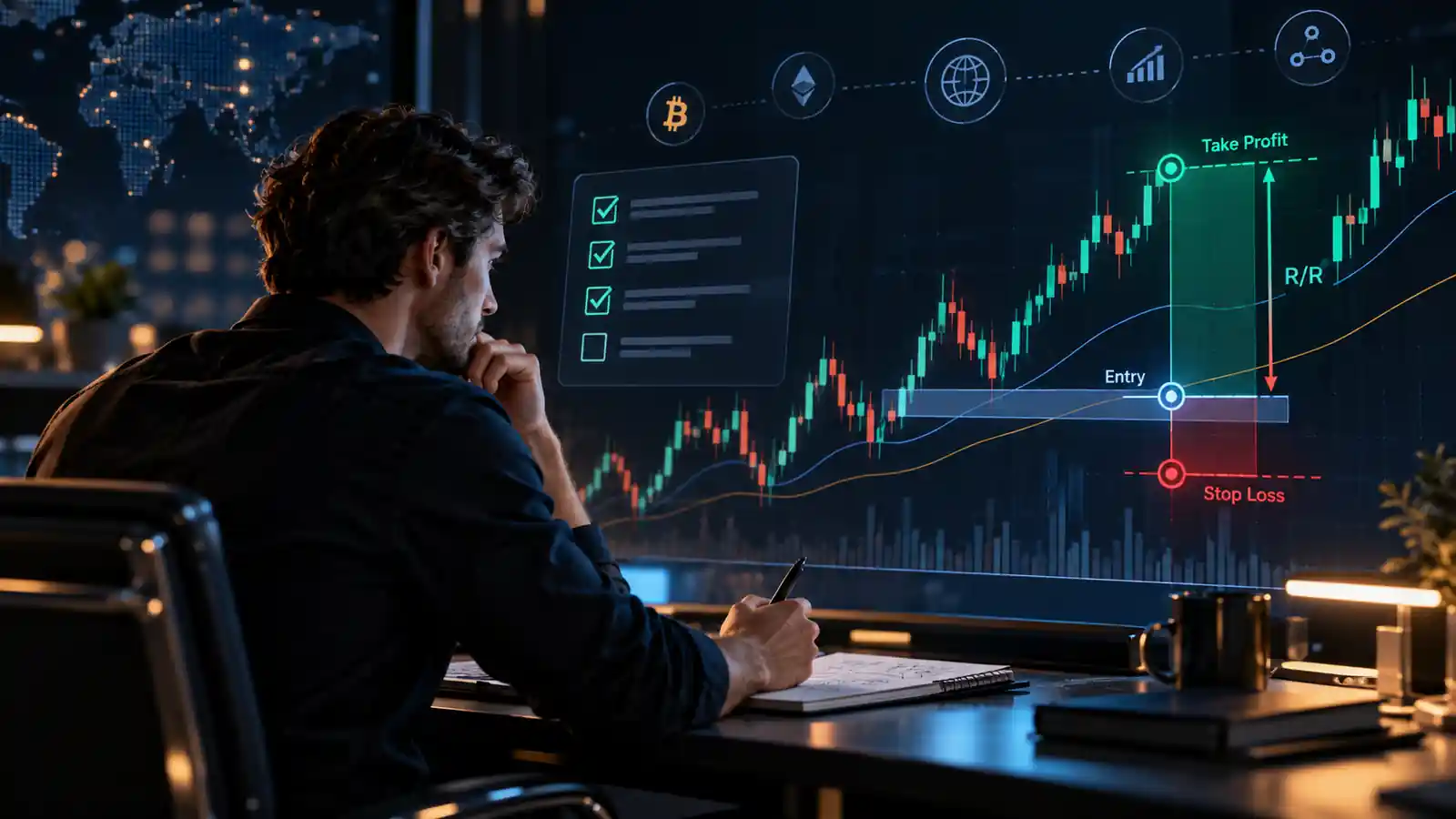
A crypto trading signal becomes useful only when it can be converted into a testable trade scenario. LONG or SHORT alone says little about trade quality: Entry, Stop Loss, Take Profit, Risk/Reward, current price, market regime and events around the asset all matter. Below is a practical workflow for verifying a signal before opening a position.
1. Turn the message into a structured trade
Most crypto signals arrive as a set of parameters: pair, direction, Entry, Stop Loss and targets. Normalize them into one structure before entering.
A minimum set includes:
- trading pair and market;
- LONG or SHORT;
- actual Entry zone;
- Stop Loss and the reason for placing it there;
- one or more Take Profit levels;
- acceptable risk for the trade;
- the condition after which the signal becomes stale.
Where Orenix Signal Verifier helps
Signal Verifier can accept pasted signal text or manual parameters and treat Entry, Stop Loss and Take Profit as one scenario. It shows where risk sits and how far price must move to reach the target.
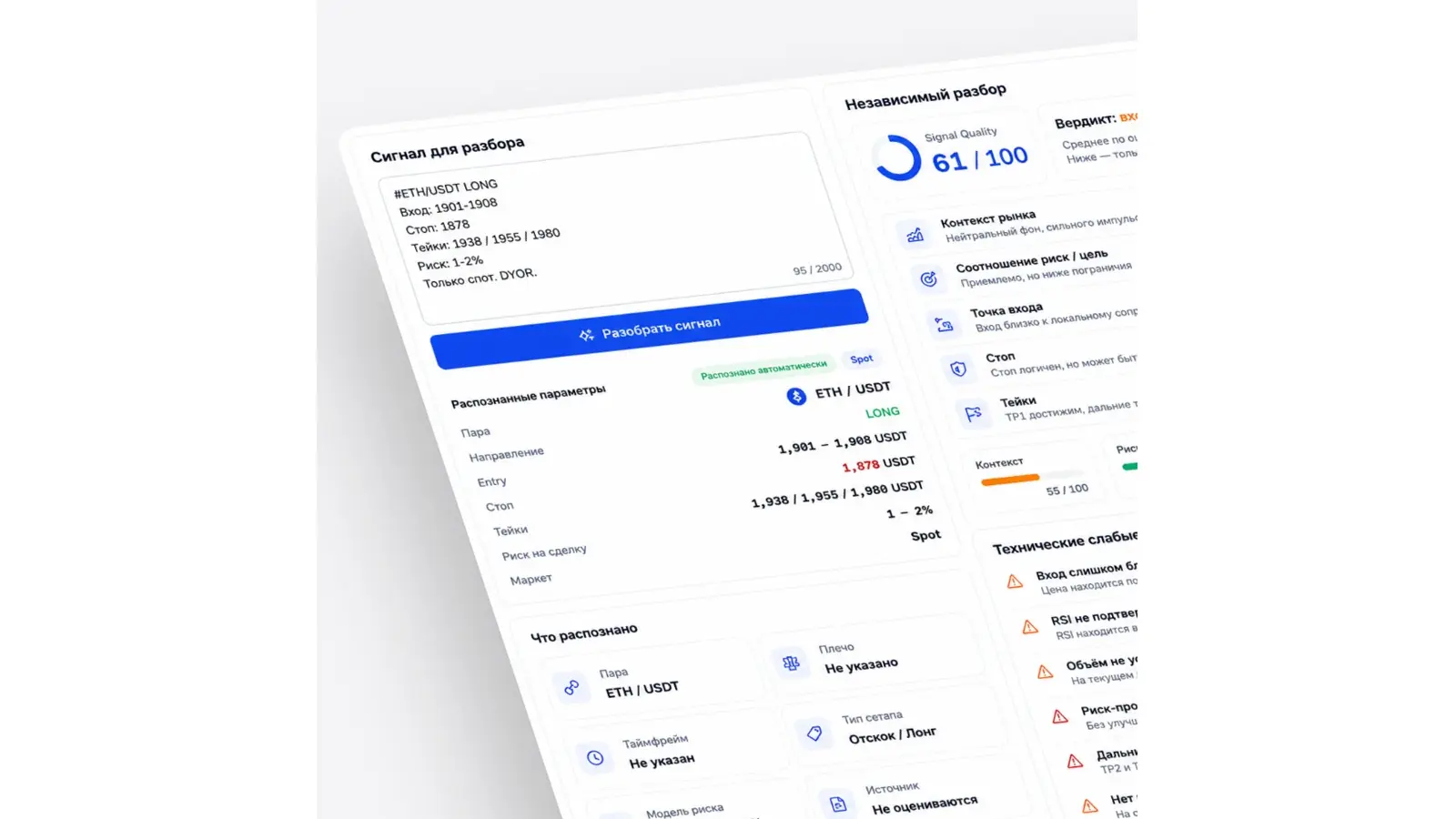
Do not start with the Score
A score is only a summary. If Entry, stop or target is weak, a high rating does not repair the trade structure.
2. Calculate Risk/Reward before potential profit
A +6% target looks attractive until the trader notices a -5% Stop Loss. For a LONG, risk is the distance from Entry to Stop Loss and potential reward is the distance from Entry to Take Profit. For a SHORT, the logic is mirrored.
| Scenario | Risk | Potential | R/R |
|---|---|---|---|
| A | 2% | 6% | 1:3 |
| B | 3% | 4.5% | 1:1.5 |
| C | 5% | 5% | 1:1 |
Risk/Reward does not show win probability; it shows potential outcome for each predefined unit of risk.
Do not improve R/R with an artificial stop
An attractive 1:5 is easy to create with a stop that is too close. Normal volatility can hit it early. The stop should sit where the scenario actually fails.
3. Check whether the entry is already late
Even a good crypto signal can age quickly. If price has already travelled halfway from Entry to Take Profit, the original risk/reward has changed. A trader entering later than the signal author is effectively opening a different trade.
Compare Entry, current price and the first target: the further price moves toward Take Profit, the less upside remains.
A strong signal can become a weak trade without a single word in the message changing; price movement alone is enough.
A test against chasing the market
Ask: “If I saw the current price without the Telegram message and without the author's name, would I open the same position?” If not, you may be chasing a move that already happened.
4. Compare the signal with the market regime
A LONG on an altcoin during calm BTC strength and the same LONG during a fast market-wide selloff are different risk scenarios. A crypto screener is therefore more useful as context than as a “buy” button.
Orenix Screener helps describe the individual asset while Market Mood adds the broader regime. This does not guarantee an outcome, but it reduces the risk of analyzing one coin in isolation.
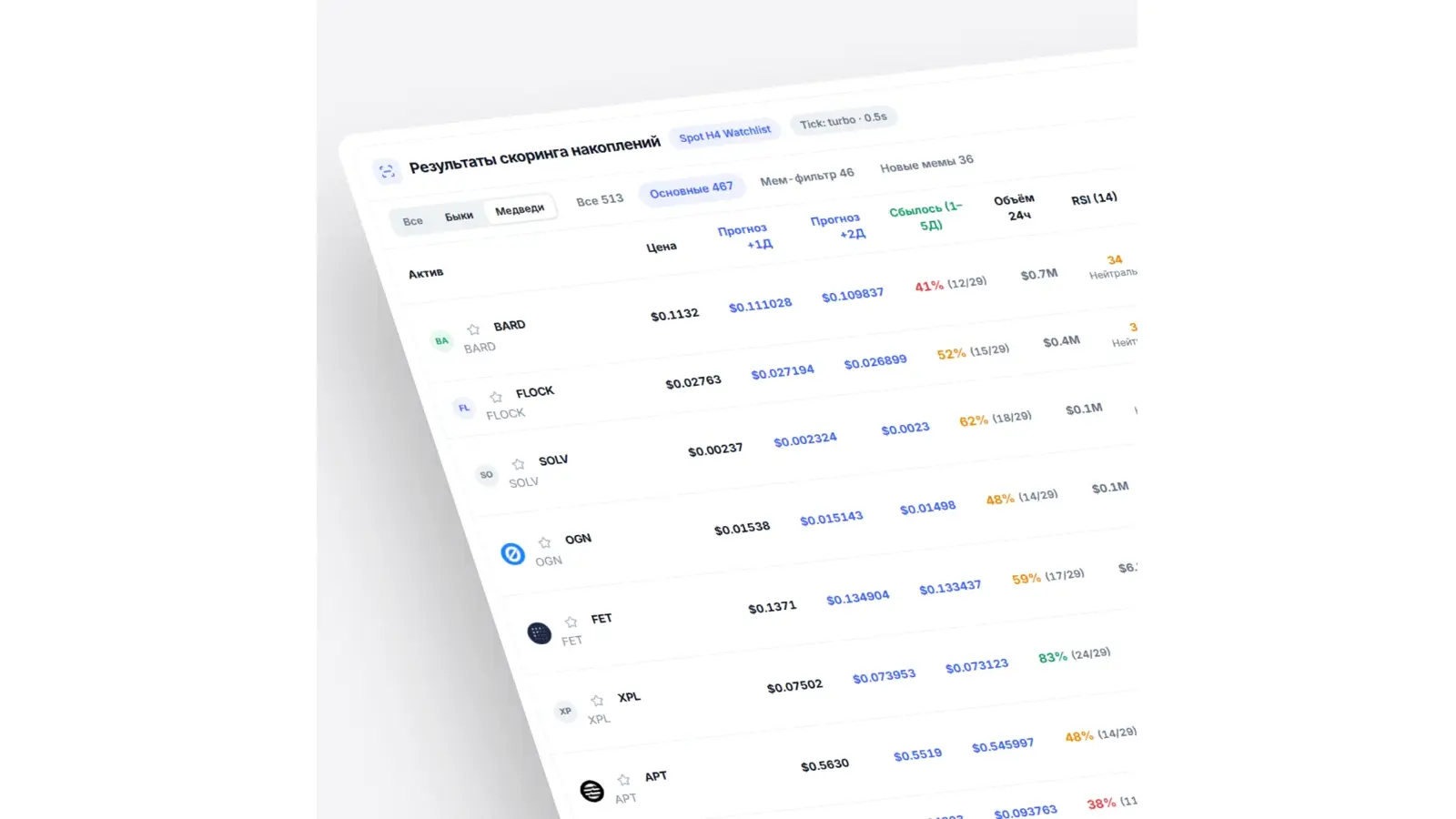
Check the broader impulse, whether the move is already extreme, BTC dependence and reversal risk. A screener provides context; it does not replace strategy or risk management.
5. Check news and events
A technically attractive setup can appear before a listing, token unlock, governance vote, protocol upgrade, security incident or major exchange announcement. In that environment, familiar volatility can change rapidly.
Orenix Radar adds event context. A news item should not automatically become a BUY or SELL command, but it can explain why an otherwise familiar setup carries more risk today.
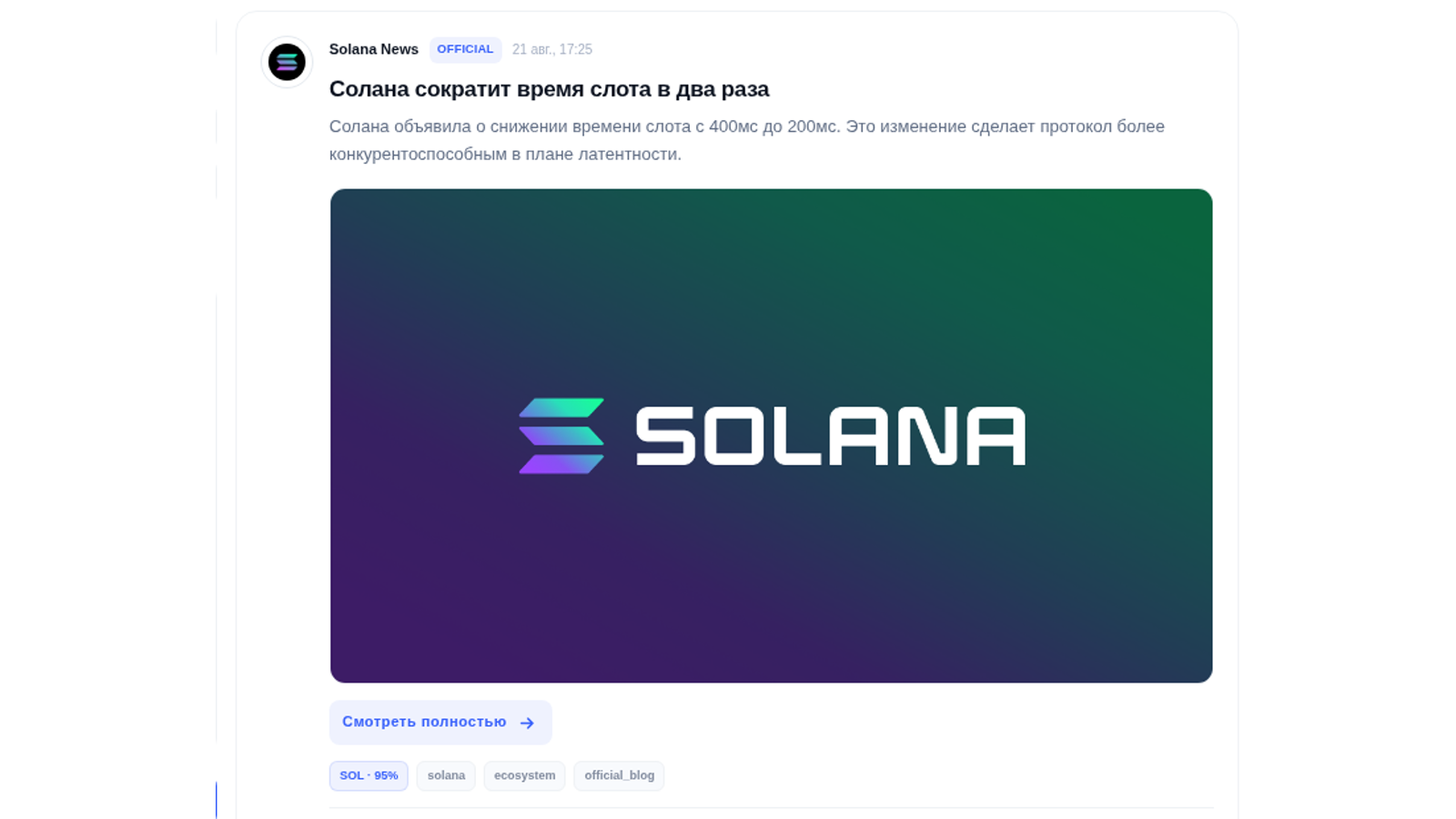
Why news is not the same as a signal
The market may have priced the event in already and the reaction may oppose the obvious narrative. News adds risk context; it does not provide a ready-made trade direction.
6. Stop Loss should represent failure of the idea
“I always use a 2% stop” sounds disciplined, but a fixed percentage may have nothing to do with the structure of a specific market. A good Stop Loss answers one question: what price movement would show that the original hypothesis is no longer valid?
That could be a break of support, a return below a key zone or a structural violation. Define it before the trade, not after price moves against you.
Leverage does not repair a weak signal
Leverage does not make the signal more accurate. Higher leverage leaves less room for market noise. Define the scenario, Stop Loss and risk first, then execution parameters.
7. Test a new signal source in Demo/Paper first
One successful screenshot does not prove source quality. You need a series of observations. Demo/Paper trading lets you test rules on live price movement without risking real capital.
Record more than the result: note drawdown, early stops, late entries, market regime and important events.
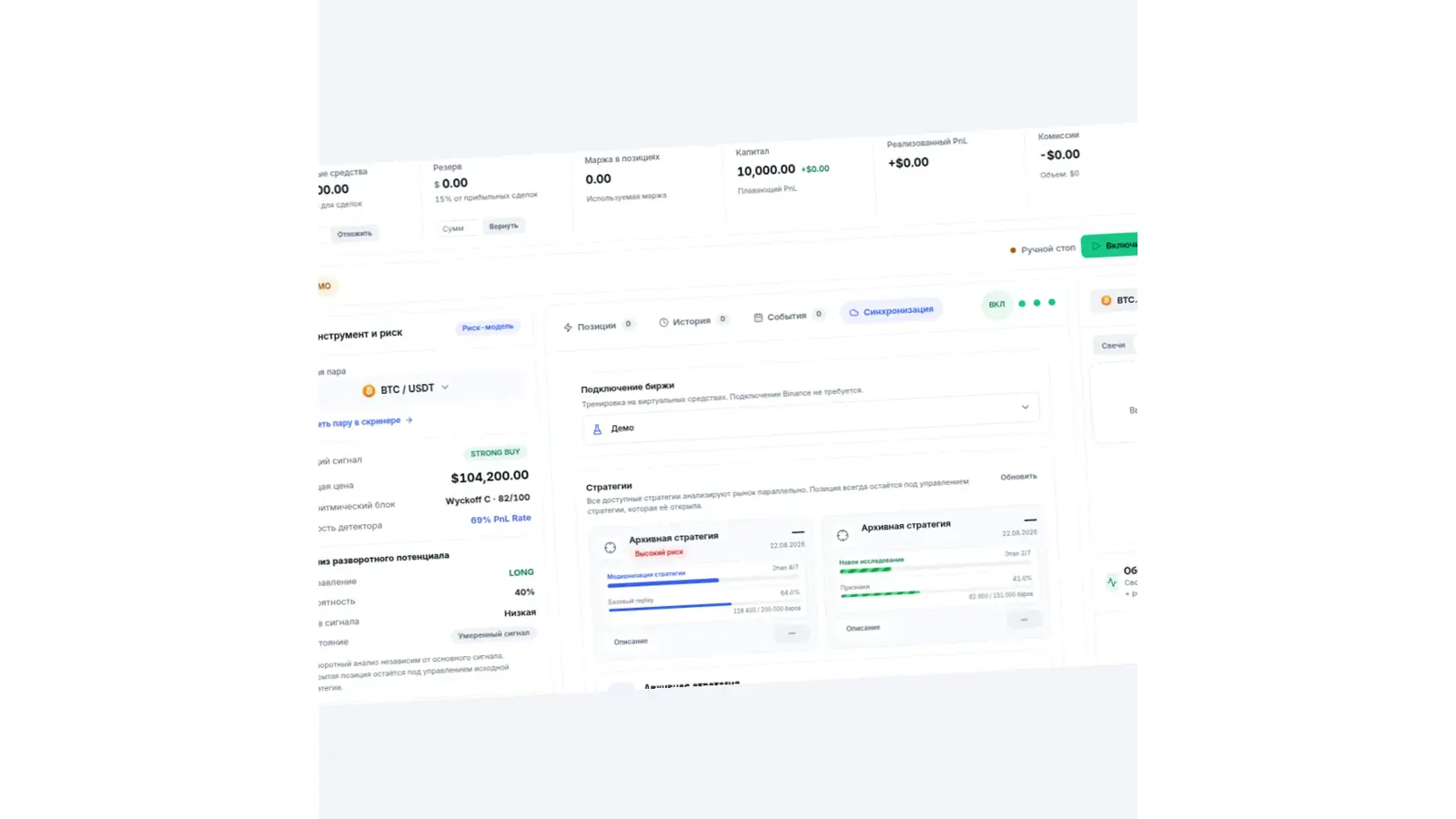
A minimal verification journal
- source and publication time;
- original and actual Entry;
- Risk/Reward;
- Stop Loss or Take Profit result;
- maximum adverse move;
- market regime and news;
- reason to accept or skip the trade.
After a series of observations, the journal shows which filters improve decisions and which only create a feeling of control.
Checklist before opening a position
Before Buy or Sell, answer seven questions:
- Are Entry, Stop Loss and Take Profit clearly defined?
- Is Risk/Reward acceptable without an artificially tight stop?
- Has price moved too far from the original Entry?
- Does the scenario fit the current market regime?
- Is there an event that changes risk sharply?
- Does Stop Loss represent a real failure of the idea?
- Is there evidence for the source or a Demo/Paper test?
If several answers are unclear, that does not automatically mean the signal is bad. It means the decision is not yet defined well enough for a controlled trade.
Orenix does not promise a “perfect signal”: Verifier structures the idea, Screener and Market Mood add context, Radar adds events, Demo/Paper tests the scenario, and Terminal preserves its parameters.
Instead of “saw signal → clicked Buy,” the workflow becomes: **saw → structured → measured risk → checked market → checked events → tested → decided**.
Conclusion
Signal verification does not predict the future. It filters trades with undefined risk, stale entries or arbitrary stops. Orenix does not guarantee profit, but it helps make decisions measurable and repeatable.