Litecoin resembles Bitcoin in its UTXO model, fixed-supply issuance and Proof of Work, but its engineering parameters are materially different. PoW uses Scrypt rather than SHA-256, target block spacing is 150 seconds, subsidy halves every 840,000 blocks, and Litecoin Core sets an 84-million-LTC maximum-money sanity bound. Above the transparent canonical ledger sits the opt-in MimbleWimble Extension Block: users can peg LTC into a separate MWEB state where amounts are hidden by commitments and range proofs and one-sided transfers use stealth-address mechanics. Scrypt mining is also connected to Dogecoin through AuxPoW: the same mining work can help secure LTC and DOGE, but the relationship is asymmetric—Litecoin does not need to know that Dogecoin exists.
Scrypt makes Litecoin mining different from Bitcoin SHA-256
Litecoin Core computes Proof-of-Work with a Scrypt variant originally selected as a memory-hard alternative to SHA-256. The current code still exposes scrypt_1024_1_1_256: N=1024, r=1, p=1, producing a 256-bit hash.
Memory-hard design does not mean permanently ASIC-proof
The original choice made early SHA-256 ASIC designs unsuitable because Scrypt requires scratchpad memory and repeated mixing. Economic incentives eventually produced specialized Scrypt ASIC hardware.
Modern Litecoin security therefore depends on a real market of specialized Scrypt miners, pools and electricity economics rather than CPU or GPU egalitarianism.
The PoW target works conceptually like other Bitcoin-family systems
A miner varies nonce and coinbase-related data, hashes the block header and searches for a result below the current target. A lower target means greater difficulty.
A Scrypt ASIC cannot simply switch to BTC
SHA-256 and Scrypt are separate hardware markets. This differs from the BCH/BTC relationship where one SHA-256 ASIC can mine either chain.

The same Scrypt work can still be useful to Dogecoin
That shared Scrypt family is what enables LTC/DOGE merged mining. Dogecoin, as the auxiliary chain, can validate proof derived from a parent mining structure.
Litecoin targets 2.5-minute blocks
Current Litecoin Core mainnet sets nPowTargetSpacing to **2.5 × 60 = 150 seconds**. That is four times shorter than Bitcoin's ten-minute target.
Shorter spacing reduces average wait for the first block
Under comparable assumptions, users statistically see a first confirmation sooner. Individual PoW blocks can still arrive much sooner or later than the target.
Faster blocks increase sensitivity to propagation delay
With shorter intervals, the same absolute network delay consumes a larger fraction of the block interval. Bandwidth, relay efficiency and node performance therefore matter for stale-block risk.
The difficulty target timespan is 3.5 days
Mainnet uses a 3.5-day nPowTargetTimespan and 150-second spacing, corresponding to 2016 target intervals per retarget period.
Confirmation counts should not be compared without time and security context
Six LTC blocks represent roughly fifteen minutes of target time, while six BTC blocks represent roughly an hour. Economic finality also depends on hashrate, security budget, attack cost and custodian policy.
A confirmation count without block interval and security context is incomplete. “Six confirmations” means different elapsed time and accumulated work across PoW networks.
Issuance starts at 50 LTC and halves every 840,000 blocks
Litecoin Core's subsidy schedule begins at 50 LTC and halves every **840,000 blocks**.
Why the interval is four times Bitcoin's 210,000 blocks
At a 2.5-minute target, 840,000 Litecoin blocks take roughly the same wall-clock time as 210,000 ten-minute Bitcoin blocks—about four years.
Current code uses an 84-million-LTC maximum-money bound
MAX_MONEY in Litecoin Core is **84,000,000 LTC**. This is a consensus-critical range sanity bound, while emitted supply approaches that magnitude under the geometric halving schedule.
Fees become more important as subsidy declines
A miner's coinbase reward combines subsidy and transaction fees. As halvings continue, sustainable security increasingly depends on fee revenue relative to the shrinking issuance component.
Faster blocks mean more subsidy events, offset by a longer block-count interval
Litecoin creates target blocks about four times as frequently as Bitcoin and therefore uses a halving interval four times larger in block terms, preserving a similar calendar cadence.

MWEB adds opt-in privacy through Extension Blocks
The MimbleWimble Extension Block did not replace Litecoin's main ledger. It adds a separate consensus-validated state committed alongside each canonical block.
LIP-0002 describes extension blocks as additional block data committed through an integrating transaction. LIP-0003 applies that construction to MimbleWimble.
Users explicitly opt into MWEB
Ordinary LTC transactions remain on the transparent UTXO ledger. MWEB privacy features apply after value is pegged into the extension state.
Older nodes see the canonical commitment without validating MWEB internals
Extension blocks were designed as a soft-fork mechanism. Non-upgraded clients can keep enforcing canonical-chain rules while lacking the ability to validate the internal MWEB transaction set.
Upgraded nodes maintain separate MWEB state
Current Litecoin Core MWEB consensus uses PMMR structures, output commitments, kernels and a UTXO leafset to validate extension-block state.
MWEB is not an independently governed sidechain
Its state is committed to and validated by Litecoin consensus. There is no separate validator committee deciding whether a peg is valid.
Confidential amounts and kernels change public transaction visibility
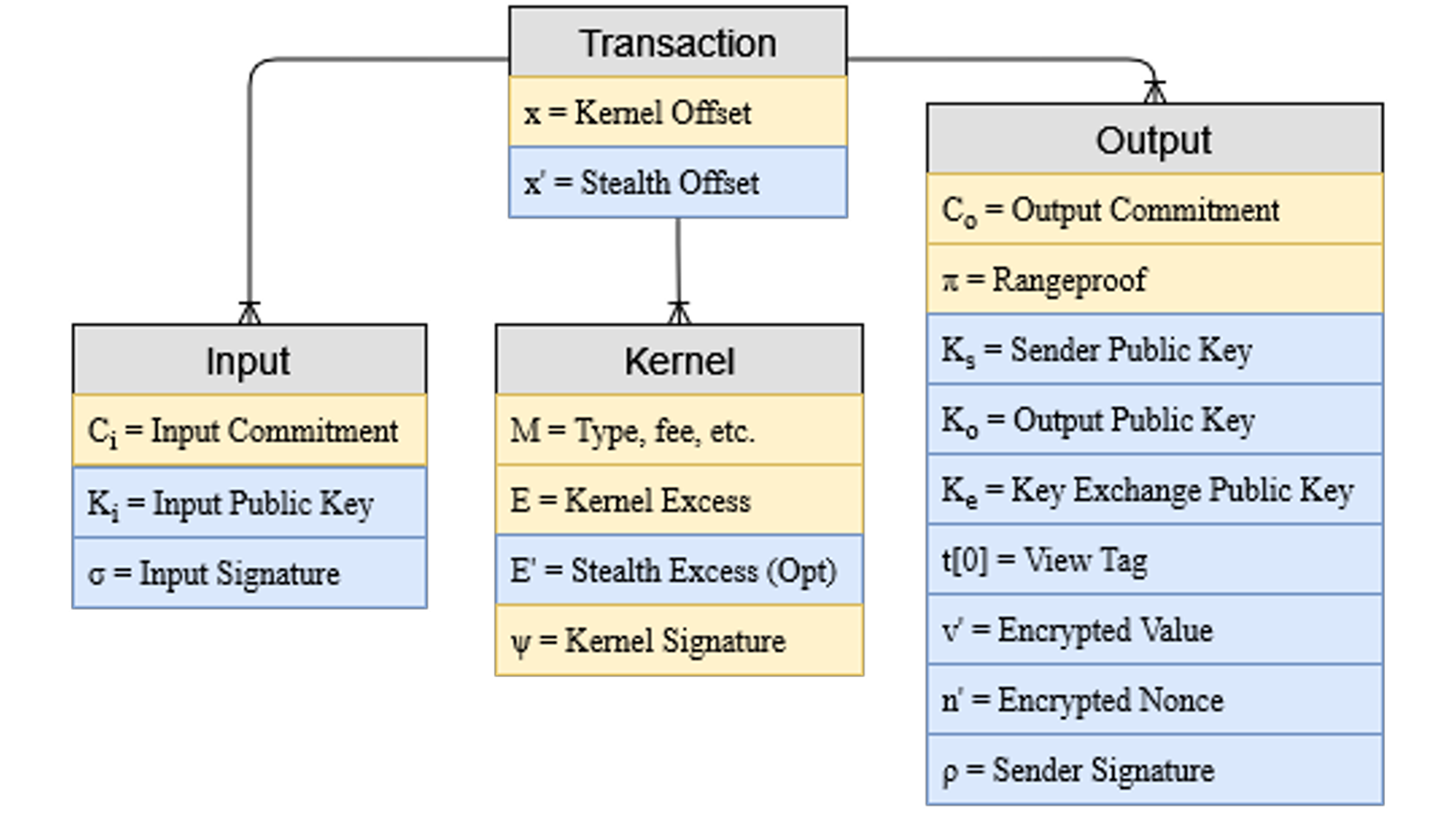
On canonical Litecoin, outputs and values are public. In MWEB an output value is hidden inside a Pedersen-style commitment while a range proof demonstrates that the committed amount lies in a valid range.
A commitment hides the amount while remaining verifiable
Consensus can check balance equations across commitments and kernels without learning every transfer amount in cleartext.
Range proofs prevent hidden negative or overflow values
Current MWEB consensus requires a bulletproof for each output proving its committed value is within the range from zero to 2^64.
Kernels carry fees and cryptographic excess
An MWEB kernel includes features, fee, excess and signature data. Kernel commitments allow conservation of value to remain verifiable after transaction aggregation and pruning.
Cut-through reduces historical linkability
MimbleWimble can prune spent intermediate outputs after a sufficient horizon while retaining the commitments and kernels needed for validation. This reduces the permanent transaction graph compared with a transparent UTXO history.
MWEB strengthens on-chain privacy but does not make every LTC payment invisible. Peg boundaries remain visible and network metadata, timing, wallet behavior and exchange records can create additional linkage signals.
Stealth addresses and one-sided MWEB transactions support offline receiving
Traditional MimbleWimble construction often requires interaction between sender and receiver. LIP-0004 introduces a one-sided transaction model.
A stealth address separates scanning from spending
A wallet publishes address material from which a sender derives a one-time output key. The receiver later scans outputs and identifies those it can spend.
The amount is masked with a shared secret
LIP-0004 outputs include a masked value and nonce alongside a commitment and range proof. An observer does not receive the clear amount, while the receiver can recover it using private scan and spend material.
The receiver does not need to be online at payment time
That improves normal wallet UX and cold storage because the sender can construct a valid output without an interactive round-trip.
Payment proofs can exist without globally revealing the transfer
The design uses signatures and key material so parties can later prove a relationship when needed without publishing the whole transaction history to every observer.
Viewing and spending capabilities should remain separate
Privacy wallet architecture benefits from distinct scan/view and spend secrets, allowing monitoring without continuous access to a spend key.
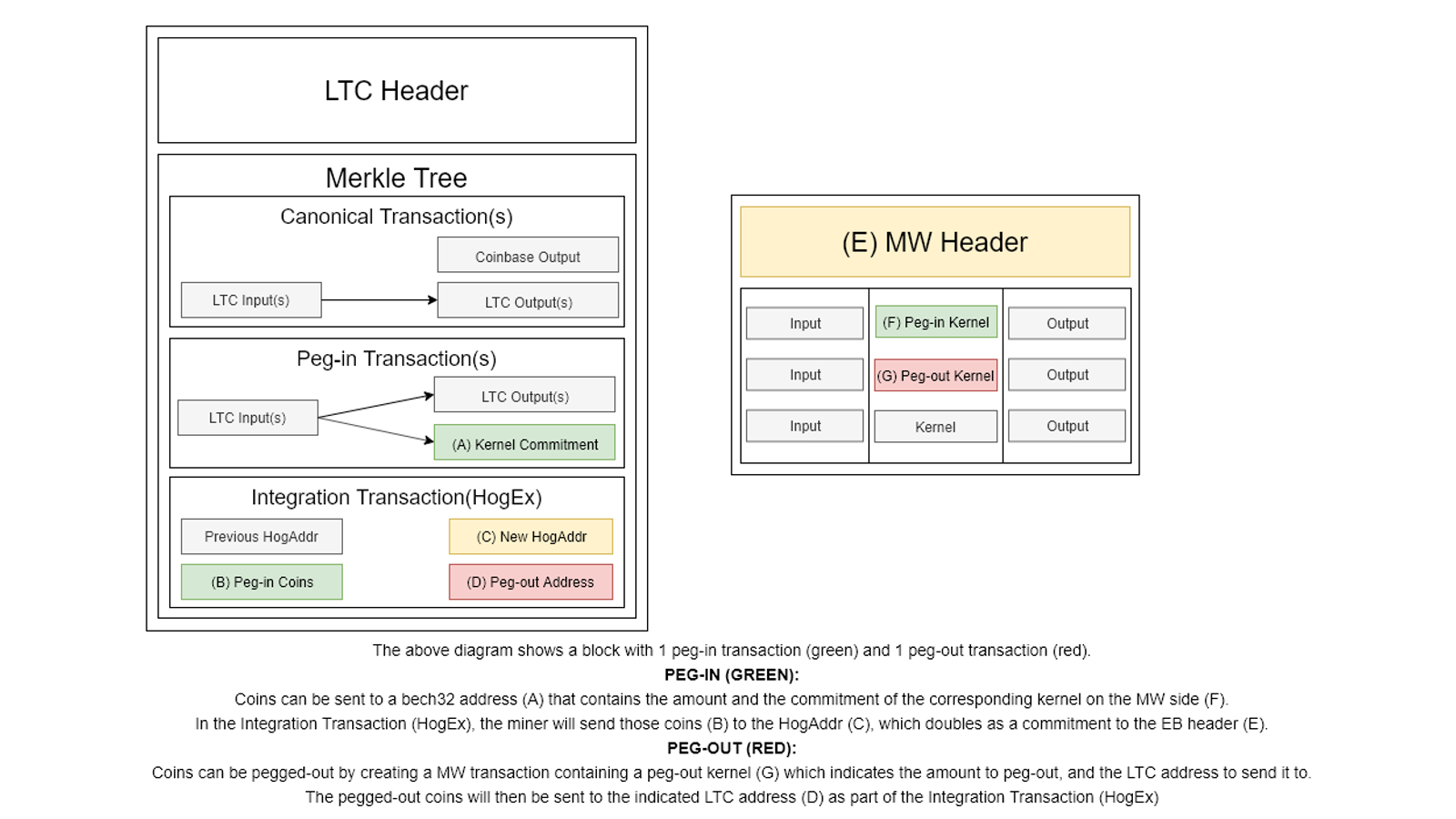
Peg-ins, peg-outs and HogEx connect MWEB with canonical LTC
Moving value between the transparent ledger and extension block has to conserve total LTC supply.
Peg-in creates a canonical output matched to an MWEB kernel
Current consensus requires the canonical peg-in set to match extension-block peg-ins by kernel ID and amount. MWEB total supply rises by the sum of peg-ins.
Peg-out reduces MWEB supply and creates a canonical output
A kernel specifies the destination amount and scriptPubKey. The miner includes the corresponding output in the canonical block's HogEx transaction.
Pegged-out coins have a maturity delay
Current MWEB consensus requires **six blocks** before pegged-out coins may be spent. This reduces reorganization hazards because the integrating transaction can change identity after a reorg.
HogEx is the consensus bridge inside each block
HogEx is a special canonical transaction tying previous extension state, new peg-ins, peg-outs and the current MWEB block commitment together.
MWEB fees participate in supply accounting
The consensus formula reduces total MWEB supply by peg-outs and fees. Miners collect extension-block fees through integration with canonical block reward accounting.
Merged mining lets Litecoin work secure Dogecoin too
The LTC/DOGE relationship is often described too loosely. “They are mined together” is incomplete unless the direction of proof is specified.
Dogecoin accepts Auxiliary Proof of Work
Dogecoin Core mainnet activates AuxPoW from height **371337**. A DOGE block can carry proof that its auxiliary commitment was included in parent-chain Scrypt mining work.
Litecoin does not validate Dogecoin
A Litecoin block remains an ordinary Scrypt PoW block and does not need to understand DOGE consensus. The relationship is **asymmetric**.
One hash search can earn two reward streams
A pool constructs a parent mining job that commits to the auxiliary Dogecoin block in the parent coinbase and Merkle structure. If the Scrypt result meets Litecoin difficulty it can create an LTC block. If the same work meets Dogecoin's target and the AuxPoW proof is valid, it can also secure a DOGE block.

Dogecoin gains access to a larger Scrypt security market
Merged mining lets DOGE benefit from infrastructure and hardware already economically active around Litecoin without forcing miners to choose only one reward stream.
A Litecoin miner is not required to merge-mine DOGE
It is a pool and software choice. Plain Scrypt work can secure only LTC; additional auxiliary construction is required before Dogecoin can validate that work.
LTC and DOGE headline hashrates should not simply be added
The same physical hash work may count toward the security of both networks. Treating them as independent resources can double-count hardware effort.
Explorer and risk analysis differ between transparent LTC and MWEB
A normal Litecoin explorer displays a UTXO graph with inputs, outputs, amounts, fee, height and confirmations. MWEB intentionally reveals less.
Canonical Litecoin is analyzed like a Bitcoin-family UTXO chain
Inspect input outpoints, likely change outputs, fee relative to size, block timestamp, confirmation depth and script type.
An MWEB explorer cannot display data consensus deliberately hides
Confidential amounts and stealth outputs reduce public observability. Missing clear values are a feature of the privacy design rather than an explorer malfunction.
Peg boundaries remain important observable events
Movement into or out of MWEB touches the canonical chain. Timing and peg amounts can give analysts additional clues, particularly for distinctive amounts or rapid round trips.
Privacy set depends on actual use
If MWEB has few participants, the statistical anonymity set is smaller. Cryptography can be strong while practical privacy still depends on transaction flow and user behavior.
Exchange support is a separate operational layer
A custodian may not accept MWEB deposits even though Litecoin consensus supports the extension block. Network capability and exchange integration are different facts.
| Layer | Public visibility | Main risk |
|---|---|---|
| Canonical LTC | Inputs, outputs, amounts, graph | Address clustering |
| MWEB | Commitments, kernels, reduced metadata | Boundary/timing analysis |
| Peg-in/out | Canonical value movement | Cross-boundary linkage |
| Network layer | Peer/IP timing may exist off-chain | Metadata correlation |
| Custodian | Identity plus deposit/withdraw records | Off-chain privacy loss |
The main conclusion
Litecoin is more than “Bitcoin with faster blocks.” It is a distinct PoW ecosystem with a **Scrypt hardware market**, a 150-second target interval and an 840,000-block halving schedule. Its monetary design is scaled around more frequent blocks and an 84-million-LTC bound.
MWEB adds opt-in privacy without replacing the canonical ledger: LTC is pegged into extension state, values are hidden behind commitments and range proofs, stealth addresses enable one-sided payments, and HogEx ties the extension block back to the main chain. Privacy is stronger than transparent UTXO tracing but not absolute because peg boundaries and off-chain metadata remain observable surfaces.
Merged mining with Dogecoin adds another architectural layer. Dogecoin accepts AuxPoW derived from Scrypt parent work; Litecoin itself does not depend on DOGE consensus. One hash-search process can therefore secure two networks and produce two reward streams while the underlying security resource is partly shared.
The engineering question for LTC is: **which Scrypt hardware market secures the chain, how does the 150-second cadence affect propagation, is a payment using the transparent or MWEB path, where are the privacy boundaries around pegs, and how much of the same Scrypt work is reused by Dogecoin through AuxPoW?**
FAQ
Why does Litecoin use Scrypt?
Scrypt was selected as a memory-hard PoW alternative to SHA-256. Litecoin Core uses scrypt_1024_1_1_256. The modern network is nevertheless primarily secured by specialized Scrypt ASICs rather than CPUs.
How long is a Litecoin block interval?
The mainnet target is 150 seconds, or 2.5 minutes on average. It is a statistical target rather than a guarantee for the next block.
What is MWEB?
The MimbleWimble Extension Block is opt-in Litecoin extension state with confidential values, range proofs, kernels and stealth-address based one-sided payments, committed within Litecoin consensus.
Is the amount of an MWEB transfer public?
Inside MWEB the output amount is hidden by a commitment and range proof. Peg-in and peg-out interactions with the canonical chain still form observable boundaries.
Do Litecoin and Dogecoin share one blockchain?
No. They are independent chains. Dogecoin can validate AuxPoW derived from parent Scrypt mining work, allowing DOGE to be merge-mined alongside LTC.
Does Litecoin receive security from Dogecoin in the same way?
No. Litecoin validates its own Scrypt PoW and does not require DOGE. Dogecoin is the auxiliary chain that checks proof of parent work.
This material is educational and does not constitute financial advice.