Avalanche reaches consensus differently from longest-chain PoW and from classical leader-round BFT. A node repeatedly queries a small random sample of validators, updates its preference when the sample shows a strong majority, and builds confidence when the same outcome persists across enough rounds. Snowman applies this sampling mechanism to a linear chain of blocks, making it suitable for EVM-style state machines. The architecture also needs a terminology update: the older term **Subnet** has largely been replaced in the current Builder Hub by **Avalanche L1**, meaning a sovereign network with its own validator membership, VM and economics. The Primary Network is itself a special Avalanche L1 running the C-, P- and X-Chains.
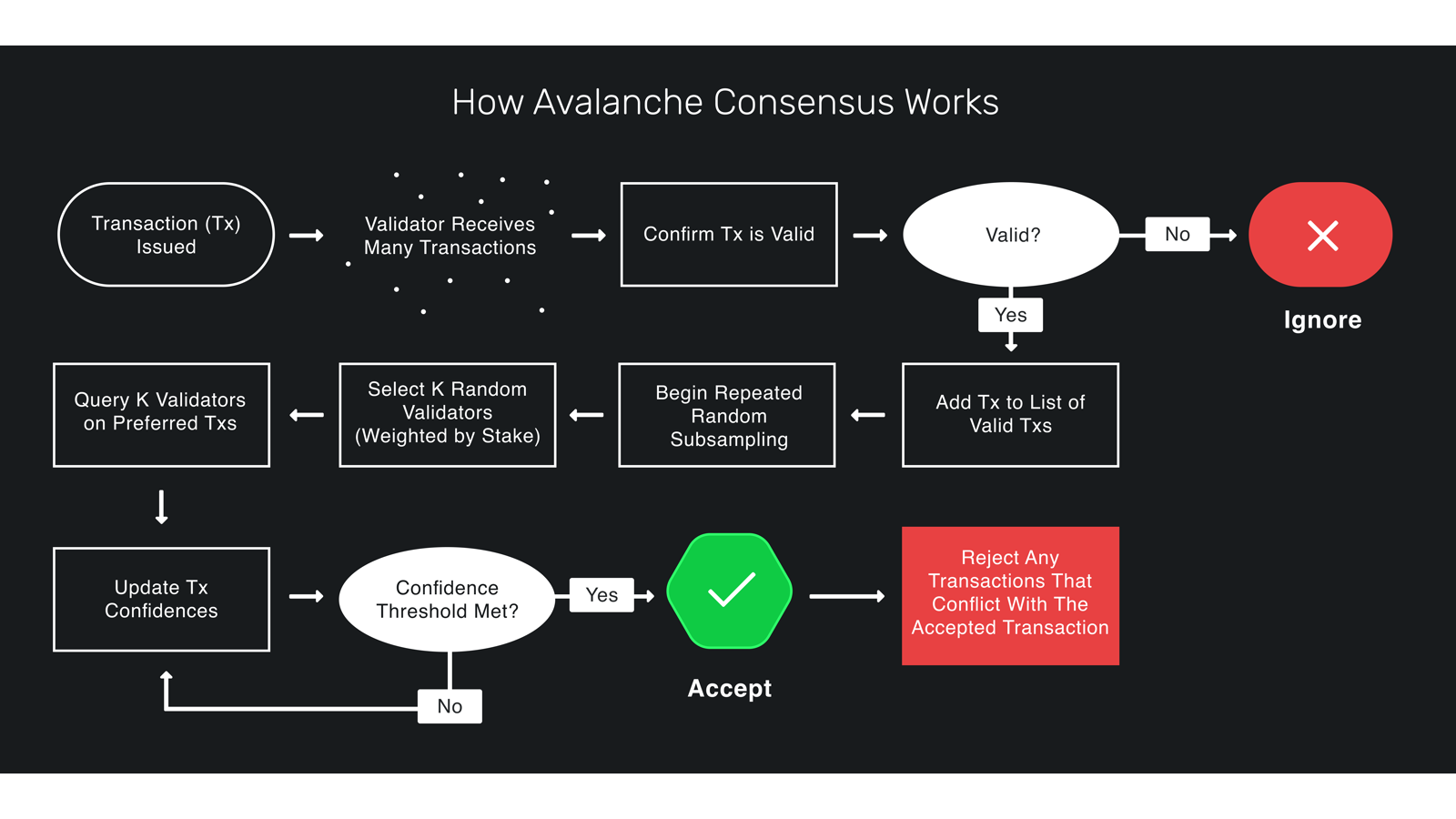
The Snow family uses repeated random subsampling
Avalanche-family protocols do not require every validator to broadcast a vote to every other validator in each round. Instead, a node asks a small random subset of validators for their current preference.
Sample size k limits communication fan-out
If the network has n validators, a node queries a random sample of size k, with k much smaller than n. One decision round therefore avoids a full all-to-all vote exchange.
Majority threshold α defines a convincing sample
When a sufficiently large fraction of sampled validators report the same candidate, the sample produces a local majority signal. Builder Hub denotes that threshold **α**.
Confidence threshold β measures persistence
A node does not accept after one favorable sample. It repeats sampling and accumulates confidence when the same outcome continues. The required confidence threshold is **β**.
Positive feedback amplifies a common preference
As more honest validators prefer the same candidate, new random samples are more likely to observe that majority. More nodes then adopt it, further increasing the probability of consistent future samples.
Probabilistic sampling does not make transaction validity probabilistic
An invalid transaction does not become valid because a sample prefers it. Validators first apply deterministic validity rules; consensus selects among valid conflicting states or blocks.
Snowman turns sampling into linear blockchain consensus
Snowball intuition describes preference and confidence around competing choices. Snowman adapts the mechanism to an ordered block chain where each accepted block has one parent.
Each node tracks a preferred chain tip
When descendants conflict, the node polls peers and updates preference toward the branch that receives sustained sampled support.
Parent confidence extends to descendants
The chain structure lets validators reason about ordered state transitions rather than independent transactions, which is important for smart-contract execution.
There is no proof-of-work race
Validators do not compete through hashing. Sampling influence is stake-weighted and security depends on assumptions about honest validation weight and the dynamics of repeated sampling.
Current Builder Hub describes sub-second immutable finality
The documentation describes Snowman as providing **sub-second, immutable finality**. That is a protocol property under normal network conditions, not an SLA for every RPC endpoint, wallet or overloaded application.
Conflicts may require more rounds without creating a longest-chain reorg window
Non-conflicting decisions converge quickly. Competing candidates can take additional samples until preference stabilizes.
“Probabilistic consensus” in Avalanche describes the convergence mechanism. Once accepted, an outcome is considered final rather than a block that merely becomes safer after 6, 12 or 100 confirmations.
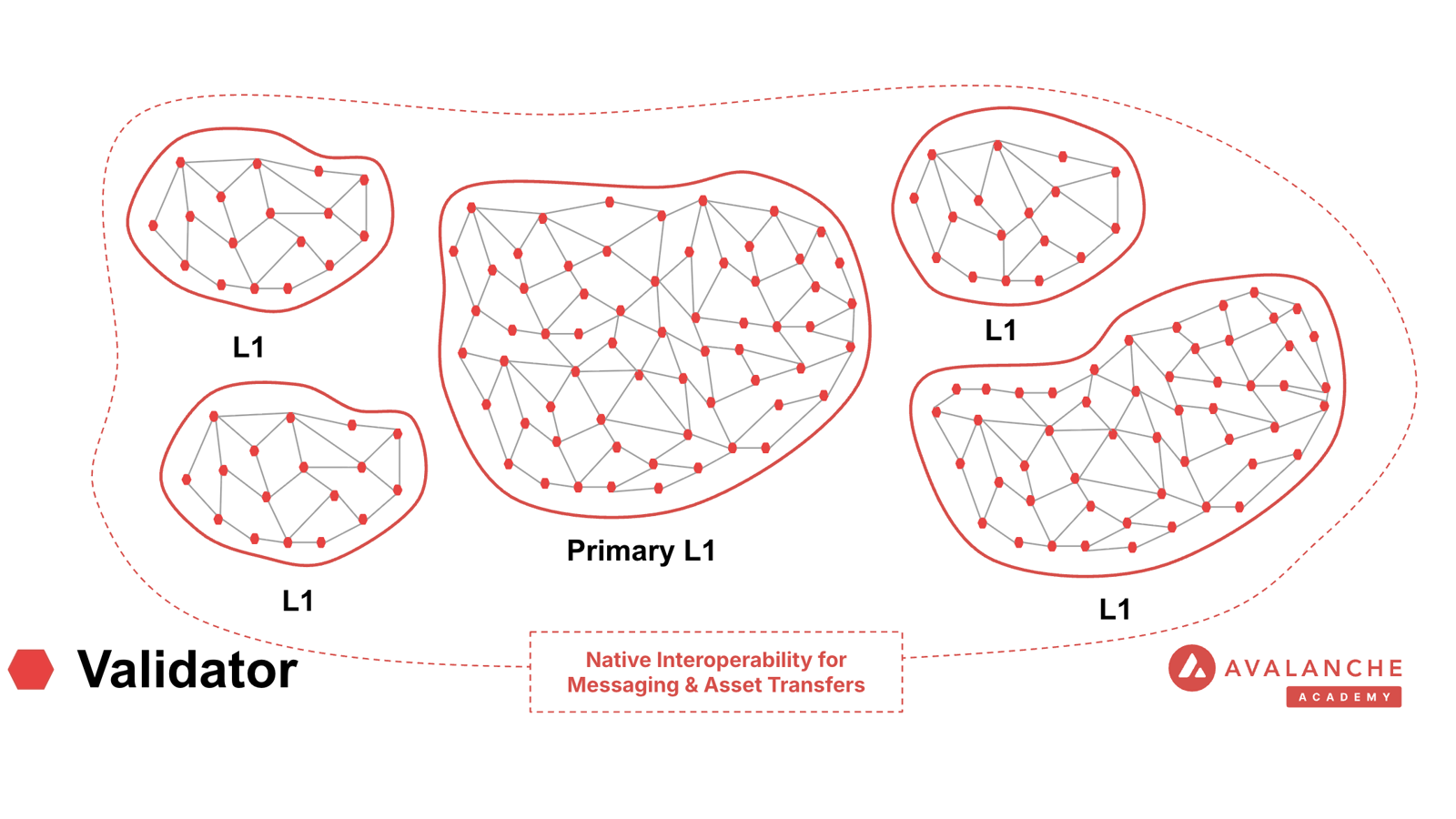
The Primary Network is a special Avalanche L1 with C-, P- and X-Chains
Avalanche Mainnet is not one execution chain. Current documentation calls it a heterogeneous network of blockchains.
C-Chain is the EVM execution layer
The Contract Chain implements the Ethereum Virtual Machine through Coreth, supports Solidity and Geth-compatible APIs, and uses AVAX as the native gas asset.
P-Chain manages validators, staking and L1-level operations
The Platform Chain is responsible for validator membership and platform operations, including staking, creation of Avalanche L1s and adding validators to relevant L1 structures.
X-Chain handles Avalanche Native Token operations
The Exchange Chain is designed around Avalanche-native smart assets and uses a different VM and state model from the EVM C-Chain.
One AVAX ecosystem still contains multiple chain contexts
AVAX is a native ecosystem asset, but representation and transfer mechanics depend on chain and VM. Cross-chain movement should not be treated as an ordinary internal EVM transfer.
Explorer context must match the chain
A C-Chain transaction hash, a P-Chain staking operation and an X-Chain asset transaction belong to different namespaces. Incident analysis starts by identifying the exact chain rather than only the AVAX ticker.
Avalanche L1s replace the older Subnet mental model
Older material widely used the word **Subnet**. The current Builder Hub presents the architecture primarily as **Avalanche L1s**.
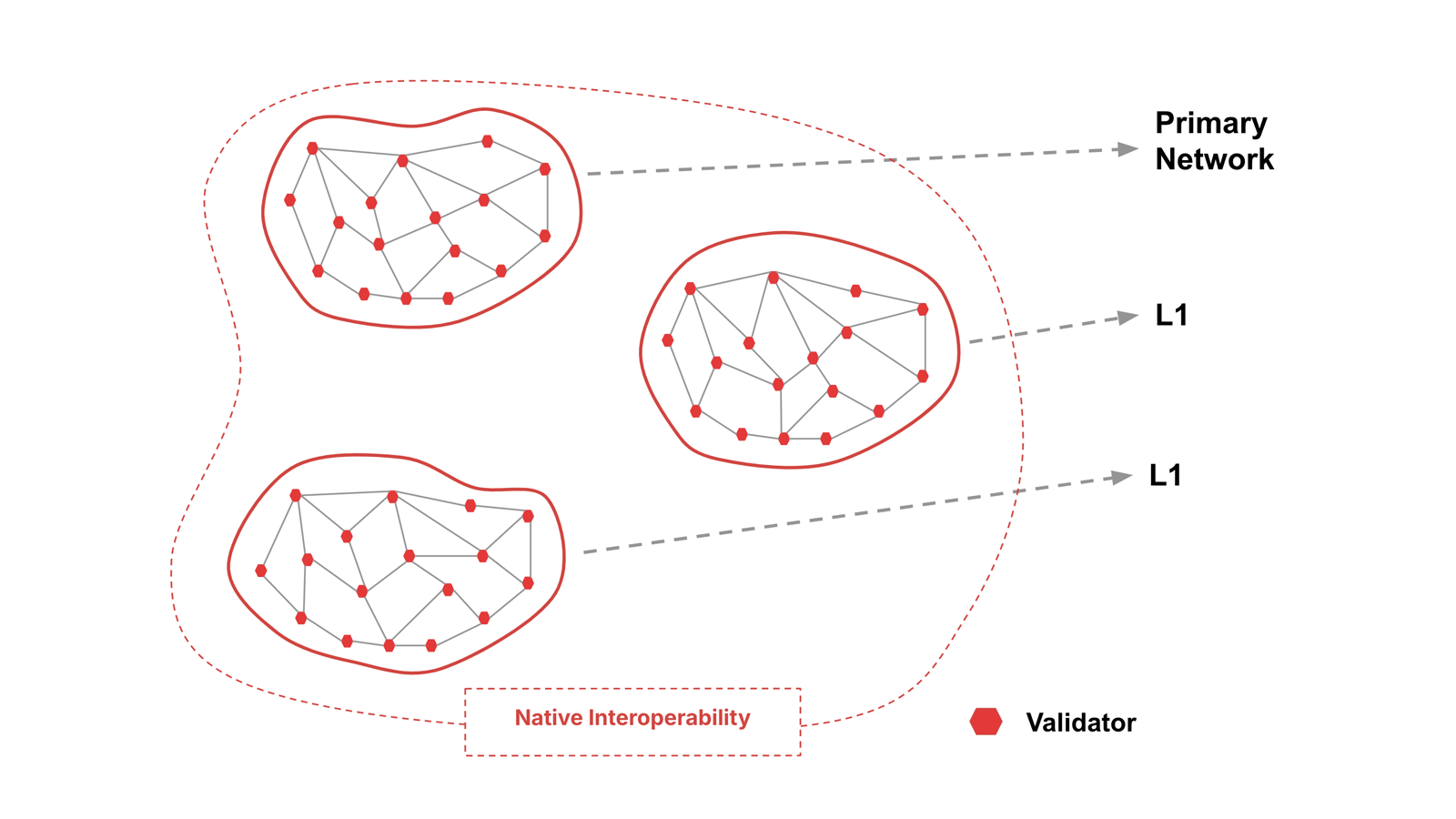
An Avalanche L1 is a sovereign network
An L1 can define its own validator set, membership rules, fee token and economics, execution VM and application-specific constraints.
The Primary Network is itself a special Avalanche L1
Current docs explicitly describe the Primary Network as a special Avalanche L1 that hosts the C/P/X chains. “Primary Network versus L1” is therefore the wrong framing.
An L1 does not have to inherit the full Primary-Network validator set
Modern Avalanche architecture allows sovereign validator management, one of the main reasons the older Subnet mental model needs updating.
A custom VM changes more than the smart-contract API
An L1 may use an EVM-compatible stack or a custom VM. VM choice affects transaction format, state model, gas rules, block construction and application semantics.
Sovereignty reduces shared-security assumptions and increases local responsibility
A sovereign validator set means the chain's security depends on that set and its economics. A new L1 does not automatically inherit the entire economic security of the Primary Network.
“L1” here is Avalanche-specific terminology
It should not automatically be mapped to Ethereum's Layer-1/Layer-2 framing. Risk analysis should inspect the validator manager, blockchain ID, VM, fee token and interchain assumptions of the specific network.
Validators and AVAX staking determine economic weight on the Primary Network
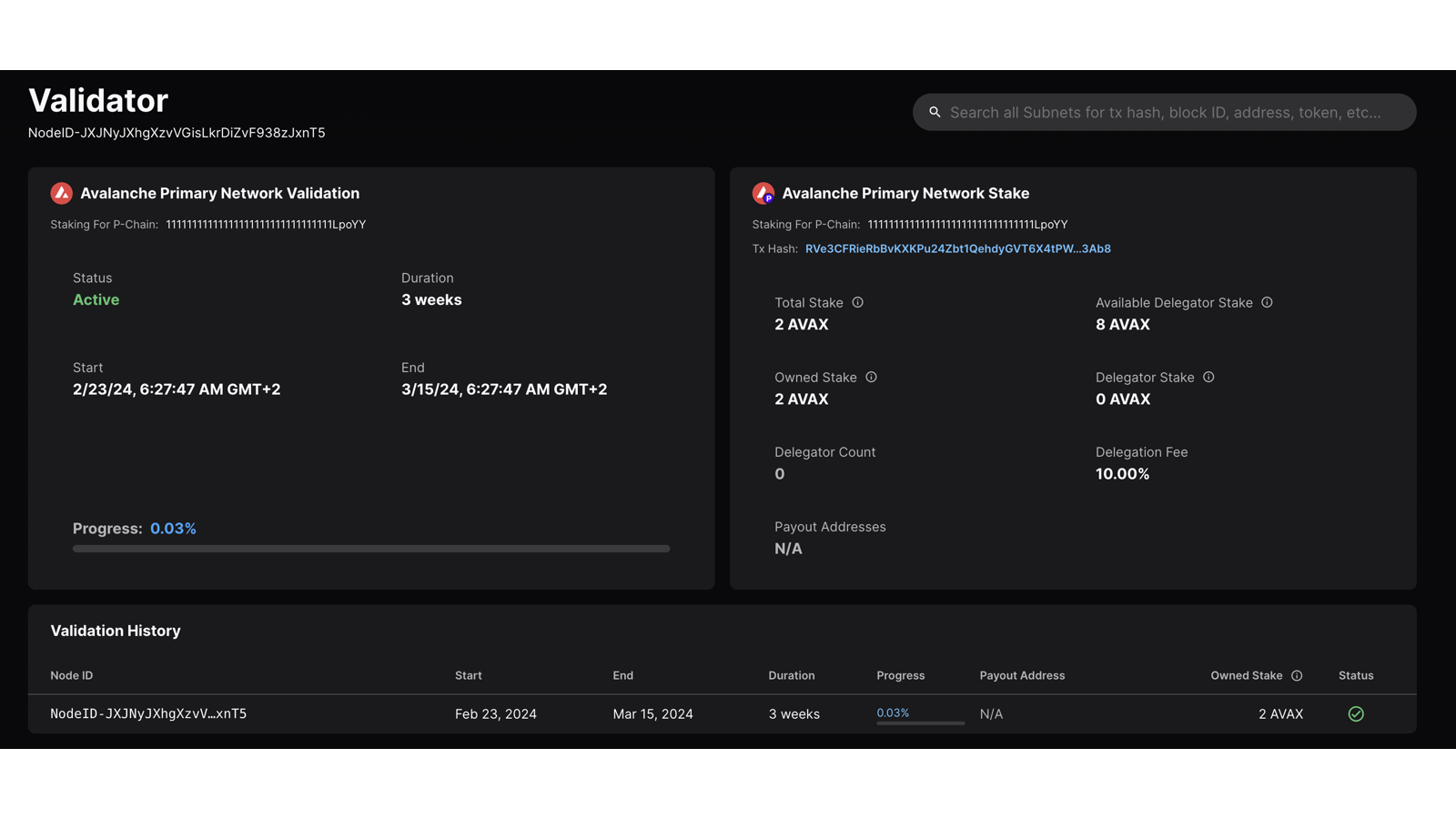
The Primary Network uses Proof of Stake. Validators run nodes, participate in sampling and receive influence proportional to stake.
Minimum validator stake is 2,000 AVAX
Current Builder Hub Mainnet documentation specifies **2,000 AVAX** as the minimum Primary Network validator stake.
Minimum delegation is 25 AVAX
A holder that does not operate a node can delegate to an existing validator. The current Mainnet minimum is **25 AVAX**.
Sampling probability is proportional to stake
Builder Hub states that larger validator stake increases the probability of being sampled and therefore influence in the consensus process.
Rewards require more than 80% responsiveness
A validator must be online and responsive for **more than 80%** of its validation period to qualify for rewards under current rules.
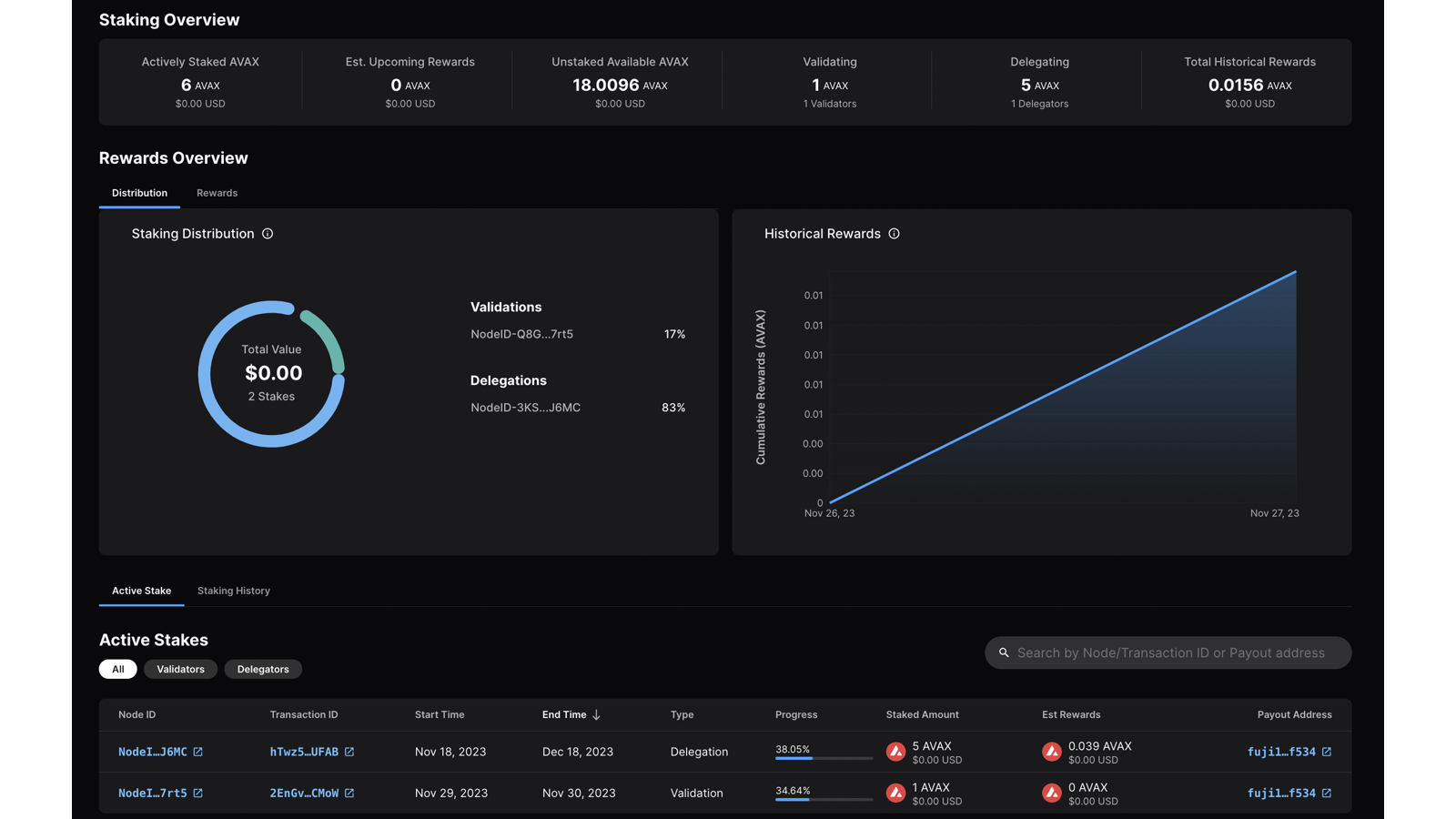
Delegators share economics with the selected validator
A delegator does not run the consensus node and receives its reward net of the validator's delegation fee if reward conditions are satisfied.
Staking is committed for a defined validation period
Avalanche staking differs from perpetual balance-based validator systems. Validator and delegation transactions define a participation period, with reward determined at the end according to protocol rules.
Primary Network staking parameters are not universal L1 requirements
A sovereign Avalanche L1 may use its own Validator Manager and economic rules. The 2,000/25 AVAX thresholds belong to Primary Network staking.
Finality must be separated from RPC and application latency
Snowman documentation uses the strong phrase “sub-second immutable finality,” but a user request crosses several independent latency layers.
Consensus finality is the validator decision
It is the point at which Snowman accepts a block or transaction and honest validators should not later switch to a conflicting accepted history.
Execution latency belongs to the VM
An EVM transaction can be consensus-ordered while contract execution, state persistence and local node processing have their own cost.
RPC latency is a transport concern
A public endpoint can be rate-limited, overloaded or geographically distant. Slow RPC response does not prove slow consensus.
Explorer indexing is another pipeline
An explorer may display an accepted transaction later because its backend or indexer is behind.
Cross-L1 settlement can add message or proof stages
Moving value or instructions between Avalanche L1s or external ecosystems may require separate message verification, relaying or bridge assumptions.
| Layer | What it measures | Can it exceed consensus latency? |
|---|---|---|
| Snowman acceptance | Protocol finality | Baseline |
| VM execution | State transition | Yes |
| RPC response | Node/API transport | Yes |
| Explorer indexing | Query/index pipeline | Yes |
| Cross-L1 application flow | Additional messaging/proofs | Yes |
“One-second finality” is not a promise that every UI completes within one second
Production SLOs should measure p50/p95 RPC, acceptance time, state availability and indexer delay separately.
AVAX explorer analysis starts by choosing the correct chain and security domain
Avalanche's heterogeneous architecture makes ticker-only analysis inadequate.
C-Chain is inspected like an EVM network
Check chain ID 43114, sender, recipient, nonce, gas, logs, internal calls and contract addresses.
P-Chain exposes platform operations
Validator additions, delegations, L1-level management and staking operations live in PlatformVM context rather than ordinary EVM logs.
X-Chain uses an asset-centric model
Native asset operations are not equivalent to account-based EVM transactions. A common explorer interface should not erase VM differences.
An Avalanche L1 requires separate validator/security inspection
Two L1s can both be EVM-compatible while using different validator sets, fee assets and governance rules. EVM compatibility does not imply identical finality or security.
Similar addresses across chains do not imply one state history
The same key can control addresses in several contexts while balances and state remain chain-specific.
Operational checklist
- Primary Network or sovereign Avalanche L1.
- Exact chain or blockchain ID.
- VM and transaction format.
- Validator set or validator manager.
- Gas/fee asset.
- Consensus and finality rules.
- Messaging or bridge assumptions when crossing chain boundaries.
Interchain connectivity does not erase sovereign security boundaries
Avalanche supports communication between L1s through interchain messaging tooling.
Source and destination remain distinct state machines
A cross-L1 message does not turn two chains into one atomic database. Source finality, message verification and destination execution remain separate steps.
Validator-set verification is security-critical
The destination needs rules for trusting the source message. Exact verification depends on the messaging stack and validator-manager design.
Liquidity bridging and arbitrary messaging are different products
A bridge transports economic representation of an asset; generic messaging transports a verified instruction. Their risk models need not be identical.
Sovereign fees allow application-specific economics
An L1 can choose local fee or token policy rather than universally requiring AVAX for every transaction. That is useful for enterprise and application-specific networks but increases ecosystem complexity for users.
Restricted validator membership can be a feature or a centralization risk
A permissioned institutional L1 may intentionally use a narrow set. The same validator structure may be unacceptable for a public DeFi chain. Architecture should be judged against the declared trust model.
Threat model: sampling moves risk into stake, networking and implementation
Snow protocols reduce all-to-all communication but do not eliminate consensus assumptions.
Stake concentration affects samples
When validation weight is concentrated, random samples more often reflect the same controlling actors. Decentralization should be measured by stake distribution, not validator count alone.
Staking economics provide Sybil resistance
Creating thousands of node identities does not produce thousands of equal votes because influence is tied to stake.
Network isolation can distort the set of observable peers
Eclipse conditions or severe partitions can limit the peers a node can query. Peer management and networking remain part of production security.
Validator uptime affects both rewards and liveness
The protocol expects responsive validators. Broad outages can slow convergence even without Byzantine behavior.
VM bugs are outside the consensus proof
Snowman can correctly agree on a block whose VM or application code contains a bug. Consensus safety and application correctness are different properties.
A sovereign L1 must be evaluated on its own security budget
A small validator set does not automatically inherit the entire market capitalization or validator weight of the AVAX ecosystem.
Avalanche contains multiple security domains. As sovereign L1 adoption grows, “Avalanche security” becomes less useful as one universal number.
Main conclusion and FAQ
Main conclusion
Avalanche-family consensus reaches agreement through **repeated random subsampling**. A node queries a small random validator sample, uses threshold α as a majority signal, and builds confidence toward β across consistent rounds. Snowman applies this positive-feedback mechanism to a linear blockchain, providing the current Primary Network with fast finality without proof-of-work racing or classical full all-to-all BFT voting rounds.
Architecturally, Avalanche Mainnet is a heterogeneous network. The Primary Network is a special Avalanche L1 with C-Chain for EVM execution, P-Chain for validator, staking and L1-level operations, and X-Chain for Avalanche Native Token operations. The modern sovereign-chain abstraction is called an Avalanche L1; the older word Subnet should be treated as legacy terminology rather than the primary current model.
Analyzing AVAX therefore requires three questions at once: **which consensus and security domain accepts the transaction, which VM executes it, and which validator and economic model secures that chain?**
What are α and β in Avalanche consensus?
α is the required majority inside a random validator sample. β is the confidence threshold describing how many sustained consistent samples are required before acceptance.
Why is Snowman called probabilistic if finality is immutable?
The probability enters the sampling and convergence process. After acceptance, the protocol does not rely on a longest-chain model where more confirmations only gradually reduce reorganization risk.
What is the Primary Network?
It is a special Avalanche L1 running the C-, P- and X-Chains. C-Chain is EVM, P-Chain handles validators, staking and L1 operations, and X-Chain handles Avalanche Native Token operations.
Are Subnets and Avalanche L1s the same thing?
The current Builder Hub uses Avalanche L1 as the modern sovereign-network abstraction replacing older Subnet terminology. Older guides may still use Subnet, so current documentation should be preferred.
How much AVAX is required to validate or delegate?
Current Primary Network Mainnet minimums are 2,000 AVAX for a validator and 25 AVAX for delegation. Sovereign Avalanche L1s may use different economics.
What does sub-second finality mean?
Snowman documentation describes sub-second immutable protocol finality. It is not a guarantee that every public RPC, explorer, bridge or overloaded smart contract completes the entire user flow in less than one second.
Does every Avalanche L1 inherit full Primary-Network security?
No. A sovereign L1 can have its own validator set and economics. Its security should be evaluated from its validator manager, membership or stake design and interchain trust assumptions.
This material is educational and does not constitute financial advice or a promise of staking returns.