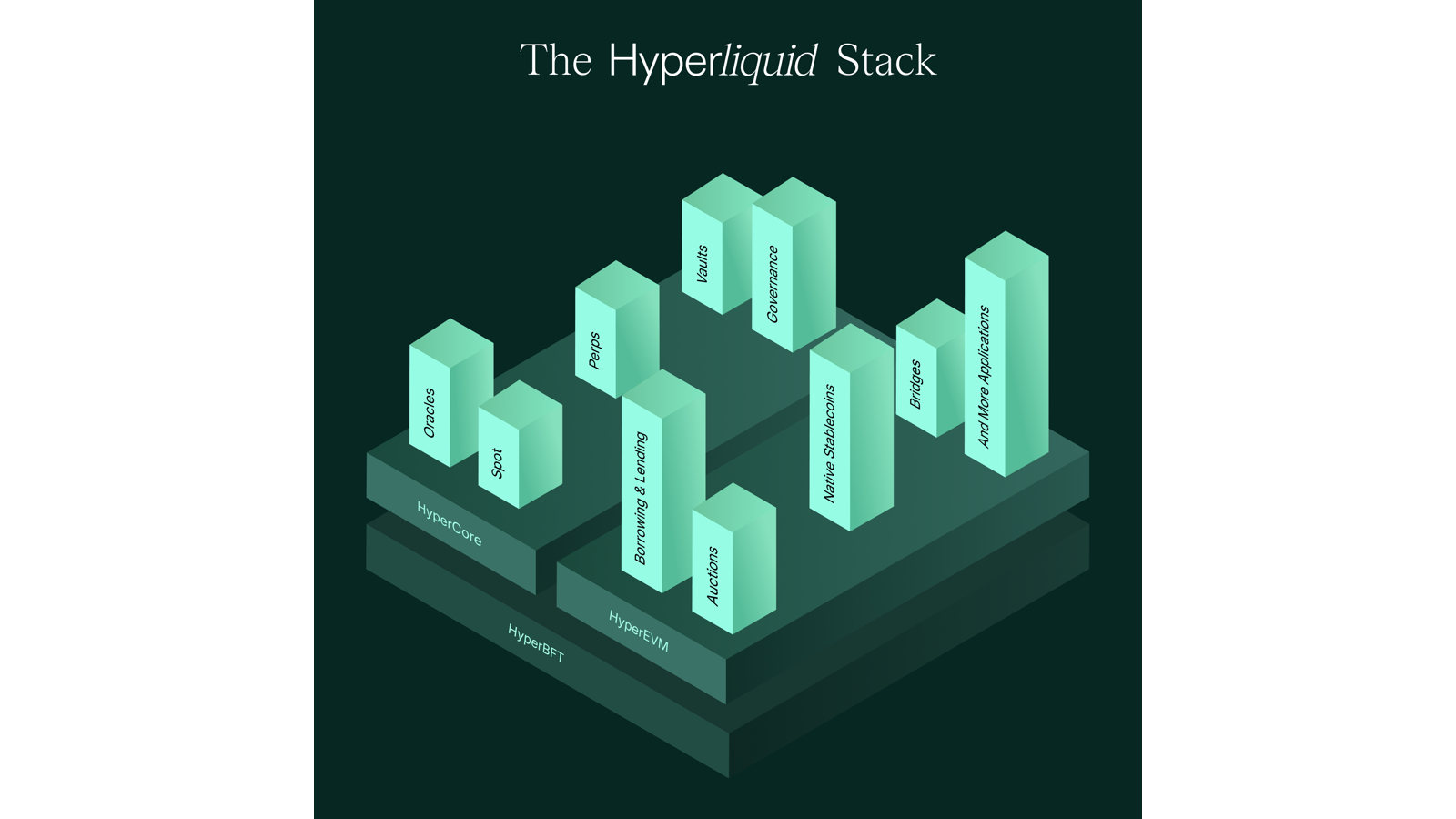
Hyperliquid is not merely a DEX interface deployed on somebody else's network. It is its own L1 with execution split into two broad components. **HyperCore** contains fully on-chain perpetual and spot order books: orders, cancels, trades and liquidations become blockchain state. **HyperEVM** adds EVM-compatible smart contracts and protocol interfaces into HyperCore liquidity. Both components inherit ordering and finality from HyperBFT. Understanding HYPE therefore requires connecting exchange microstructure, validator topology, vault risk, HyperEVM integration and fee economics rather than treating them as unrelated products.
HyperCore makes the order book part of consensus state
An AMM derives price from reserves and a bonding curve. Hyperliquid instead uses the familiar central-limit-order-book model while maintaining the book inside its L1 state machine.
Orders carry price, size, side and time priority
Limit orders rest at specific price levels. At the same price, earlier orders receive priority under **price-time priority**, making execution semantics closer to traditional electronic markets than to a constant-product AMM.
Matching is deterministic
Validators receive the same canonical sequence of actions and must produce the same matching result. There is no private local order-book state belonging to one market maker.
A cancel is a state transition too
Cancellation must enter the ordered HyperCore action stream. Between submitting a cancel and final inclusion there is still a latency window, so low-latency traders need to track already-sent orders carefully.
Margin checks participate in order and matching logic
A perpetual order is not only price and quantity. HyperCore also accounts for collateral, leverage, open positions, maintenance margin and liquidation constraints.
Order throughput and user latency are different measurements
Official documentation describes very high HyperCore order throughput. End-user latency additionally depends on network path, API servers, signing, websocket delivery and local state processing.
HyperBFT provides one-block finality for exchange actions
Hyperliquid describes HyperBFT as a custom Byzantine consensus algorithm inspired by HotStuff and its successors and optimized for high-frequency exchange state transitions.
Consensus defines canonical ordering first
If two traders send conflicting actions at nearly the same time, the receive timestamp of one API server is not the final authority. HyperBFT block ordering defines the sequence executed by HyperCore.
One-block finality matters for cancel and liquidation logic
In a longest-chain system a trader reasons about reorganization probability. Hyperliquid documentation states that orders, cancels, trades and liquidations inherit one-block finality from HyperBFT.
HotStuff inspiration does not mean vanilla HotStuff parameters
HyperBFT is Hyperliquid's own protocol and implementation. Security analysis should use current Hyperliquid node software and documentation rather than importing assumptions from another HotStuff network.
Validator stake determines the active set
Current validator documentation describes the active validator set as the **top 27 validators by stake**. This operational fact matters more than counting every address that has ever delegated HYPE.
Quorum risk depends on stake distribution
Validator count alone does not measure decentralization. Analysts should inspect delegated-stake concentration, correlated infrastructure and whether a small number of entities can approach Byzantine thresholds.
On an exchange-first L1, consensus risk becomes market risk directly: an ordering or liveness failure can affect cancel priority, liquidations, collateral availability and oracle-dependent margin state.
Root peers are networking topology, not a second consensus tier
Node documentation uses root peers for peer discovery, bootstrap and robust data propagation. They are sometimes incorrectly described as “master validators.”
Validators remain the consensus actors
Root-peer connectivity does not create another voting weight. Consensus power comes from the active validator set and stake rather than presence in a bootstrap peer list.
Root peers help a node enter the gossip network
A new node needs reliable peers before it can receive blocks and state. Bootstrap peers reduce the initial discovery problem.
Network centralization should be measured separately
Distributed stake can coexist with concentrated cloud regions, transit providers or bootstrap endpoints. Consensus decentralization and network-path diversity are different metrics.
Non-validating nodes support independent data access
A trader, indexer or infrastructure provider can operate a node without joining the active validator set, reducing dependence on public APIs.
Low-latency peer placement does not replace market risk controls
A nearby API or node reduces transport delay but does not guarantee a fill. Queue priority, block ordering, competing flow and margin state remain market variables.
Vaults turn trading strategies into pooled on-chain accounts
A Hyperliquid vault is a pooled structure where depositors receive economic exposure to a strategy run by a vault leader or by a protocol-defined mechanism.
Vault equity follows actual trading PnL
This is not fixed-yield staking. A vault can hold perpetual positions and inventory and can realize profits or losses.
HLP is a protocol vault tied to liquidity and liquidation activity
The Hyperliquidity Provider vault participates in exchange liquidity and protocol operations. Its PnL should not be confused with validator staking rewards.
User-created and protocol vaults have different trust models
A user vault depends on strategy and leader behavior within protocol constraints. HLP has a system-defined role and different economics.
A depositor owns a share of vault equity, not each underlying position
The deposit gives proportional economic exposure. The depositor does not directly manage the strategy's individual orders.
Withdrawal rules create their own liquidity constraints
Users should inspect lock and withdrawal rules for the specific vault. Open positions and withdrawal demand can create a separate operational risk.
A high historical vault APY is not staking yield
Annualized trading PnL depends on volatility, spread capture, liquidations and inventory. A short profitable period cannot be safely extrapolated as fixed protocol return.
HyperEVM adds general-purpose contracts beside HyperCore liquidity
HyperEVM is an EVM-compatible execution environment on the same Hyperliquid L1. Its purpose is not to rebuild the order book in Solidity but to let applications use HyperCore as a financial primitive.
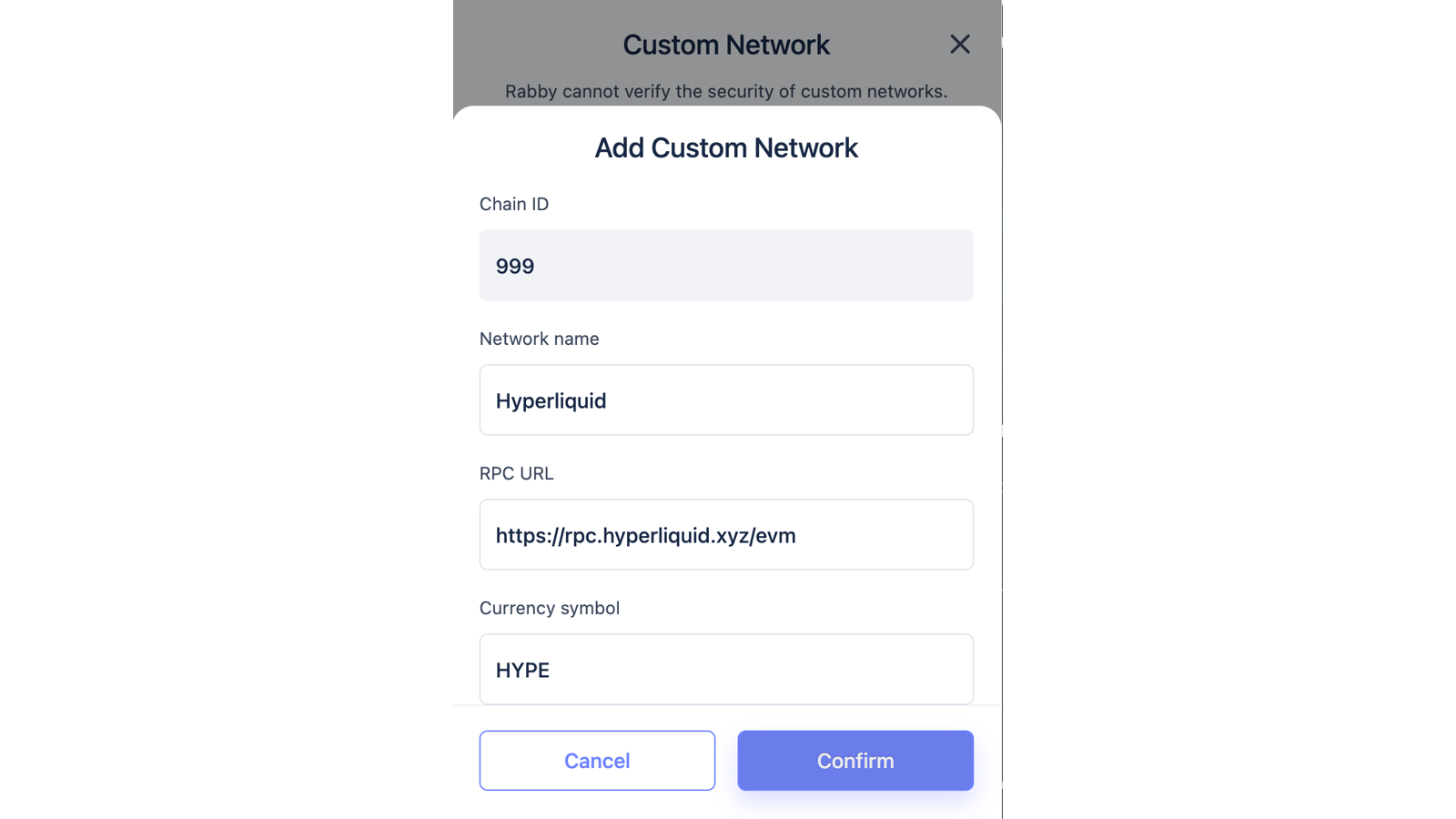
HyperEVM chain ID is 999
Current onboarding documentation uses chain ID **999**, HYPE as the native gas symbol and official Hyperliquid RPC endpoints.
HYPE is the native HyperEVM gas asset
HYPE transferred from HyperCore into the EVM context appears as native balance rather than a normal wrapped ERC-20 token.
CoreWriter sends supported actions from EVM into HyperCore
A system contract interface lets smart contracts submit supported HyperCore actions, connecting application logic to native exchange state.
Read precompiles expose Core state to contracts
HyperEVM applications can read selected HyperCore state through precompiles instead of relying on an external oracle for every exchange field.
Core-to-EVM movement is not an ordinary ERC-20 bridge
It is a protocol-native transfer between two execution components of one L1. HYPE uses system-address and native-balance semantics.
One L1 does not mean synchronous shared memory
HyperCore and HyperEVM are connected through protocol interfaces while retaining distinct execution stages. Application developers need the documented interaction timing.
Dual-block HyperEVM separates fast and heavy workloads
Current HyperEVM documentation describes a **dual-block architecture**.
Small blocks target roughly one second
The fast path targets about **1 second** with a **3 million gas** block limit, suitable for latency-sensitive EVM calls.
Large blocks target roughly one minute
The large-block path targets about **1 minute** with a **30 million gas** limit for heavier transactions.
Both block types share one EVM state
They are not separate chains. They update a common HyperEVM state history while using different capacity and latency buckets.
Fees and nonces still matter
A fast block does not guarantee that every underpriced or nonce-blocked transaction enters immediately.
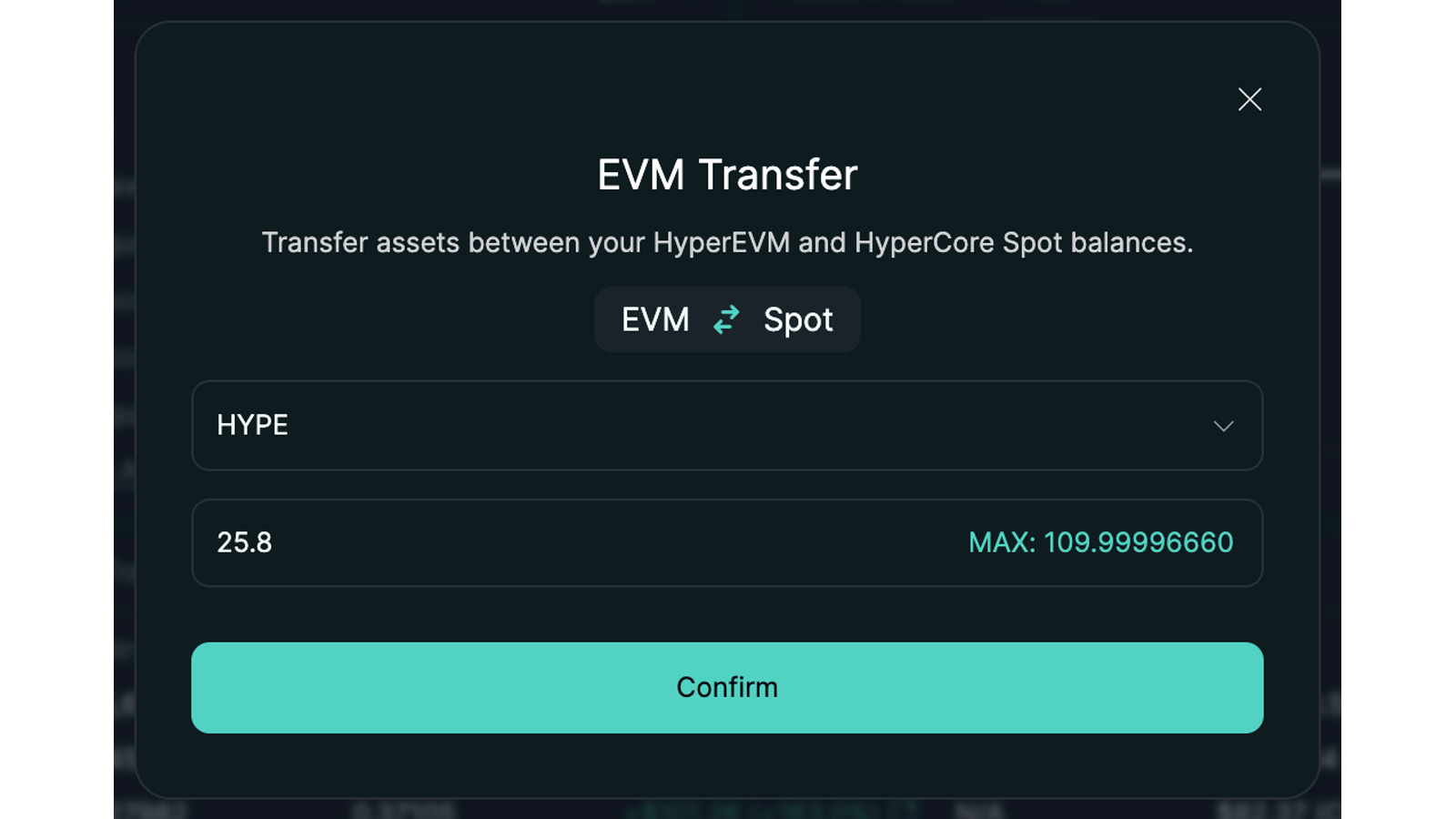
HyperCore-to-EVM transfers wait for the next EVM block
Interaction-timing documentation states that Core-to-EVM transfers are queued until the next HyperEVM block.
EVM-to-Core actions have a defined intra-block order
Current docs describe the sequence as L1 block, EVM block, EVM-to-Core transfers and then CoreWriter actions. This matters for contracts attempting to initialize Core state and act on it in one logical flow.
Atomicity is bounded by documented execution order
Applications should not assume arbitrary Core/EVM operations are one synchronous transaction merely because both environments belong to the same L1.
HYPE staking is separate from trading collateral and vault yield
HYPE is the network's security and economic asset and the native HyperEVM gas token. Staking uses a distinct HyperCore staking balance.
Validator operation requires substantial self-delegation
Current validator documentation requires **10,000 HYPE self-delegation** with a **one-year lock** for validator operation requirements, distinct from ordinary user delegation.
Ordinary delegation has a one-day lock
Current staking documentation states that delegating to a validator has a **one-day lockup**.
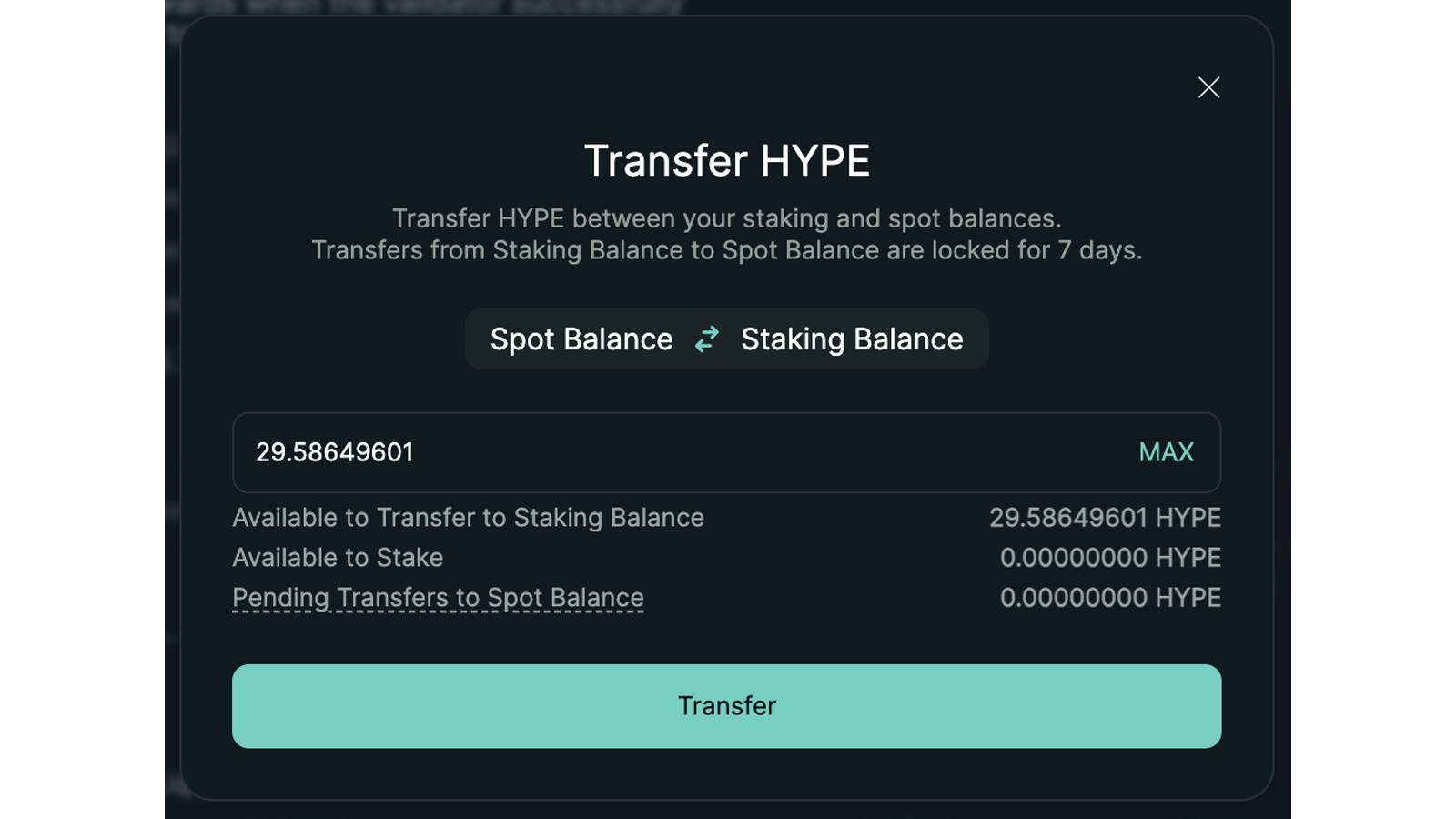
Staking-to-spot withdrawal has a seven-day queue
After unstaking, moving HYPE from staking balance back to spot balance takes **seven days**, creating a real liquidity and opportunity-cost constraint.
Staking epochs are roughly 90 minutes
Current docs describe a staking epoch as 100,000 rounds, approximately **90 minutes**, with rewards distributed through epoch mechanics.
Automatic slashing is not currently implemented
Validator documentation explicitly notes that automatic slashing is currently not implemented. HYPE staking should therefore not be described as a classical system where validator faults automatically burn delegated principal today.
Rewards still depend on validator quality and delegation economics
Delegators should inspect validator performance, stake concentration and economic terms rather than only a displayed APY.
“No automatic slashing today” does not mean “no validator risk.” Rules can change, a validator can fall out of the active top 27, and users still bear locking and withdrawal-queue risk.
Fee flow connects exchange activity, HLP, deployers and HYPE
Hyperliquid fee economics are not a simple rule where every fee goes to validators.
Maker and taker fees depend on rolling activity tiers
Trading fees vary by user volume and product. Maker economics and taker fees create microstructure incentives for liquidity provision.
Protocol fee flows support several community-oriented components
Current fee documentation describes routing across **HLP, the Assistance Fund and deployers** depending on market and product context.
The Assistance Fund converts fee inflows into HYPE
Official documentation states that the Assistance Fund system address automatically converts its trading-fee inflows into HYPE.
HYPE accumulated by the Assistance Fund is burned
Current fee documentation explicitly states that HYPE received by the Assistance Fund is **burned**, creating a fee-linked supply sink whose magnitude depends on actual activity and routing rules.
HIP-1 defines the native spot-token standard
HIP-1 specifies HyperCore-native token deployment. These assets are not merely ERC-20 tokens copied into an order book.
HIP-2 provides protocol-managed liquidity
Hyperliquidity helps bootstrap liquidity in native spot markets through protocol-defined logic rather than requiring one privileged external market maker.
| Flow | Economic meaning | Main risk |
|---|---|---|
| Trading fees | Payment for execution | Cyclical volume |
| HLP | Liquidity and market-making PnL | Inventory/strategy loss |
| Assistance Fund | Fee conversion into HYPE | Depends on fee routing |
| HYPE burn | Supply sink | Does not guarantee price appreciation |
| Validator staking | Consensus-security incentive | Lock and concentration |
| Deployers | Market-specific economics | Configuration dependence |
Buyback and burn do not guarantee holder returns
Fee-derived demand can reduce supply pressure through burning, but token price also depends on valuation, unlocks, market regime and demand. The mechanism should not be presented as a guaranteed return.
Explorer and trader risk analysis must read multiple state planes
A Hyperliquid user flow can touch HyperCore, HyperEVM and external deposit or withdrawal rails.
HyperCore order history is the primary exchange record
Inspect order status, fills, average execution price, fees, liquidation state and funding. A frontend summary is not a replacement for raw API or L1 records.
HyperEVM transactions have ordinary EVM fields
Transaction hash, block, sender, recipient, gas, logs and contract calls can be inspected with EVM tooling, while a CoreWriter effect should also be matched to its HyperCore action.
Perpetual risk depends on mark and oracle mechanics
Entry price is only one variable. Liquidation depends on leverage, collateral, funding, mark or oracle state and portfolio-margin rules.
API degradation can look like exchange failure without a consensus failure
An independent node or alternative data source helps distinguish a public frontend/API incident from an L1 halt.
A vault position is not the same as a personal wallet position
Analytics should separate a depositor's vault share from underlying strategy positions and realized PnL.
Practical checklist
- HyperCore or HyperEVM action.
- Exact order or transaction state.
- Consensus and block timestamp.
- Fees and funding.
- Collateral and liquidation state.
- Vault ownership if a vault is involved.
- CoreWriter or transfer boundary for cross-environment flows.
- Validator and API health during incidents.
Main conclusion and FAQ
Main conclusion
Hyperliquid is an **exchange-first L1**, not an AMM frontend. HyperCore makes price-time-priority order books, positions, funding and liquidations part of deterministic blockchain state. HyperBFT defines canonical ordering and one-block finality. Current documentation describes the active consensus set as the top 27 validators by stake, while root peers belong to networking and bootstrap rather than a separate governance tier.
HyperEVM places general-purpose EVM contracts next to native exchange liquidity. Its dual-block architecture separates fast one-second/3M-gas blocks from heavier one-minute/30M-gas blocks, while CoreWriter and read interfaces connect contracts with HyperCore. Vaults add pooled-strategy risk, and HYPE participates in validator staking, gas and the Assistance Fund's fee-derived burn flow.
The useful question is therefore not simply “what is HYPE?” but **which order-book state creates fee demand, who finalizes ordering, how concentrated the active validator set is, where collateral sits, what vault risk the user accepts, and whether the action crosses HyperCore, HyperEVM or both.**
Is the Hyperliquid order book really on-chain?
Yes. Current documentation describes HyperCore perpetual and spot order books as fully on-chain: orders, cancels, trades and liquidations are L1 state transitions with one-block finality.
What is HyperBFT?
It is Hyperliquid's custom Byzantine consensus inspired by the HotStuff family and optimized for an exchange-first L1 workload. It defines canonical ordering of blocks and actions.
Do root peers control consensus?
No. Root peers belong to peer discovery and networking topology. Consensus participation is determined by the active validator set and stake.
What is HLP?
The Hyperliquidity Provider is a protocol vault associated with liquidity, market making and exchange operations. Its PnL is trading or strategy PnL rather than fixed staking yield.
How does HyperEVM differ from HyperCore?
HyperCore is the native exchange state machine containing order books and positions. HyperEVM is a general-purpose EVM environment. They share one L1 and protocol interfaces but have different execution semantics.
How long does HYPE unstaking take?
Delegation has a one-day lock, and transferring HYPE from staking balance back to spot balance after unstaking takes seven days under current documentation.
Are trading fees burned?
Not all fees directly. Current documentation describes multiple routing paths. The Assistance Fund automatically converts its trading-fee inflows into HYPE, and the resulting HYPE is burned.
This material is educational and does not constitute financial advice or a promise of returns.