Cardano is often compared with account-based smart-contract chains, but the analogy breaks quickly. Its ledger is built around Extended UTXO: a transaction does not mutate one global account balance “in place”; it consumes specific unspent outputs and creates new ones. A smart-contract script decides whether a particular output may be spent using datum, redeemer and transaction context. Ouroboros distributes block-production opportunities among stake pools, while ADA delegation does not transfer custody or lock the coins. Accounting, consensus and staking therefore combine into a different dApp architecture.
Cardano uses eUTXO rather than the Ethereum account model
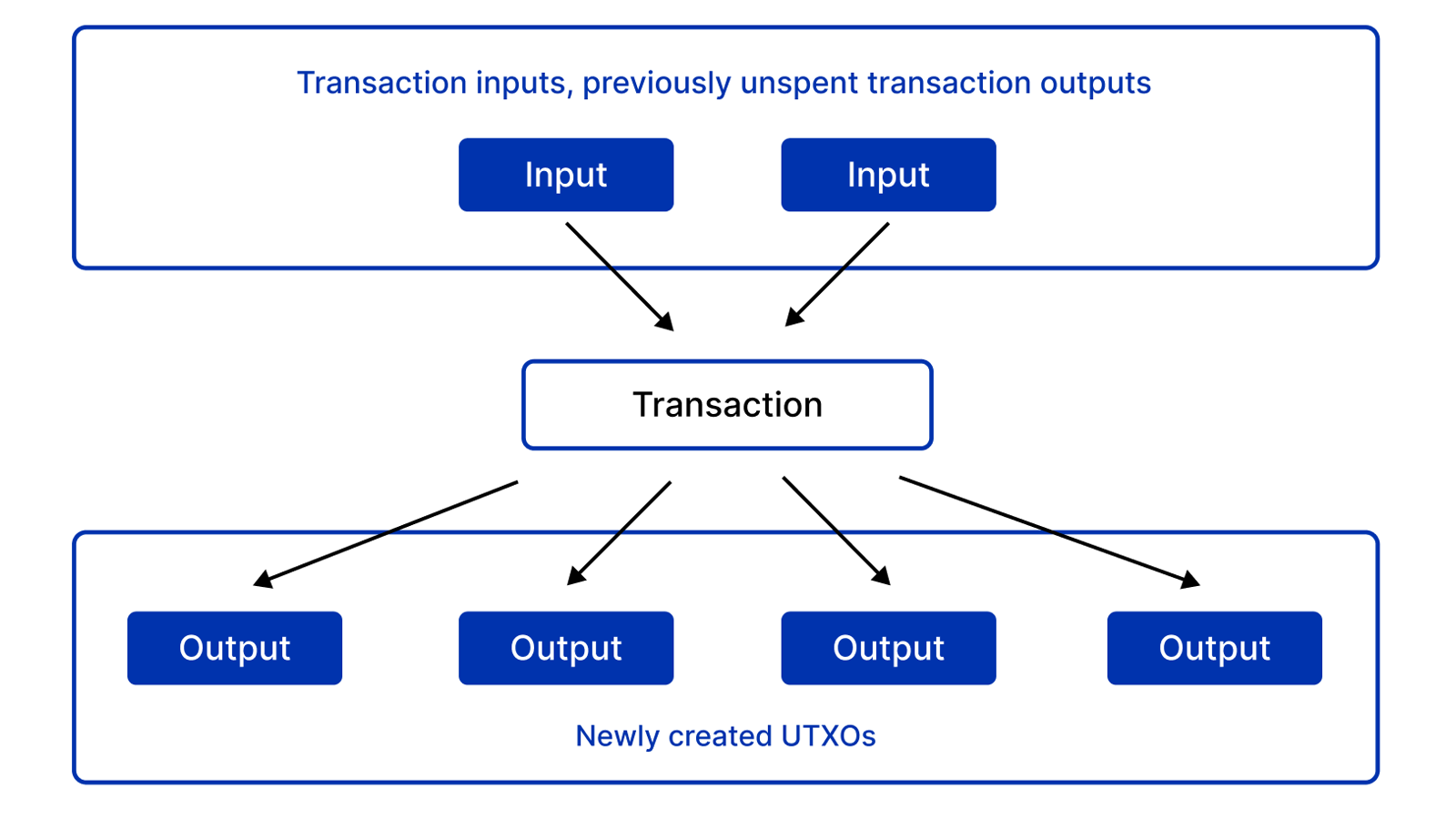
Cardano inherits Bitcoin's basic UTXO idea: transactions have inputs and outputs, and an input points to an unspent output created by an earlier transaction. One UTXO can be consumed only once and as a whole.
Extended UTXO adds smart-contract capability. An output can be locked by a script address and carry datum; the spending transaction provides a redeemer and context, while the validator answers whether the input is allowed to be consumed.
State does not live in one global object
In an account model a DEX contract might store reserves in one contract's storage. In eUTXO, application state can be represented by one or several outputs, each existing as an independently spendable object.
That changes concurrency design. If two users try to consume the same state UTXO at the same time, both transactions cannot win because one input can only be spent once.
Datum, redeemer and context separate state from intent
A **datum** carries information attached to an output. A **redeemer** is data supplied by the spender when attempting to unlock it. **Transaction context** gives the validator information about the whole transaction: inputs, outputs, minting, signatures, validity ranges and other fields.
A validator does not maintain a mutable variable by itself. It verifies a transition from one set of outputs to another.
eUTXO does not eliminate shared state
Shared state is possible, but developers must decide how it is partitioned among UTXOs. One global state output simplifies reasoning but creates contention. Multiple parallel state shards increase throughput while adding coordination complexity.
Concurrency is a design property, not a magic chain constant
A poor eUTXO design can serialize every user through one hot UTXO. A strong design splits state across independent branches. “How much parallelism does eUTXO provide?” cannot be answered without the application's state topology.
eUTXO determinism makes transaction behavior easier to estimate before submission
Cardano documentation emphasizes deterministic transaction validation. Inputs, outputs, script data and execution budget are explicitly listed, so a node can reason about what will be evaluated before the transaction is submitted.
This differs from models where unrelated changes to shared contract state between simulation and inclusion can alter the execution path.
Fees and script budgets are more predictable, but network competition still exists
Deterministic execution does not guarantee inclusion. While a transaction waits, another transaction can consume the required UTXO first. The original transaction then becomes invalid because of a spent input even if its script logic was sound.
Collateral separates failed Plutus execution from ordinary spending
Cardano uses collateral inputs for script transactions. They cover resources when phase-two script validation fails, preventing invalid scripts from consuming validator computation for free.
Predictable execution cost and guaranteed block inclusion are different properties. eUTXO reduces computation uncertainty but does not remove competition for specific inputs.
Ouroboros Praos divides time into slots and epochs
Cardano consensus uses the Ouroboros Proof-of-Stake family. In production engineering terms, the core model is slots, epochs and stake-weighted leader election.
The current Cardano Developer Portal states that one slot lasts **one second** and an epoch contains **432,000 slots**, or about **five days**. Not every slot has a block producer: on average, one nomination is expected every 20 seconds, around 21,600 nominations per epoch.
One slot can have zero or multiple eligible leaders
Ouroboros Praos uses private leader selection. A stake pool determines locally whether it is eligible to produce a block for a slot. Empty slots and competing candidate blocks are possible; chain-selection rules resolve forks.
More stake increases probability, not a fixed block entitlement
A pool controlling more active stake has a higher probability of becoming a slot leader. It remains a probabilistic process and short periods can deviate substantially from statistical expectation.
Settlement requires chain depth
The newest chain tip is not absolute finality. Ouroboros treats recent blocks as transient and confidence rises as subsequent blocks accumulate under the protocol's settlement assumptions.
Praos hides future leaders from an attacker
Private leader election and key-evolving cryptography reduce the ability of an adversary to know the next producer early enough to target it before its assigned slot.
Stake pools turn distributed ADA stake into operational consensus
Requiring every ADA holder to keep block-producing infrastructure online continuously would make participation impractical. Cardano separates the **economic stake owner** from the **stake pool operator**.
A delegator assigns staking rights to a pool. The pool maintains online infrastructure and participates in block production in proportion to aggregate delegated stake.
Delegation does not give ADA to the pool operator
Cardano delegation is non-custodial: payment funds remain in the user's wallet. Staking rights are delegated rather than private keys or coins. ADA is not locked by ordinary delegation and remains spendable.
Delegated principal is not slashed
The current Cardano Developer Portal explicitly describes no slashing of delegated ADA. Poor pool performance means missed potential rewards rather than confiscated delegator principal.
Stake credentials are separate from payment credentials
Cardano address architecture can use separate credentials for payment authorization and staking authorization. That is why delegation can persist without granting spending authority.
Relay topology reduces direct exposure of the block producer
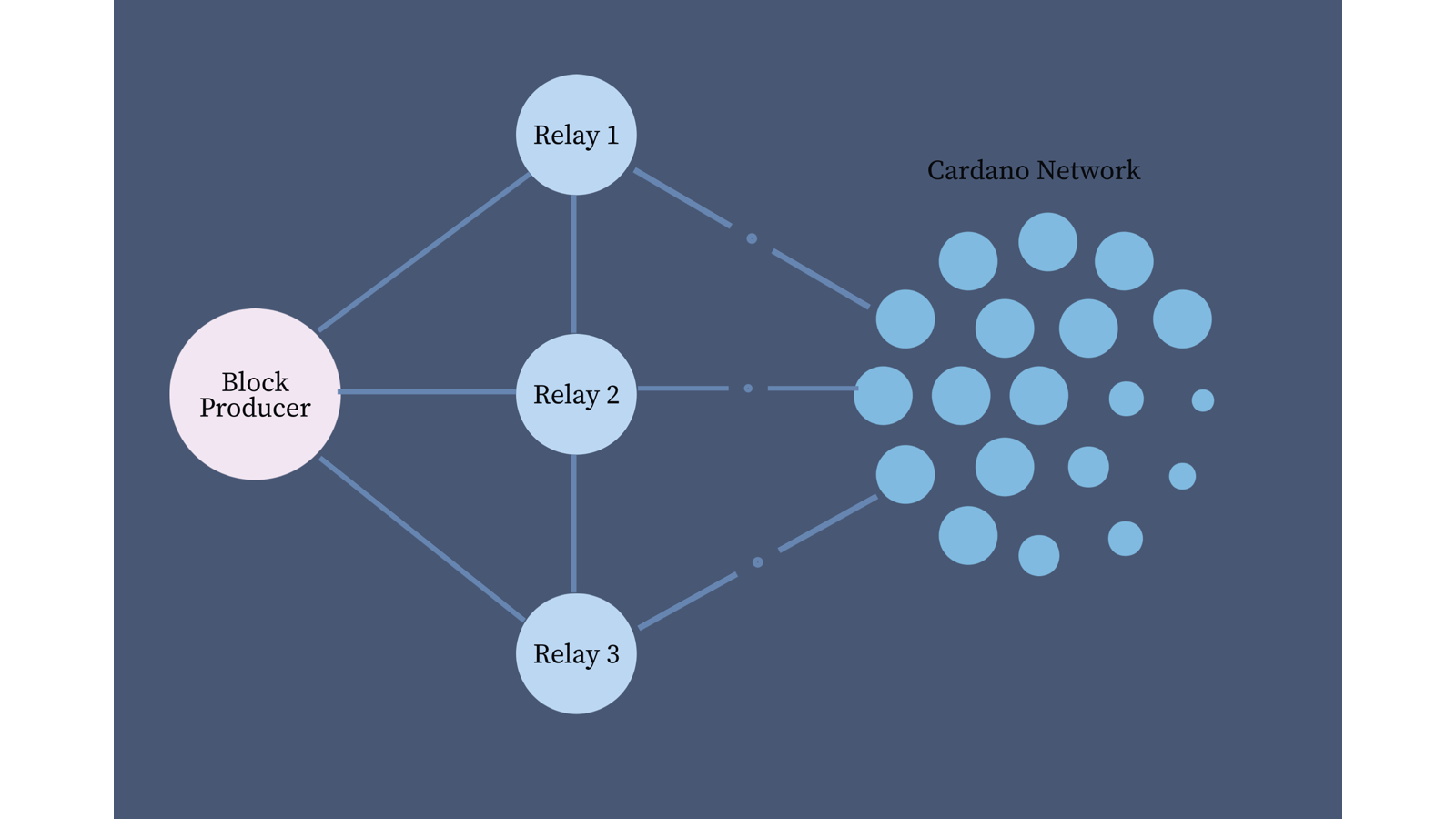
A production pool normally avoids exposing the block-producing node directly to the public network. Relays handle peer traffic and propagate blocks and transactions, reducing the producer's attack surface.
The epoch pipeline explains delayed staking rewards
Delegation does not start earning rewards immediately. Ouroboros uses epoch snapshots so future stake distribution is known for leader election.
Current developer documentation presents the lifecycle as:
- **Epoch N** — the user delegates.
- **N+1** — the stake enters a snapshot.
- **N+2** — the pool produces blocks using that stake.
- **N+3** — rewards are calculated.
- **N+4** — rewards reach the reward account.
The initial delay is roughly **15–20 days**, after which rewards normally arrive every epoch (~5 days) while the pool produces blocks.
Rewards come from fees and the ADA Reserve
Stake-pool rewards are funded by transaction fees and reserve emissions under protocol parameters. Pool economics first account for operating cost and margin, then distribute the remaining reward among owner and delegators according to stake rules.
Saturation discourages concentration into one giant pool
After the saturation point, additional delegated stake stops increasing rewards proportionally. This creates an economic incentive for delegators to distribute stake across competitive pools.
Pledge ties operator capital to pool economics
A pool owner can pledge ADA. Pledge affects reward formulas, but a larger pledge does not automatically make a pool superior; performance, saturation, fees, margin and reliability also matter.
Plutus smart contracts are validators of spending rules
Plutus is Cardano's smart-contract platform. In eUTXO terms, an on-chain script is often better understood as a validator deciding whether a script-controlled output may be consumed rather than as an always-running object with mutable storage.
Contract state is encoded in outputs
A dApp creates an output containing value and datum. The next state transition consumes that output and creates another output that satisfies the validator's rules.
A redeemer expresses spender intent
An escrow validator might receive a redeemer corresponding to “release” or “refund.” The script checks signatures, deadlines and datum, allowing the transaction only when the intended conditions hold.
Whole-transaction context lets validators inspect new outputs
A validator can examine more than one input. It can verify where assets go, which outputs are created, which tokens are minted or burned and which signers are present.
Native multi-assets reduce the need for ERC-20-style balance contracts
Cardano supports native assets directly in the ledger. Minting policies control issuance, while ordinary transfers of native tokens do not require executing a separate ERC-20 balance contract on every transfer.
eUTXO and account models expose different engineering trade-offs
Neither model is universally “better.” They simplify different kinds of reasoning.
| Question | Cardano eUTXO | Typical account model |
|---|---|---|
| State | Distributed among outputs | Mutable contract/account storage |
| Conflict | Two tx cannot consume one UTXO | Shared storage, nonce or account-state conflicts |
| Pre-execution reasoning | Inputs and state explicitly named | Depends on current global state |
| Parallelism | Independent UTXO branches | Independent accounts/storage paths |
| Token model | Native multi-assets + policies | Often token contracts |
| Smart-contract transition | Spend old output → create new | Mutate contract storage |
eUTXO complicates direct ports of EVM patterns
A liquidity pool, order book or marketplace cannot be copied contract-for-contract without reconsidering state layout, batching and contention.
Account models are natural for some global shared-state applications
If an application truly requires one frequently changing global counter, mutable account storage can be simpler. eUTXO requires explicit serialization or sharding of that state.
eUTXO makes object ownership explicit
A transaction identifies the exact objects it spends. That helps formal reasoning, local validation and auditing of transaction structure.
ADA connects fees, staking and governance, but those roles should be separated
ADA is Cardano's native asset. It is used for transaction fees, ledger value requirements, staking and delegation, and governance-related rights in modern Cardano architecture.
Staking yield is not a fixed interest rate
Rewards depend on pool performance, saturation, protocol parameters, stake distribution and reserve or fee economics. A fixed APY should not be inferred from the existence of delegation.
Spendable balance and delegated stake coexist
ADA does not move into a staking contract during ordinary Cardano delegation. Wallet funds remain spendable while epoch snapshots account for the stake credential's balance in future consensus and reward calculations.
Governance delegation and stake-pool delegation are separate decisions
Modern Cardano governance uses separate governance credentials and representatives. Choosing a pool for consensus participation should not automatically be treated as voting for that operator on governance proposals.
Explorer analysis on Cardano means reading UTXOs, not only from and to
Account-chain explorers encourage a simple narrative: from A to B, amount and gas. A Cardano transaction can have several inputs, several outputs, change, native assets, scripts and collateral.
Useful checklist
- Transaction inputs and source UTXOs.
- Outputs and change addresses.
- ADA and native assets in each output.
- Script inputs, datum, redeemer and execution units when applicable.
- Collateral inputs for Plutus transactions.
- Block, slot and epoch.
- Fees and validity interval.
- Mint or burn policies.
One wallet can look like many addresses and outputs
HD wallets produce change addresses and UTXO selection can combine several outputs. An explorer view showing five inputs and three outputs does not imply five unrelated senders.
Stake-pool explorers answer a different set of questions
Useful pool metrics include active stake, pledge, saturation, blocks produced, margin, cost and historical performance. One lucky epoch does not establish long-term quality.
The main conclusion
Cardano is best understood through the combination **eUTXO + Ouroboros + delegation**. eUTXO turns state into a graph of spendable outputs and gives scripts datum, redeemer and context rather than familiar mutable contract accounts. Ouroboros divides time into one-second slots and five-day epochs and selects block producers probabilistically by stake. Stake pools allow holders to delegate consensus rights without transferring custody or locking principal.
Those choices have practical consequences. dApps must design UTXO topology and concurrency instead of only business logic. Staking rewards pass through an epoch snapshot pipeline and therefore arrive with delay. Explorer analysis must read exact inputs and outputs rather than only from and to. ADA participates in fees, staking and governance, but those roles should not be collapsed into one token-value formula.
The best engineering question about Cardano is not “why doesn't it use a familiar account contract?” It is: **which UTXO contains the state, who may consume it, which new output must be created after the transition, and how does stake distribution determine the next consensus epoch?**
FAQ
What is eUTXO?
It is Cardano's Extended Unspent Transaction Output model. Transactions consume specific unspent outputs and create new ones; outputs can carry datum and be locked by scripts, while redeemers and transaction context feed validation logic.
How is eUTXO different from Ethereum's account model?
Account-model contracts commonly mutate shared storage. eUTXO represents state as outputs; a state transition consumes an old output and creates a new one. That changes concurrency and dApp design patterns.
How long is a Cardano epoch?
The current Cardano Developer Portal lists 432,000 one-second slots, roughly five days per epoch. Block nomination is expected on average around once every 20 seconds, while an individual slot can have zero or multiple eligible leaders.
Is ADA locked when staking?
Ordinary delegation is non-custodial and does not lock ADA. Funds remain in the wallet and are spendable; staking rights are delegated to a stake pool.
Is delegated ADA subject to slashing?
Current Cardano documentation states that delegated principal is not slashed. An underperforming pool can reduce or eliminate rewards for a period without confiscating delegated ADA.
Why do staking rewards not appear immediately?
Leader election uses epoch snapshots. Current developer documentation shows delegation in N → snapshot N+1 → production N+2 → calculation N+3 → distribution N+4, producing an initial delay of roughly 15–20 days.
This material is educational and does not constitute financial advice or a promise of staking returns.