
Chainlink is not one oracle contract and not a single database of prices. It is a network of services where external data passes through data providers and independent node operators, is aggregated by decentralized oracle networks, and is published into on-chain contracts. CCIP uses related infrastructure for cross-chain messages and tokens. LINK connects these services economically: it is a standard payment unit, compensates network service providers and serves as staking collateral for cryptoeconomic security.
Chainlink is a service network, not one “source of truth”
A smart contract cannot safely open an exchange HTTP API and ask for ETH/USD because validating nodes could receive different responses. Chainlink inserts an oracle layer between nondeterministic external systems and deterministic blockchain execution.
The phrase “Chainlink provides a price” hides multiple stages: data vendors, node operators, off-chain aggregation and reporting, on-chain aggregator or proxy contracts, and the consuming application.
A DON is a separate fault domain between the outside world and a blockchain
A Decentralized Oracle Network combines independent nodes that collect observations and produce a report. Blockchain consensus then verifies an ordinary on-chain report transaction rather than trusting one external API directly.
Different Chainlink services can use different network configurations
A Price Feed, CCIP lane, Automation job or other service does not necessarily share the same node set, quorum or contract topology. The Chainlink brand does not replace analysis of a specific service instance.
Oracle decentralization is not a logo count
Source diversity, node-operator diversity, report quorum, upgrade controls and chain-specific deployment all matter. Ten nodes reading one upstream source do not provide the same resilience as independently sourced data pipelines.

How a Price Feed is assembled: sources → nodes → aggregation → consumer
Chainlink Data Feeds publish prices and other values into aggregator contracts. A consumer generally reads a proxy contract through AggregatorV3Interface rather than contacting an off-chain source directly.
Each layer solves a different problem. Data vendors normalize market information. Oracle nodes collect observations. A DON aggregates them. An aggregator contract stores the on-chain result. A proxy allows the underlying aggregator to change without forcing every consumer to migrate addresses.
Source aggregation reduces one-exchange risk
A reference price built from several liquid venues or data vendors is less exposed to one local outage or manipulated market.
Node aggregation reduces one-operator risk
Even a good source can be read, normalized or transmitted incorrectly by a compromised node. Independent nodes and quorum reporting reduce that operational dependency.
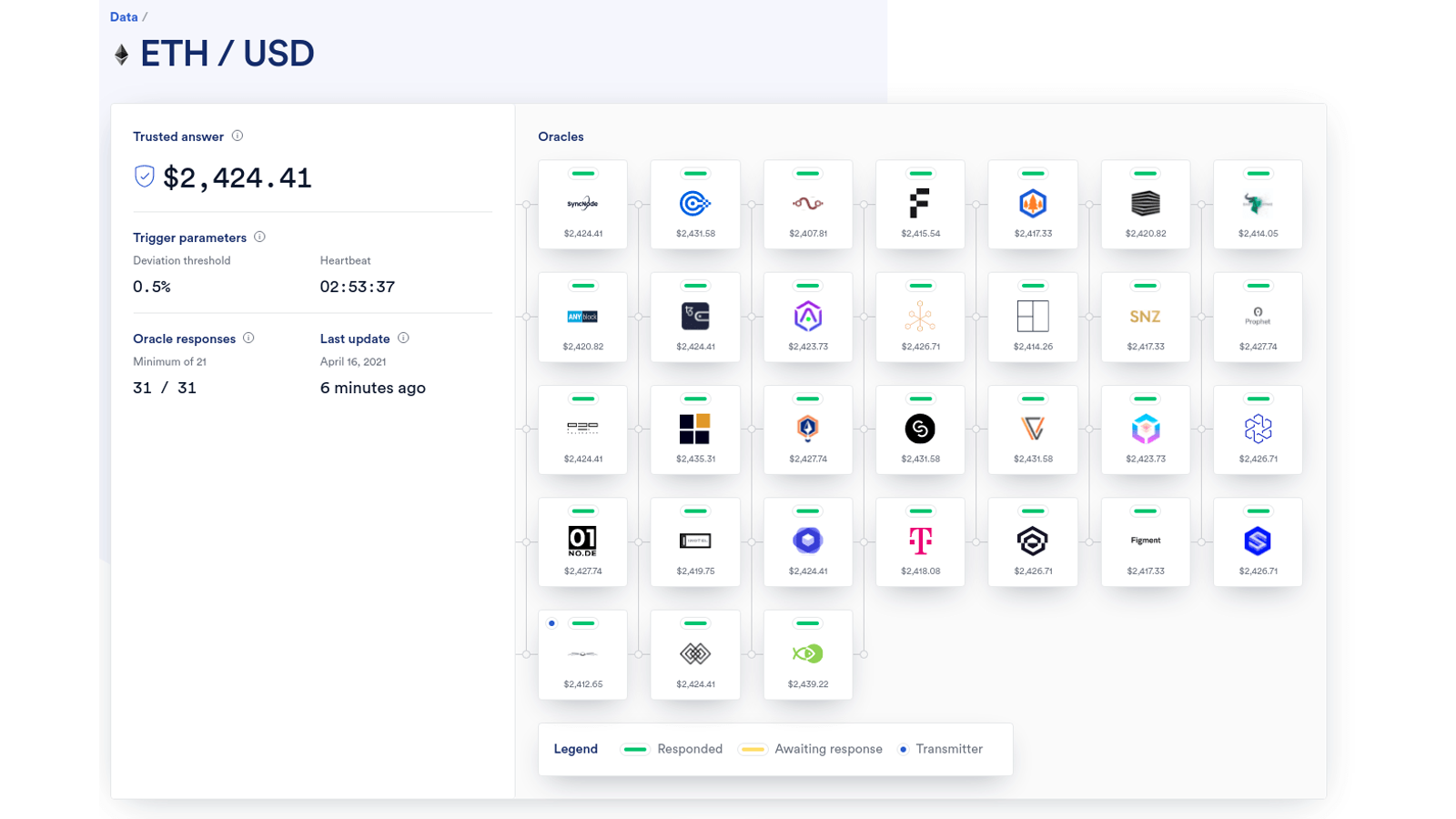
Heartbeat and deviation threshold determine when updates occur
A Price Feed is not a millisecond streaming feed. Updates generally occur when the value moves beyond a configured deviation threshold or the heartbeat interval expires.
Consumers still need freshness checks
latestRoundData includes update metadata in addition to the answer. A protocol that blindly accepts stale data can use a correctly signed but economically dangerous input.
An oracle report can be cryptographically valid and still be unsuitable for the current action if the consumer ignores age, decimals or market assumptions.
LINK is the payment unit, provider compensation and a cross-chain asset
Chainlink Documentation calls LINK the native digital asset of the Chainlink Network and its standard unit of payment for services. Node operators and other service providers receive economic compensation for performing network work.
LINK was originally issued on Ethereum and uses **ERC-677**, inheriting ERC-20 functionality while adding the ability to attach a data payload to token transfers. LINK's smallest denomination is the Juel: 1 LINK equals 1e18 Juels.
LINK is not simply “gas for oracles”
On-chain execution still consumes the native gas asset of the blockchain. LINK is the Chainlink service and network-economics asset, not a replacement for ETH gas.
Payment Abstraction lets customers pay in other forms
Current Chainlink documentation describes Payment Abstraction: users and enterprises can pay in preferred on-chain tokens or off-chain fiat, with payments programmatically converted into LINK through decentralized exchange infrastructure.
This matters economically because enterprise adoption does not require a company to manually buy LINK before every invoice while the network can still settle service economics into LINK.
Chainlink Reserve connects service revenue with LINK accumulation
Documentation describes the Chainlink Reserve as a strategic on-chain reserve of LINK funded through Payment Abstraction from on-chain service usage and off-chain enterprise revenue. It is not a staking pool and does not guarantee token-price appreciation; it is a distinct treasury and economic mechanism.
Staking v0.2 turns LINK into collateral for oracle security
Chainlink Staking v0.2 is a protocol layer that uses staked LINK to increase security guarantees for in-scope oracle services. Community stakers and node-operator stakers have different responsibilities and limits.
The current public FAQ lists a **45 million LINK** launch cap: 40.875 million allocated to community participants with the remainder for node operators servicing in-scope Data Feeds.
Community and node operators have different limits
A community staker can stake from 1 to 15,000 LINK per address when capacity is available. Node Operator Stakers can stake from 1,000 to 75,000 LINK.
Staking is not just a passive-yield vault
The community layer participates in alerting mechanisms designed to surface service failures. Node operators perform production oracle work and sit closer to slashable operational responsibility.

Slashing in v0.2 focuses on node-operator performance conditions
v0.2 introduces the ability to slash staked LINK from node operators under predefined failure conditions. This is an economic penalty mechanism rather than automatic punishment for every short outage.
Unstaking has a cooldown and claim window
The public FAQ describes a 28-day cooldown followed by a seven-day claim window. Stake that is not withdrawn during the window automatically re-enters v0.2.
The reward architecture is designed to expand
v0.2 is modular and uses a dynamic reward design intended to support new reward sources over time, including user fees as staking expands to additional services. It would be inaccurate to claim that every unit of current staking yield already comes from organic service fees.
CCIP moves authenticated cross-chain messages, not price reports
Cross-Chain Interoperability Protocol solves a different problem from Price Feeds. It allows applications to send data, tokens or programmable token transfers across blockchains.
Each cross-chain lane uses several oracle-network and on-chain components. The system must establish that a source event occurred and that the destination is allowed to execute the corresponding message.
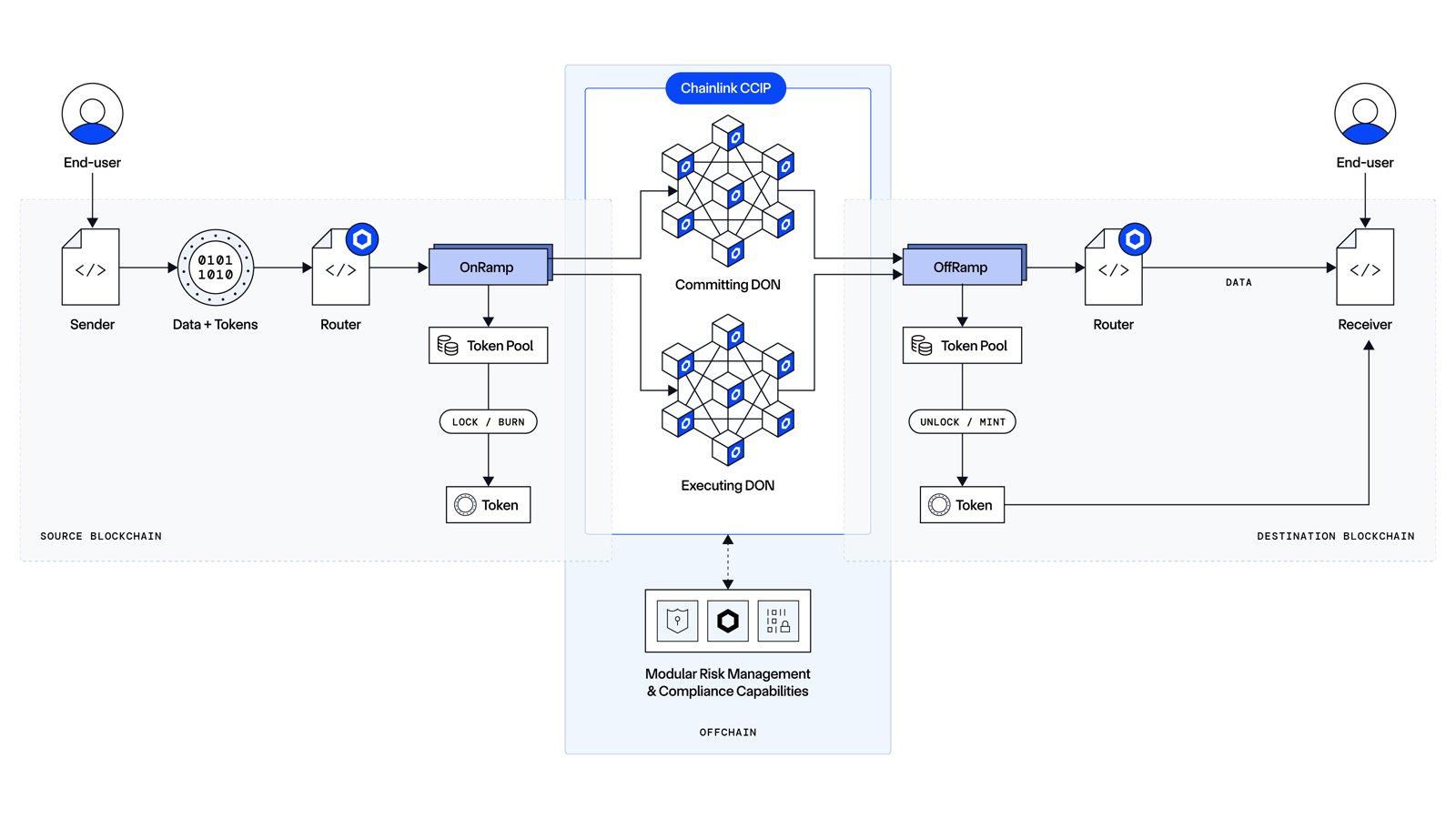
Token transfers can use different pool mechanics
CCIP supports multiple token-pool models, including lock/mint or burn/mint patterns depending on asset design. “Transferred with CCIP” does not by itself identify where backing is held.
Programmable Token Transfer combines value with instructions
An application can send a token together with encoded data so the destination contract performs another action. This is more powerful than a simple bridge while requiring careful receiver validation.
Rate limits can reduce blast radius
CCIP supports configurable rate limits for cross-chain tokens. Even if part of a system is compromised, a rate cap can restrict how much value moves during an interval.
CCIP defense in depth: DONs, timelocks and risk controls
Chainlink describes CCIP as a defense-in-depth architecture because cross-chain security spans multiple consensus systems and execution environments.
Multiple DONs reduce dependence on one signer set
CCIP is not one simple multisig. Different distributed node infrastructure participates in observation, commit and execution paths.
Timelocked upgrades provide a review period
Security-critical configuration changes and core upgrades pass through a Role-based Access Control Timelock. Node operators receive a review period and can participate in veto or approval processes under the documented model.
Source-chain finality remains an external dependency
CCIP cannot make a source chain more final than it is. If an application uses an early finality threshold, reorganization risk belongs in the threat model.
Destination application security remains separate
A correctly authenticated CCIP message can still call a vulnerable destination function. Protocol security and application security are distinct layers.
| Layer | Failure mode | Main defense |
|---|---|---|
| Data source | Bad market input | Source diversity and filtering |
| Oracle node | Compromise or outage | DON quorum |
| Feed consumer | Stale-data or decimal bug | Application validation |
| CCIP source | Chain reorg | Finality policy |
| Cross-chain infra | Failed or malicious nodes | Multiple DON and risk controls |
| Destination app | Unsafe receiver logic | Contract security |
How to verify a Chainlink service in explorers and documentation
Seeing “Chainlink” in an interface is not enough. Production integration needs the exact contract, chain, service type and update policy.
For a Price Feed
Check the proxy address in the official feed directory, decimals, heartbeat and deviation parameters, latestRoundData timestamp and underlying aggregator metadata.
For LINK
Check the official LINK contract for the specific blockchain. Chainlink Docs publishes a network-by-network table; a third-party token with the same symbol is not proof of identity.
For staking
Use official staking interfaces and contracts and verify current pool capacity, cooldown rules and protocol version. v0.1 and v0.2 have different lifecycle states.
For CCIP
Check the CCIP Directory: source and destination networks, router, on-ramp and off-ramp addresses, supported token pool and receiver contract. A message ID should map to both source and destination events.
Upgradability is part of the trust model
Proxy and upgradeable architecture allows aggregators and CCIP components to evolve without forcing every consumer to migrate. The upgrade authority and process therefore become security assumptions themselves.
The main conclusion
Chainlink is a service network that connects smart contracts with data and other blockchains. Data Feeds create a pipeline from data providers through independent oracle nodes to an aggregated on-chain report. CCIP uses related oracle-network infrastructure for authenticated cross-chain messages and token transfers.
LINK connects the architecture economically. It is an ERC-677 token, the standard service-payment asset, a compensation asset for network service providers and staking collateral. Payment Abstraction lets enterprise customers pay in convenient assets while preserving LINK conversion inside the economic layer. Staking v0.2 adds collateral, alerts, node-operator slashing and an extensible reward design.
LINK is therefore more useful to analyze through actual service demand than through the label “oracle token”: **which Chainlink services are used, which payments and provider incentives they create, which services are protected by staking, and how well the security architecture handles bad data, node failures and cross-chain risk.**
FAQ
Does Chainlink itself decide the BTC or ETH price?
No. Data Feeds aggregate observations from external market-data sources through oracle nodes. Chainlink infrastructure transports and aggregates the information; it does not invent the market price.
Why is LINK needed if gas is still paid in ETH or another native token?
Native gas pays for blockchain execution. LINK is used as a Chainlink service-payment and provider-compensation asset and as staking collateral for cryptoeconomic security.
What is Chainlink Staking v0.2?
It is Chainlink's modular staking protocol. Community participants and node operators stake LINK, participate in the security model and receive rewards. Node-operator stake can be slashed under predefined failure conditions.
How much LINK can be staked?
The current public v0.2 FAQ lists 1–15,000 LINK per community address and 1,000–75,000 LINK for node operators when capacity is available. The v0.2 launch cap is 45 million LINK.
Is CCIP just another bridge?
No. It is a general interoperability protocol for data, tokens and programmable token transfers. The token pool underneath a transfer can use different mint, burn or lock mechanics.
Can a Price Feed become stale?
Yes. Consumers should validate update timestamps and documented heartbeat or deviation settings. The most recent report can be historically correct but too old for a current business decision.
This material is educational and does not constitute financial advice or a promise of staking returns.