USDC exists simultaneously as an off-chain obligation of a regulated issuer and an on-chain token across multiple blockchains. Circle serves eligible institutional customers in the primary market, issues and redeems USDC, manages reserve assets and publishes disclosures. Each blockchain contract handles balances, transfers, mint/burn and administrative controls for that network. CCTP connects native USDC across chains through burn-and-mint rather than permanently accumulating wrapped collateral in a bridge vault. Technical analysis needs to separate these layers.
USDC is an issuer-backed stablecoin, not one global smart contract
Circle describes USDC as a digital dollar backed by highly liquid dollar-denominated reserve assets and redeemable one-to-one for eligible customers. On-chain implementation, however, is network-specific: Ethereum, Base, Solana, Arbitrum, Avalanche and other ecosystems have their own official native USDC contracts or token programs.
A balance reading “100 USDC” should therefore always be interpreted together with network and contract identity. The same ticker can be used by Circle-issued native USDC, a bridged representation or an unrelated third-party token.
Primary and secondary markets are different layers
Circle Mint serves qualified businesses and institutional users that can fund fiat balances, receive newly issued USDC or redeem USDC back to fiat. Retail holders usually acquire and sell USDC through exchanges, DEXs or wallet providers on the secondary market.
The peg is not produced by one contract rule
Price stability around one dollar comes from reserve backing, primary-market convertibility, exchange liquidity, arbitrage and trust in issuer and banking rails. A smart contract cannot inspect reserve accounts by itself.
Blockchain proves token supply, not reserve assets
An on-chain observer can calculate token supply and transfers for a contract. Bank deposits, Treasury securities and money-market-fund holdings require separate financial disclosure and assurance infrastructure.
Mint and redeem: how fiat becomes native USDC and back again
In the primary-market flow, a qualified Circle Mint customer completes account and compliance procedures and funds a supported fiat balance. After funding is confirmed, Circle issues USDC on a selected supported blockchain and sends it to the requested destination.
Redemption runs in the opposite direction: the customer returns native USDC through Circle-controlled flows, tokens leave circulation through issuer mint/burn mechanics, and corresponding fiat value is paid according to account and banking rules.
Mint changes token supply
Unlike a secondary-market transfer between wallets, primary issuance increases native USDC supply on a network, while redemption reduces aggregate circulating amount after the corresponding burn or issuer process.
An exchange withdrawal is not necessarily a mint
When an exchange sends 50,000 USDC from its hot wallet to a customer, that is normally a transfer of existing supply. A mint event is required only when the issuer creates new native supply.
Burn does not always mean “somebody redeemed dollars to a bank”
CCTP also burns USDC on a source chain for cross-chain transfer. Burn events need to be classified by caller and downstream destination mint; redemption and CCTP burn have different economic meaning.
USDC reserves: liquidity, disclosure and monthly assurance
Circle states that USDC is fully backed by highly liquid cash and cash-equivalent assets, with reserve holdings that equal or exceed USDC in circulation.
The current Transparency page discloses reserve holdings weekly together with mint and burn flows. A Big Four accounting firm separately provides monthly third-party assurance over USDC reserves under AICPA attestation standards.
Most reserve assets are designed for high liquidity
Circle describes a structure where a significant portion of reserves sits in the Circle Reserve Fund and short-duration U.S. Treasury-related instruments, with additional liquidity in cash deposits inside the regulated financial system.
Attestation and audit are different assurance concepts
A monthly reserve attestation tests a defined assertion about reserve assets and circulation under specified standards. A full financial-statement audit has a broader scope. Those terms should not be treated as interchangeable.
Weekly disclosure reduces lag but does not put reserves on-chain
Publishing reserve composition and issuance or redemption flows improves transparency, but the underlying securities and bank balances remain inside traditional finance. An Ethereum contract cannot directly liquidate the Circle Reserve Fund when somebody redeems.
USDC stability is produced by on-chain token contracts and off-chain regulated finance working together. Neither half should be analyzed as if the other did not exist.
Native USDC and bridged USDC share a dollar intent but have different redemption paths
Native USDC is issued directly by Circle on a supported blockchain. Circle publishes the official contract address and controls mint and burn authority through issuer infrastructure.
Bridged USDC appears when a third-party bridge locks native USDC on a source chain and creates a representation on a destination chain. It may be labeled USDC.e, USDbC or another suffix, although wallets can still display familiar branding.
Native supply does not depend on a third-party bridge collateral vault
If Circle issues one million native USDC on chain B, that represents the issuer liability backed by the common reserve model. If a bridge issues one million wrapped USDC, redemption depends on that bridge and its locked source collateral.
A bridged token adds another failure domain
A bridge exploit, broken message verification, compromised guardian set or liquidity failure can damage a wrapped representation even while Circle's USDC reserves remain healthy.
Contract address matters more than symbol
Circle's contract-address documentation explicitly notes cases where a network has Circle-issued native USDC alongside a separate bridged token such as USDC.e. Integrations, oracles and collateral lists must distinguish them by address.
| Asset type | Who mints it | What backs it | Primary redemption path |
|---|---|---|---|
| Native USDC | Circle issuer contracts | Circle USDC reserves | Circle / market liquidity |
| Bridged USDC | Bridge contract | Locked native token / bridge accounting | Bridge back to native asset |
| Fake USDC ticker | Any deployer | Undefined | May not exist |
CCTP V2 moves USDC with burn-and-mint instead of lock-and-wrap
Cross-Chain Transfer Protocol is Circle's permissionless mechanism for moving native USDC among supported blockchains. Current developer guidance recommends **CCTP V2** for new integrations; V1 is legacy or remains required where V2 is not yet available.
The core idea is that source USDC is **burned**, Circle's attestation infrastructure signs the cross-domain message, and destination contracts **mint native USDC**. The user does not receive a bridge-specific wrapper.
The EVM flow begins with TokenMessengerV2
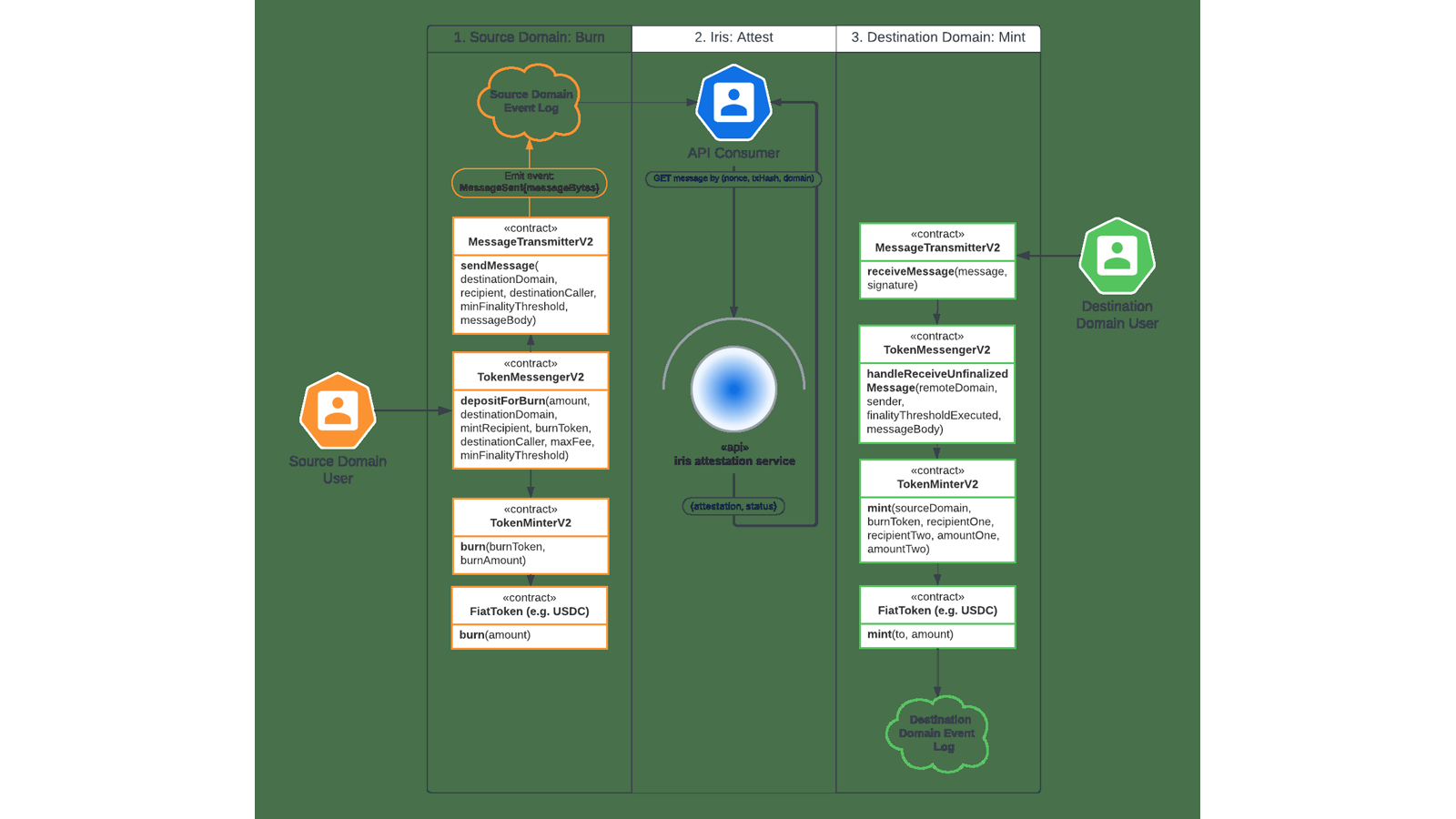
An application calls depositForBurn on TokenMessengerV2. The contract interacts with TokenMinterV2 to burn USDC while MessageTransmitterV2 creates a cross-domain message.
Iris signs the message off-chain
Circle's Iris attestation service observes the source event and, after the required finality threshold, signs the message. A relayer or application retrieves the attestation through Circle's API.
Destination MessageTransmitterV2 verifies the attestation
The destination receiveMessage call verifies signature, domains, nonce and message contents. The TokenMessenger and TokenMinter path then creates native USDC for the mintRecipient.
Burn-and-mint preserves aggregate supply under a correct flow
Source supply falls by the burn amount and destination supply rises after the attested mint. During the transfer, the user's token value is temporarily not spendable as native supply on either side rather than existing twice.
Standard and Fast Transfer trade finality against latency and fees
CCTP V2 supports different finality profiles. Standard Transfer waits for a stronger source-chain finality threshold and normally has no CCTP transfer fee beyond network gas and optional services. Fast Transfer uses a pre-finality attestation and a fee so destination mint can occur sooner.
Current Circle documentation gives indicative timings of roughly **8–20 seconds for Fast Transfer** and around **15–19 minutes for Standard Transfer on Ethereum and L2 paths**, while exact latency depends on the source chain and finality conditions.
Fast Transfer uses an allowance risk budget
Circle limits available Fast Transfer allowance. This reflects additional reorg and finality exposure: mint happens before the strongest source finality, so pre-finality issuance is not unlimited.
Fees are expressed in burn-token units
The V2 message includes maxFee and feeExecuted. An API can return source-to-destination fee quotes before the transfer. Production UX should separate network gas from CCTP or forwarding fees.
Expiration does not permanently strand a valid burn
Fast Transfer messages include expirationBlock. If attestation or mint misses the window, V2 supports re-attestation with a refreshed expiration as long as the burn remains valid.
A fast cross-chain transfer is not “the same finality with a faster server.” It is a distinct risk and fee profile encoded in V2 finality thresholds and allowance mechanics.
Explorer and settlement matrix: verify cross-chain USDC layer by layer
A destination balance alone is insufficient for debugging. CCTP has a source transaction, burn event, message, attestation and destination mint.
Source chain
Verify the official USDC contract, TokenMessengerV2 call, amount, source and destination domains and mintRecipient. The transaction should succeed and emit the expected burn and message data.
Iris and API layer
Using the source transaction hash or nonce, retrieve the V2 message and attestation status. Distinguish waiting for finality, attested state, expired messages and re-attestation cases.
Destination chain
Inspect receiveMessage, MessageTransmitterV2 result, replay protection and the final native USDC mint recipient.
| Stage | Artifact | If it stalls |
|---|---|---|
| Source burn | Transaction + burn event | Revert, gas, contract address |
| Message creation | CCTP message + nonce | Domain and logs |
| Finality | finalityThresholdExecuted | Wait for source finality / Fast path |
| Attestation | Iris signature | API status / expiration |
| Destination receive | receiveMessage transaction | Gas, caller, destination contract |
| Mint | Native USDC balance/event | Recipient and token identity |
CCTP is not a conventional liquidity bridge
A destination liquidity provider does not need to pre-fund the user's entire Standard burn-and-mint amount in a pool. Native supply is created by issuer mint authority after a valid attestation.
CCTP messages can be combined with application logic
V2 supports hookData and general messaging features within documented contracts. That can enable richer cross-chain flows while increasing application integration complexity and attack surface.
USDC risk matrix: reserve risk and blockchain risk live in different layers
USDC reduces directional volatility against the dollar but is not risk-free. The main domains should be analyzed independently.
- **Reserve and issuer risk:** quality, liquidity and custody of reserve assets.
- **Banking and payment-rail risk:** fiat redemption relies on regulated financial infrastructure.
- **Smart-contract risk:** bugs or administrative compromise in native token contracts.
- **Chain risk:** finality, outages and congestion on the underlying blockchain.
- **Bridge risk:** bridged USDC adds a third-party bridge.
- **CCTP attestation risk:** cross-chain mint depends on Circle's attestation infrastructure and contracts.
- **Compliance risk:** issuer-controlled stablecoins have regulatory and administrative controls.
- **Liquidity risk:** secondary-market price can temporarily deviate from one dollar.
Native USDC does not eliminate issuer counterparty risk
Even without a bridge, users depend on Circle's reserve and redemption infrastructure and token administration. Native means “issued directly by Circle on this chain,” not “fully permissionless asset.”
Bridged USDC does not automatically inherit the full native profile
A wrapper can lose value because of a bridge exploit while Circle reserves remain intact. DeFi collateral analysis should therefore model the bridge separately.
CCTP removes permanent locked-collateral bridge exposure but adds attestation dependency
Burn-and-mint avoids a permanent vault holding source USDC, but destination mint still requires a valid Circle attestation. This is a different security architecture, not the absence of a cross-chain trust boundary.
The main conclusion
USDC is regulated issuer-backed money infrastructure distributed across several blockchains. Circle Mint connects the fiat primary market with on-chain issuance and redemption. Reserves back the one-to-one economic liability and are disclosed through weekly holdings data and monthly third-party assurance. Native USDC on each chain has an official Circle contract or token identity.
For cross-chain movement, CCTP V2 replaces the common lock-and-wrap model with **burn source native USDC → Iris attestation → mint destination native USDC**. This reduces wrapper fragmentation and bridge-vault dependency while retaining contract, finality and attestation risks.
The practical engineering rule is never to ask only “is this USDC?” Ask **which contract, native or bridged, who has mint authority, what the redemption path is, and exactly how the token arrived on this blockchain.**
FAQ
How does Circle issue new USDC?
An eligible Circle Mint customer funds a supported fiat balance, after which the issuer creates native USDC on the selected supported blockchain. A normal exchange transfer of existing USDC is not new issuance.
How is native USDC different from USDC.e?
Native USDC is issued directly by Circle on that chain. USDC.e generally represents bridged USDC backed by tokens and bridge mechanics on another network. Always verify the contract address.
Does CCTP lock USDC in a bridge vault?
For native USDC, no. CCTP burns source USDC, obtains an attestation and mints native USDC on the destination chain.
What is Iris?
Iris is Circle's off-chain CCTP attestation service. It observes valid source messages after the required finality threshold and signs an attestation that destination contracts verify before minting.
How is Fast Transfer different from Standard Transfer?
Fast uses pre-finality attestation, a limited allowance and a fee to mint sooner. Standard waits for stronger finality and is slower with a different risk and fee profile.
How are USDC reserves checked?
Circle publishes reserve holdings and mint/burn transparency data, while a Big Four accounting firm provides monthly third-party assurance reports. Those attestations should not automatically be described as a full audit of Circle's entire business.
This material is educational and does not constitute financial advice or a guarantee of issuer solvency.