Pressing Send in a crypto wallet creates the illusion of an instant transfer: enter an address, choose an amount, approve, and a transaction hash appears. But coins have not “flown” through the internet into another wallet at that moment. The wallet has constructed and signed an instruction. What follows is a distributed process involving local validation, peer-to-peer propagation, mempool admission, competition for block space, execution or script validation, canonical-chain selection, and eventually enough confirmation or finality for an application to treat the result as settled.
Understanding that lifecycle is more useful than memorizing a table of “Bitcoin takes X minutes” or “Ethereum takes Y seconds.” Time depends on fee policy, local mempools, nonce or UTXO dependencies, client rules, block-space demand, producer behavior and reorganization risk. Two transactions broadcast in the same second can take very different paths to durable settlement.
A transaction is a signed instruction, not a packet containing coins
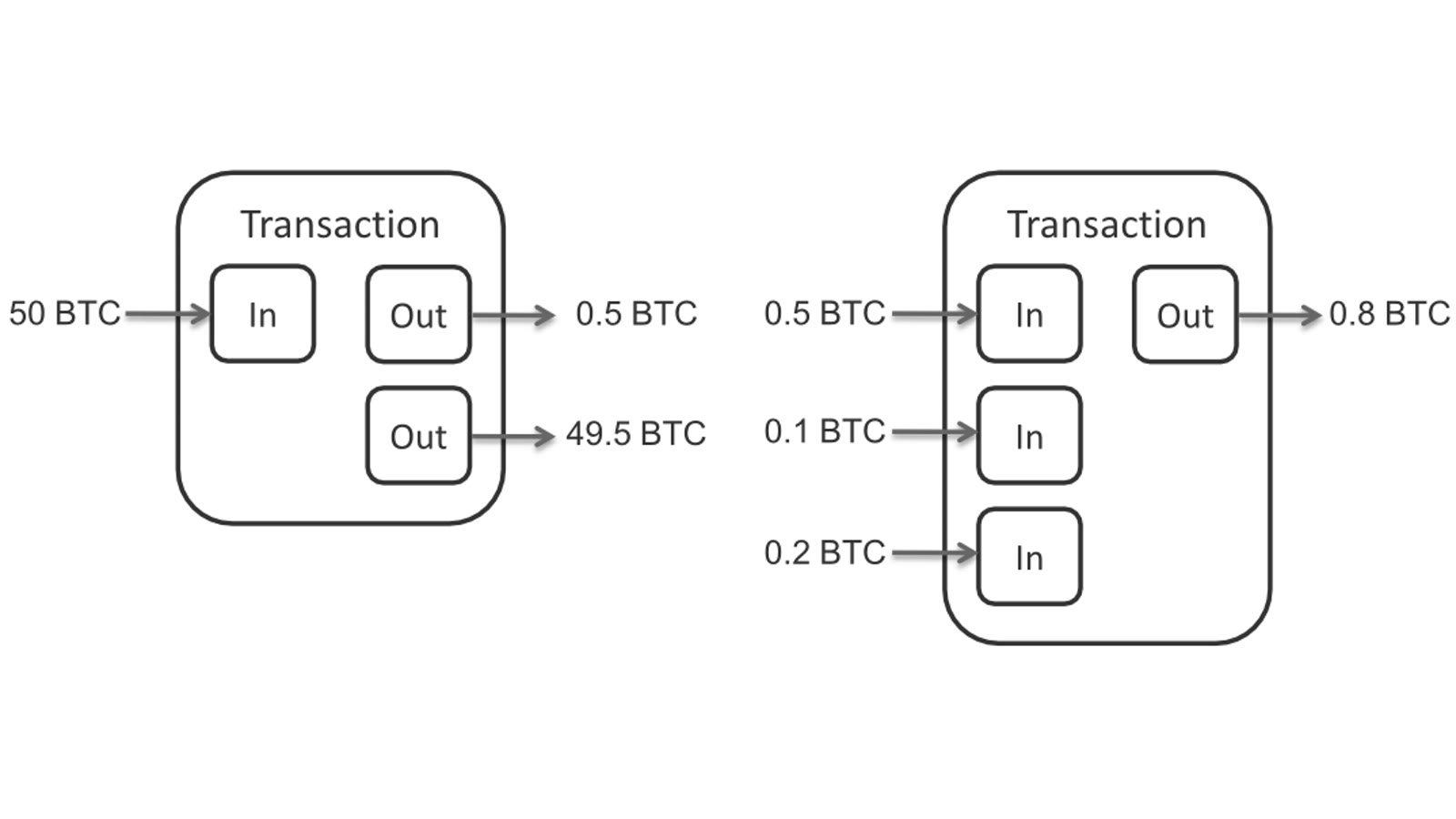
Bitcoin transactions consume previously created unspent transaction outputs and create new outputs. A wallet does not decrement a row in a global account table. It selects UTXOs, creates new spending conditions and often creates a change output back to the sender. A wallet balance is therefore a derived view of spendable outputs, not a consensus record saying “Alice = 1.3 BTC.”
Ethereum uses an account-based state model. A transaction from an externally owned account includes a destination, value or calldata, gas parameters and a nonce. It requests a state transition: transfer ETH, call a contract, deploy code or change contract storage through EVM execution. In both systems the network receives a cryptographically authorized instruction rather than a literal object called money.
Step 1: the wallet constructs the transaction
Before signing, a wallet assembles the fields that describe the user’s intent. For Bitcoin this includes inputs, outputs, change, fee and fields such as sequence or locktime. For Ethereum it includes account nonce, destination, value, calldata, gas limit and fee parameters. A user interface may hide much of this complexity, but the choices still become part of the serialized transaction.
Problems can begin before the network sees anything. A wrong address, noncompetitive fee, incorrect nonce, insufficient gas limit or an attempt to spend an already-consumed UTXO can lead to rejection or extended pending status. A blockchain does not correct intent. The signature does the opposite: it makes the chosen instruction provably authorized.
Step 2: the private key creates an authorization signature
The wallet signs the protocol-defined representation of the transaction with the sender’s private key. The signature does not reveal the key, but it lets validators verify that the authorized party approved the transaction data. Alter the signed fields and the signature no longer validates.
This is a critical security boundary. Consensus can choose the ordering of valid transactions, but it cannot legitimately manufacture the owner’s signature. A large miner or validator may influence inclusion or ordering within its threat model, yet it does not automatically gain the power to spend arbitrary user balances.
Step 3: a transaction hash appears
After the signed transaction is serialized, the client can derive an identifier commonly displayed as a txid or transaction hash. It becomes the observation key used by wallets, explorers and node RPC interfaces to refer to the same operation.
But a hash is not proof of inclusion. A wallet can calculate it locally before broadcast succeeds. “I have a tx hash” therefore does not mean “this transaction is already on the blockchain.” The next questions are whether any remote peer has seen it, whether a node currently holds it in a transaction pool, and whether it later appears in a canonical block.
Step 4: broadcast means peer-to-peer propagation, not insertion into one global queue
Bitcoin full nodes relay transactions through a peer-to-peer network. A node receives a transaction, validates it against relevant rules and local policy, and can advertise it to connected peers. Ethereum clients similarly propagate pending transactions among peers. Information spreads through a network graph; there is no central server that every transaction must enter.
That produces an important practical effect: two nodes can observe different pending sets at the same time. Network latency, topology, local policy and memory limits mean “the network mempool” is a useful shorthand, not one literal distributed database with globally synchronized rows.
Step 5: a mempool is a node’s local view of candidates for inclusion
The Bitcoin Developer Guide describes the memory pool as a set of unconfirmed transactions a node considers eligible for future blocks. Bitcoin Core’s getrawmempool RPC returns the contents of that specific node’s mempool. Another node may return a slightly different set.
This explains seemingly inconsistent explorers. One service can show a transaction as pending while another has not seen it. One miner can receive it before another. Ethereum transaction pools have similar locality: clients keep candidate operations according to protocol validity plus client-specific admission and replacement rules.
Consensus rules and mempool policy are not the same thing
A transaction can satisfy block-level consensus requirements yet fail the default relay policy of a particular node. Mempools protect scarce local resources such as RAM, bandwidth and validation CPU. Clients therefore impose policy around minimum fees, size, dependencies, replacement and other properties.
That distinction matters when someone says “the network rejected my transaction.” Sometimes the transaction is genuinely invalid under consensus and cannot appear in a valid block. Sometimes it is merely unattractive or nonstandard under common relay policy. The troubleshooting path is different in each case.
Why transactions stay pending
The obvious reason is a fee that is not competitive with other demand for block space. Producers have finite capacity and select candidates according to economic and technical policy. During congestion, low-priority transactions can wait across multiple blocks.
But pending is not synonymous with low fee. An Ethereum transaction with nonce 105 may be blocked behind a missing or stuck nonce 104. A Bitcoin child can depend on an unconfirmed parent. A node may evict a transaction from memory. A wallet may record a local send attempt that never propagated well. Diagnosis should identify the actual state before automatically assuming “increase the fee.”
Ethereum nonce: ordering inside one account
The account nonce gives transactions from one externally owned account a sequence. If nonce 10 is confirmed, the next ordinary state-changing transaction uses 11. This both prevents simple replay and constrains ordering for operations from that account.
If nonce 11 is stuck while nonce 12 has a high fee, the later transaction cannot simply execute first under normal account semantics. That creates the familiar queue of pending transactions from one address. Replacement usually means signing a different transaction with the same nonce and stronger fee parameters, subject to client and wallet policy.
Bitcoin UTXO dependencies create a different kind of ordering
Bitcoin has no account nonce, but transactions create dependencies through outputs. A transaction cannot spend an output that does not exist in the relevant chain state. A child spending an unconfirmed parent output therefore depends on that parent’s fate.
This enables package-level fee strategies and creates a different troubleshooting model. The ordering relationship comes from the graph of spends rather than an account counter. Wallet interfaces may hide the graph, while nodes and miners still reason about it directly.
Replacement is not editing an existing transaction
When a wallet offers to speed up a pending transaction, it is not opening the old signed object and changing one fee field in place. Altering signed data creates a different transaction and normally a different hash. The replacement competes with the earlier version under network policy.
Ethereum replacements typically reuse the same account nonce so only one version can occupy that sequence position. Bitcoin Replace-by-Fee and related policy determine when nodes will replace one unconfirmed transaction with another. This is why a user can see multiple hashes even though they think of the action as one payment being “sped up.”
Step 6: the block producer selects candidates
A Bitcoin miner or Ethereum validator constructs a block from transactions available to its node, not from an abstract globally synchronized list. Fee economics matter, but selection can also depend on transaction dependencies, size, gas constraints, local policy, private order flow and timing.
Admission to one mempool is not a guarantee of inclusion in the next block. Even a high fee cannot override invalidity. A producer may select other transactions, may not have received yours in time, or may lose a competing-block race. Pending-to-included is a network and consensus transition, not an API request with a fixed SLA.
Step 7: validating nodes independently check the block
A block producer is not a trusted database administrator. When a new block propagates, validating nodes verify it themselves. Bitcoin nodes check scripts, signatures, input availability, amounts and block rules. Ethereum execution clients re-execute transactions and verify the resulting state transition under protocol rules.
If a producer includes an invalid transaction, honest validating nodes should not accept it merely because a miner created the block or a validator signed it. Independent validation is what separates permissionless consensus from a conventional database with a privileged writer.
Ethereum execution success is different from transaction inclusion
An Ethereum transaction can be included in a valid block while the EVM call itself reverts. Network resources were still consumed, so the operation remains part of chain history and gas accounting applies. Explorers commonly display a failed or reverted execution status.
That is different from a transaction rejected before entering a pool or one that disappears before inclusion. Troubleshooting should distinguish broadcast failure, pending, dropped, included-success and included-revert. They are separate lifecycle states with different remedies.
Confirmations: the block exists, but history may still move
After inclusion comes a different risk. In Bitcoin, confirmation count grows as later blocks build on top of the block containing the transaction. The deeper it sits in the accumulated-work chain, the more work an alternative branch must overcome to replace it.
There is no magical stair where one confirmation is unsafe and six is universally absolute. Applications choose thresholds according to value at risk and operational policy. A small retail payment and a large exchange withdrawal do not need to use the same risk budget.
Ethereum finality is a separate consensus state
Ethereum’s official transaction documentation describes the lifecycle from broadcast to a transaction pool, then block inclusion, followed by justified and finalized states in the consensus layer. Finality comes from validator voting around checkpoints. It is not simply another name for “more confirmations.”
That is why an interface showing “12 confirmations” on one network and “finalized” on another is reporting different security mechanisms. Bridges and exchanges should interpret each protocol’s own semantics instead of copying a single confirmation number across chains.
What happens during a reorganization
A reorg means a node replaces part of its previously selected canonical branch with another valid branch. If a transaction was in a discarded block, its next state depends on the replacement history and the local mempool. Bitcoin Core can return transactions from stale blocks to the memory pool if they remain valid, after which they may be mined again.
For a user this can look bizarre: an explorer showed one confirmation, then the transaction appears pending again or at a different block height. A short reorg does not automatically imply an attack. It is one reason applications wait for additional depth or explicit protocol finality before triggering irreversible external actions.
Dropped and evicted: a transaction can disappear without being confirmed
A mempool is not an archive of promises. Nodes can remove operations because of memory pressure, fee policy, replacement, conflicts or restart behavior. Other peers may still retain the same transaction, so one explorer can stop showing it while another continues to report it.
If no peers retain or rebroadcast the transaction and it never enters a block, the blockchain contains no permanent record that the user once tried to send it. A wallet can still preserve the local attempt in its own history. Local wallet history and canonical on-chain history are not the same dataset.
An explorer is an observer, not the arbiter
A block explorer aggregates node data and presents it through a convenient interface. It can expose mempool status, fee estimates, confirmations, execution results and decoded contract calls. It does not create consensus. A delayed or broken explorer does not change the underlying network state.
For a critical transfer, compare independent data sources or query your own node. Transaction hash, block hash, height, confirmation/finality state and execution result should be treated as separate facts. A green Success badge is useful only after you know what that explorer means by success.
Why “how long does a transaction take?” is underspecified
Total time is composed of several intervals: construction and signing, peer propagation, waiting for inclusion, block production, canonicalization and the application’s chosen finality threshold. A wallet can display a transaction instantly while no remote peer has received it. Inclusion can happen quickly while settlement policy deliberately waits longer.
A better diagnostic asks when peers first observed the transaction, when it entered a block, how much canonical history has accumulated above it, whether protocol finality has been reached, and what threshold the receiver requires. That turns “slow” from a vague complaint into a set of measurable states.
A practical checklist for a pending transaction
First, determine whether the hash is visible to at least one independent explorer or node. Then determine whether it is pending or already included. For Ethereum, compare its nonce with the last confirmed transaction from the account and check for a gap. For Bitcoin, inspect parent dependencies and fee policy. Only then compare the fee against current competition for block space.
If replacement is appropriate, use a wallet feature that understands the network’s rules rather than broadcasting arbitrary duplicate operations. Once the transaction is included, the problem has changed: watch confirmations or finality instead of attempting to accelerate something already inside a block.
The main conclusion
A crypto transaction does not pass through one queue. It crosses several independent layers. The wallet constructs intent. A signature proves authorization. Peer relay spreads data. Each node decides whether to keep it as a mempool candidate. A producer chooses inclusion. Validating nodes verify the resulting block. Consensus selects canonical history. Confirmations or finality tell an application when reversal risk has fallen far enough.
Keeping those layers separate resolves most common mysteries. Pending does not necessarily mean broken. A hash is not proof of inclusion. Inclusion is not necessarily finality. Success does not guarantee that a smart-contract call achieved the user’s business goal. And a transaction with early confirmations can still temporarily sit on a branch that the network later replaces.
FAQ
Why do I have a transaction hash but an explorer cannot find it? A wallet can compute the hash locally before broadcast succeeds. The transaction may not have propagated, or it may have been evicted from the mempool observed by that explorer.
Does Bitcoin have one global mempool? No. Each full node maintains its own memory pool according to local policy. They overlap heavily but do not have to be identical.
Why can a high-fee Ethereum transaction still be stuck? A previous missing or pending nonce, propagation issues or client policy can block it. Fee competitiveness is important but not the only condition.
Can I edit a transaction after it has been sent? Signed data cannot be edited in place without creating a new signature and usually a new hash. Replacement mechanisms create a competing transaction rather than modifying the original object.
What happens to a transaction after a reorg? If its block leaves canonical history, the transaction can return to a mempool and be included again if still valid, or it can conflict with the replacement history and disappear.
What is the difference between confirmation and finality? Confirmation usually describes depth in the currently canonical chain. Finality is a protocol-defined state after which ordinary consensus operation should not replace that history without violating key safety assumptions.
This material is educational and informational. It is not financial advice or a trading signal.