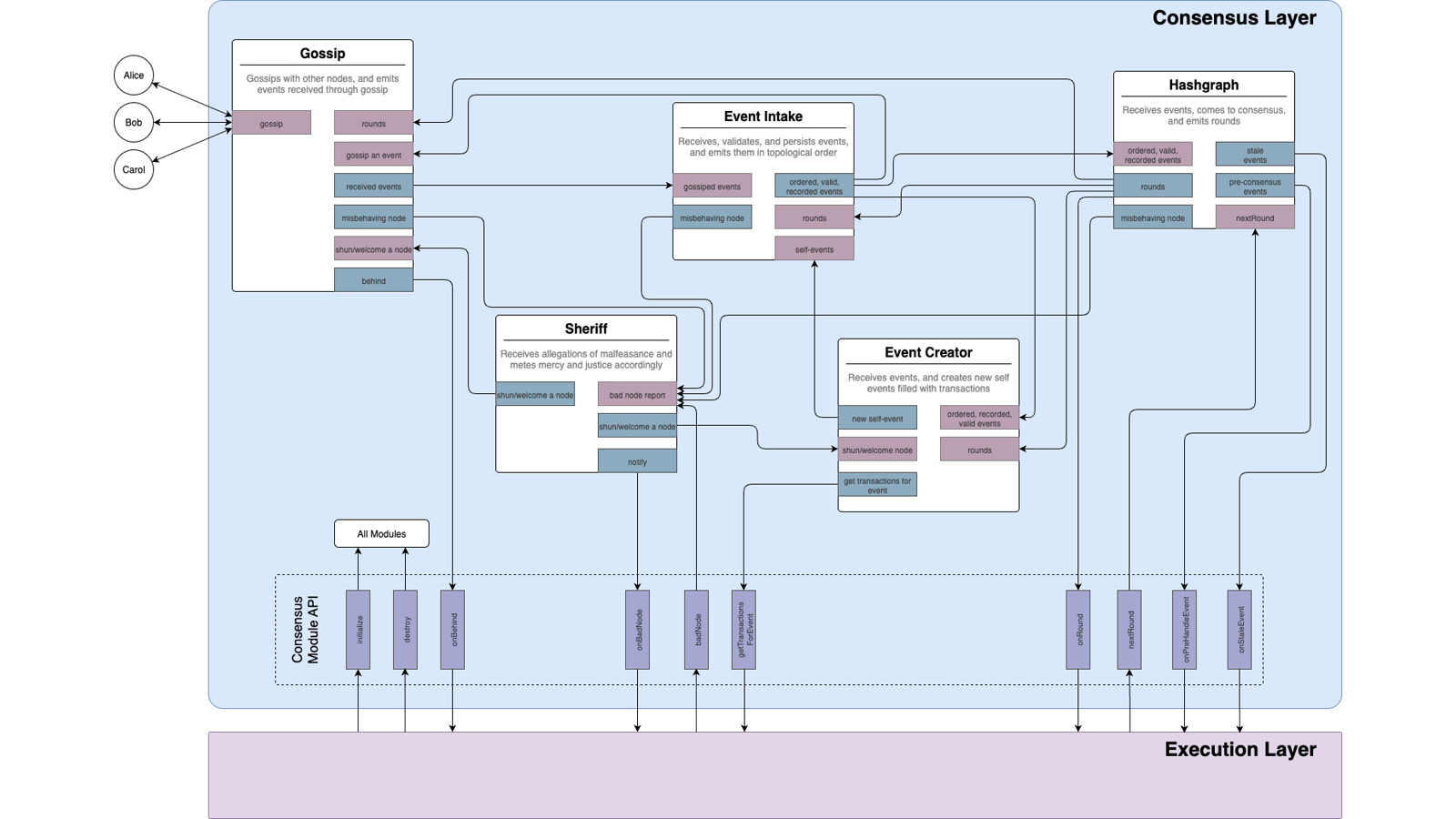
Hedera is best studied not as “another blockchain” but as a different way to order events in a distributed network. Consensus nodes do not build one linear chain of winning block producers. They build a hashgraph DAG: each event references the creator's previous event and the peer event received in the latest gossip exchange. Those parent hashes carry not only transactions but a cryptographic history of who had learned what from whom. From that history the algorithm derives virtual votes, rounds, famous witnesses, consensus order and timestamps without a separate network stream of ballots. Hedera describes the result as aBFT: once consensus order is reached, it does not remain probabilistic in the way longest-chain PoW confirmations do.
Hashgraph is a DAG of events rather than a chain of blocks
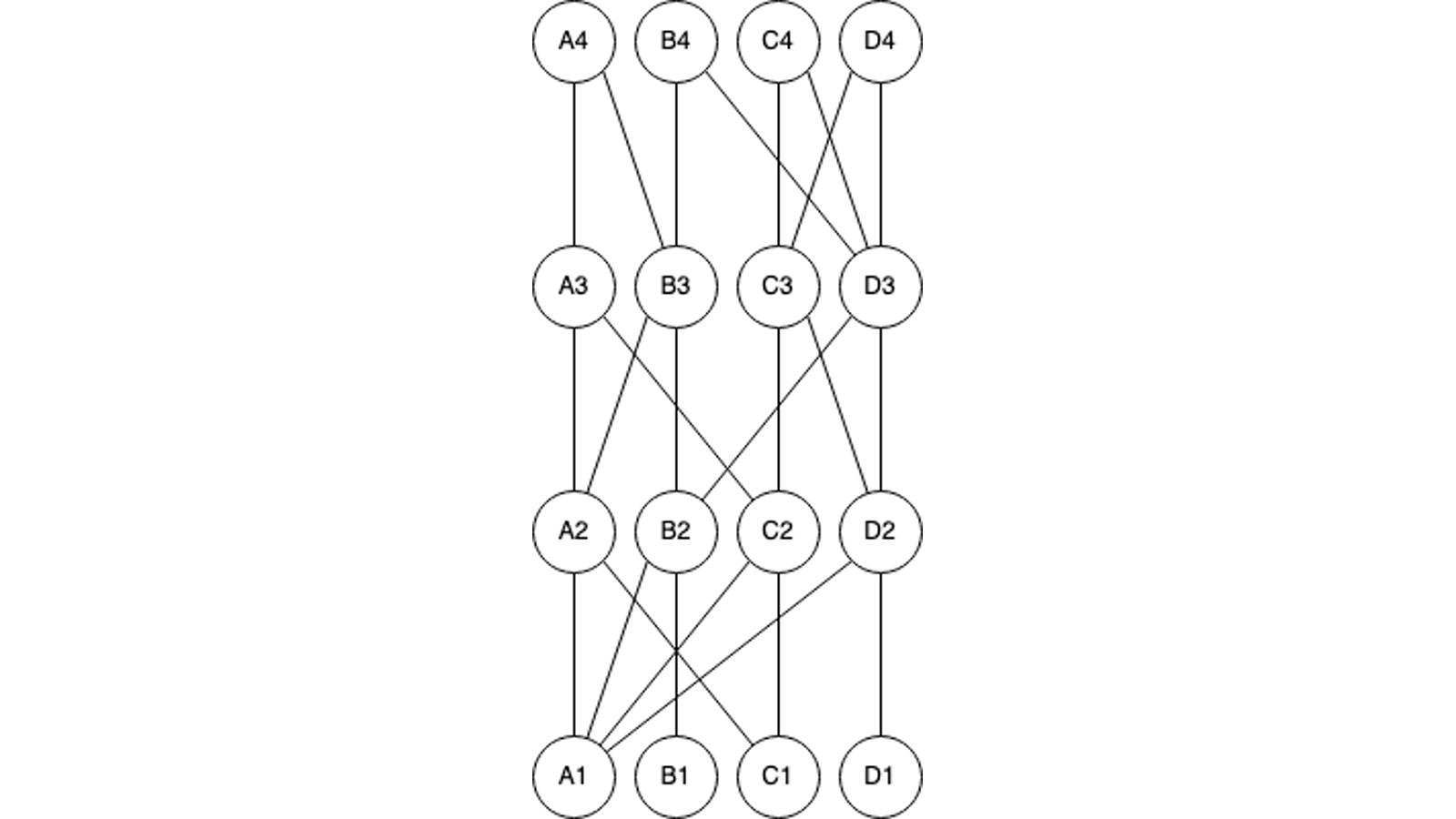
A blockchain is easy to picture as block N followed by block N+1. Hashgraph records history differently. Each consensus node creates **events**, and those events form a directed acyclic graph.
An event contains transactions and two parent hashes
One parent is the creator's previous event, the **self-parent**. The other is the latest event received from the gossip peer, the **other-parent**. Each new hash therefore commits to two branches of known history.
The DAG encodes partial order
If event B contains A among its ancestors, B was created after the information represented by A was known to its creator. Unrelated branches do not need an immediate absolute wall-clock order.
Consensus turns partial order into total order
Applications need one deterministic execution sequence. Virtual voting later assigns round received, consensus timestamp and tie-breaking order.
No blocks does not mean no batching
Nodes still receive groups of transactions, create events and propagate them. The difference is the consensus abstraction: the primary history object is an event DAG rather than a winning branch of blocks.
Gossip-about-gossip distributes both data and propagation history
A normal gossip protocol solves dissemination: choose a peer and exchange new information. Hashgraph adds another layer because the event structure also records the history of that gossip through parent relationships.
Random peer selection spreads transactions epidemically
A node synchronizes missing events with a selected peer. That recipient later gossips onward, allowing information to spread without a permanent leader.
Parent hashes prove a knowledge graph
If event X references Y as its other-parent, observers know X's creator had already learned Y. Transitive ancestry reveals which events a creator could have seen before creating X.
Gossip-about-gossip removes a separate coordination channel
Communication history itself becomes consensus input. Nodes do not later need to announce “I saw event E before round R” in a new vote message because the DAG already encodes the relevant knowledge relation.
Bandwidth is still a real resource
Hashgraph removes separate vote packets, not the need to propagate transactions and events. Throughput still depends on serialization, signatures, state execution, bandwidth and hardware.
Virtual voting reduces voting traffic, but it does not remove the fundamental requirement that consensus participants receive enough data to compute the same result independently.
Virtual voting computes ballots from the DAG rather than sending them
Once honest nodes possess the same gossip history, each can locally determine **how other nodes would have voted** if explicit ballots had been exchanged.
The first event by a node in a round is a witness
The algorithm divides the DAG into rounds. If an event can **strongly see** more than two-thirds of the current round's witnesses, it starts the next round and becomes a witness for its creator.
Strongly see requires visibility through enough independent members
A single ancestry path is not sufficient. Visibility must be supported through paths involving events across more than two-thirds of participating members, preventing one creator from fabricating broad knowledge by itself.
Fame selects representative witnesses
Witnesses in later rounds cast virtual yes/no votes on whether an earlier witness was broadly seen. Once a future witness strongly sees a supermajority of consistent votes, fame is decided.
No separate vote messages are needed
The same DAG gives honest nodes the same parent relationships and therefore the same result about what witnesses would vote. Consensus voting becomes deterministic local computation.
Coin rounds handle rare ambiguous cases
Asynchronous Byzantine agreement cannot depend only on timing assumptions. The virtual-voting family uses coin-round mechanics in exceptional rounds to guarantee eventual progress without assuming a synchronous timeout bound.
aBFT finality is not probabilistic longest-chain selection
Hedera describes the hashgraph consensus algorithm as **asynchronous Byzantine Fault Tolerant**.
Asynchronous means safety does not require a maximum network delay
The safety argument does not assume every message arrives within a fixed one-, two- or ten-second bound. An adversary may delay communication without causing honest nodes to finalize contradictory outcomes.
Byzantine means faulty nodes can behave arbitrarily
A malicious participant can equivocate, remain silent, manipulate timing or collude with other Byzantine participants. Consensus must preserve agreement below the tolerated fault threshold.
The supermajority threshold reflects the classic one-third BFT boundary
Virtual voting repeatedly relies on more-than-two-thirds visibility or voting. With less than one-third Byzantine voting weight, honest supermajorities retain the intersection needed to avoid conflicting final decisions.
Final consensus does not use a growing reorg-probability curve
Once an event receives consensus order, Hedera treats the result as final. There is no longest-chain rule where six more blocks merely lower the probability of reversal.
Deterministic finality does not mean execution remains instant under every network failure. Severe communication loss can reduce liveness. aBFT primarily means safety does not rely on a fixed message-delay assumption.
Consensus timestamps and order come from famous witnesses
After fame is decided, the algorithm can determine when an event was received by consensus and how it should be ordered relative to other events.
Round received is the first round whose famous witnesses all see the event
This turns partial DAG history into a network-wide milestone showing sufficiently broad dissemination.
Timestamp is based on a median of observed times
Hedera documentation describes collecting timestamps from the earliest relevant ancestors of famous witnesses and taking the median. One malicious clock cannot simply assign arbitrary time to the network's transaction order.
Ordering uses round received and then consensus timestamp
If timestamps collide, a deterministic tie-breaker such as signature order produces one total ordering shared by honest nodes.
A fair timestamp is a consensus value, not an atomic clock reading
The median limits outliers, but nodes still use their own system clocks. The timestamp is best interpreted as protocol-agreed ordering time rather than laboratory-grade latency measurement.
Transaction order matters for market-like applications
When conflicting actions arrive close together, a collectively derived timestamp/order reduces the ability of one permanent block leader to reorder them arbitrarily within its block.
HBAR staking gives consensus nodes economic weight without lock-up or slashing
Hedera uses HBAR stake in consensus-node weighting. Its user staking experience differs from many delegated-PoS networks.
An account can stake to a node without transferring custody
HBAR remains in the user's account. The staking relationship associates account balance with a selected node for stake/reward purposes.
The current staking program has no lock-up, bonding or slashing
Hedera documentation explicitly describes **no lock-up, bonding, or slashing**. Users retain the ability to use their HBAR and principal is not locked in a validator contract.
Reward rate is governed by network parameters
The Hedera Council's Coin Committee votes on the maximum reward rate. Actual rewards depend on network conditions and eligible stake, and the cap can change.
Reward collection is event-driven
Documentation lists triggers such as account-balance changes, changing the selected node and other account updates. Rewards do not need to arrive as a separate automatic daily transfer.
Liquid staking semantics reduce custody friction but not consensus risk
No user-principal slashing does not make network security costless. Consensus still depends on the distribution of stake and the behavior of node operators.
Hedera Council separates institutional governance from transaction access
Hedera governance is not a direct token-vote DAO model. Network policy and council membership live in the organizational structure of the Hedera Council.
The current Council page lists 34 organizations
At the time of this article, the Council describes itself as **34 industry-leading organizations across 13 industries worldwide**. This is an operational snapshot that can change over time.
Members have term limits
Council members may serve up to **two consecutive three-year terms**, limiting indefinite occupation of the same seat.
Council members have equal voting rights
The Council website emphasizes equal voting rights, so organizational governance power is not simply proportional to the amount of HBAR a member owns.
Meeting minutes are published
The Council regularly discusses network technology, pricing, security and other priorities, and documents governance decisions and related discussion through public meeting minutes.

Governance centralization and consensus safety are separate dimensions
A governance body can have significant policy authority while the underlying consensus algorithm has strong BFT properties. aBFT proofs do not automatically prove political decentralization of governance.
Mirror nodes separate historical data serving from consensus participation
Hedera uses different node roles. Consensus nodes participate in gossip, ordering and state transitions. Mirror nodes ingest network output streams and serve historical queries and APIs.
A mirror node does not vote in consensus
Indexing transactions does not turn it into a consensus participant. Read-heavy analytics can therefore scale separately from the critical ordering path.
Record streams provide post-consensus evidence
After consensus, services emit transaction records, receipts and related artifacts. Mirror infrastructure downloads and indexes those streams for explorers and applications.
Explorer time should be interpreted as consensus timestamp
It is useful to distinguish client submit time, node receipt time and the final protocol consensus timestamp. The latter determines canonical order.
Hedera transaction identity differs from Ethereum's simple tx-hash mental model
Hedera commonly identifies a transaction with payer account plus valid-start time, alongside signed-transaction hashes and records. Debugging should use Hedera-native fields rather than mechanically copying an EVM model.
Smart contracts are only one service layer
Hedera also exposes native token, consensus, file and account services. Hashgraph consensus orders operations across services, not just Solidity transactions.
Threat model: what hashgraph solves and what remains outside consensus
A strong consensus proof does not remove operational, governance and application risks.
Consensus-node concentration remains measurable
If voting weight is concentrated in a small number of operators, approaching a BFT threshold becomes organizationally easier. Real stake distribution and node diversity therefore matter.
Network partitions can reduce progress
aBFT safety tolerates asynchronous delay, but practical liveness still requires enough honest network participants to eventually exchange events.
Council compromise is different from a Byzantine consensus attack
A poor governance decision can change fees, policy or software direction through authorized processes without breaking cryptographic consensus.
Consensus faithfully executes application bugs
If a smart contract permits an exploit under its code, consensus nodes can agree perfectly on executing that valid transaction. aBFT does not infer a developer's business intent.
Mirror-node or API outage does not necessarily mean consensus stopped
An explorer can lag while consensus has already finalized the transaction. Incident response should distinguish consensus, record streams and query infrastructure.
| Layer | What it protects | What it does not solve |
|---|---|---|
| Gossip | Fast dissemination | Application-logic bugs |
| Virtual voting | Agreement/order without vote traffic | Governance policy |
| aBFT | Safety under Byzantine faults/asynchrony | Liveness under infinite partition |
| Staking | Economic consensus weighting | User custodian risk |
| Council | Organizational governance | Smart-contract correctness |
| Mirror nodes | History/query scaling | Consensus voting |
The main conclusion
Hedera builds consensus around a **knowledge graph** rather than winner-takes-all block production. Gossip spreads transactions while simultaneously creating a provable communication history. Parent hashes turn that history into a hashgraph DAG. Virtual voting locally derives rounds, witnesses and fame because nodes already know what information other participants possessed. The algorithm then assigns round received, a median-derived consensus timestamp and a deterministic total order.
HBAR contributes to economic weighting of consensus nodes while user staking stays liquid: the current program uses no lock-up, bonding or slashing of principal. Governance sits in a separate institutional layer, the Hedera Council, with rotating terms, equal member voting rights and published meeting minutes.
Hedera therefore should not be evaluated with TPS alone. Engineering analysis should ask: **how quickly gossip spreads events, how diverse consensus nodes and stake are, where the >2/3 threshold sits, how consensus timestamps are derived, who controls software and network policy, and which data explorers receive only after final consensus.**
FAQ
What is gossip-about-gossip?
A node sends transactions and events to a peer, while each new event also contains self-parent and other-parent hashes. Those links let the network reconstruct who already knew which information.
What does virtual voting mean?
Nodes do not exchange separate ballots. Given the same hashgraph DAG, each node locally computes how witnesses would vote during round and fame decisions.
What does strongly seeing two-thirds of witnesses mean?
An event needs ancestry visibility supported through events from more than two-thirds of participants. It is a stronger condition than having one direct ancestry path to the witness.
Does Hedera have probabilistic confirmations like Bitcoin?
Not in the same way. After hashgraph consensus assigns final order, the event does not need more blocks to gradually reduce reorganization probability.
Is HBAR locked during native staking?
The current Hedera staking program states that there is no lock-up or bonding, and principal is not subject to slashing under the program. The account retains custody and can use its HBAR.
Is the Council governed directly by HBAR-holder voting?
No. The Hedera Council is an organizational governance model with member organizations, equal voting rights and term limits, separate from stake-weighted network consensus.
This material is educational and does not constitute financial advice or a promise of staking returns.