Monero privacy is not produced by one magic feature. Different cryptographic primitives hide different links in the transaction graph. **Stealth addresses** prevent an observer from linking an on-chain output to the recipient's published address. **Ring signatures** make it ambiguous which historical output is actually being spent. A **key image** lets the network detect double-spends without revealing the real ring member. **RingCT** hides amounts using commitments and range proofs. View keys enable limited selective disclosure, while RandomX belongs to Proof-of-Work security rather than the privacy layer. Collapsing all of those functions into one word—“anonymity”—makes both Monero's strengths and its remaining leakage surfaces harder to understand.
Monero privacy is composed from several independent layers
A transparent UTXO explorer can normally answer three basic questions: **which output was spent, who received value, and how much moved**. Monero addresses those dimensions with separate mechanisms.
Sender ambiguity comes from ring signatures
An input does not point to one obvious spent output. It presents a ring of candidate members. Consensus verifies that the signer owns **one** member without revealing which one.
Recipient unlinkability comes from one-time output keys
A published Monero address is not written directly into every incoming output. The sender derives a fresh stealth destination for the individual payment.
Amount confidentiality comes from RingCT
Value is not published as a clear integer. Pedersen-style commitments preserve algebraic balance checks, while range proofs show that hidden values remain valid.

Privacy by default matters for the anonymity set
If confidential mode is used only by a rare minority, using it can itself become a signal. Monero applies privacy primitives by default to ordinary transfers so protected transactions are not a special transaction class.
Default privacy does not eliminate metadata
Connections to remote nodes, IP timing, exchange KYC records, operational reuse, unusual timing and user mistakes can still create links outside the cryptographic transaction layer.
Stealth addresses hide recipients with one-time destinations
A Monero user publishes a standard address derived from public spend and public view keys, but a sender does not transfer value directly to that static key.
The sender derives a unique one-time output key
Using the recipient's public keys and fresh transaction secret material, the sender derives a destination that looks like an unrelated public key. Two payments to the same public address produce different on-chain outputs.
The receiver scans the chain with a private view key
The wallet uses the private view key to identify outputs belonging to its account. An outside observer cannot simply filter the blockchain by the recipient's published address.
Spending authority remains separate
The private spend key authorizes spending. This allows monitoring and scanning capability to be separated from the ability to move funds.
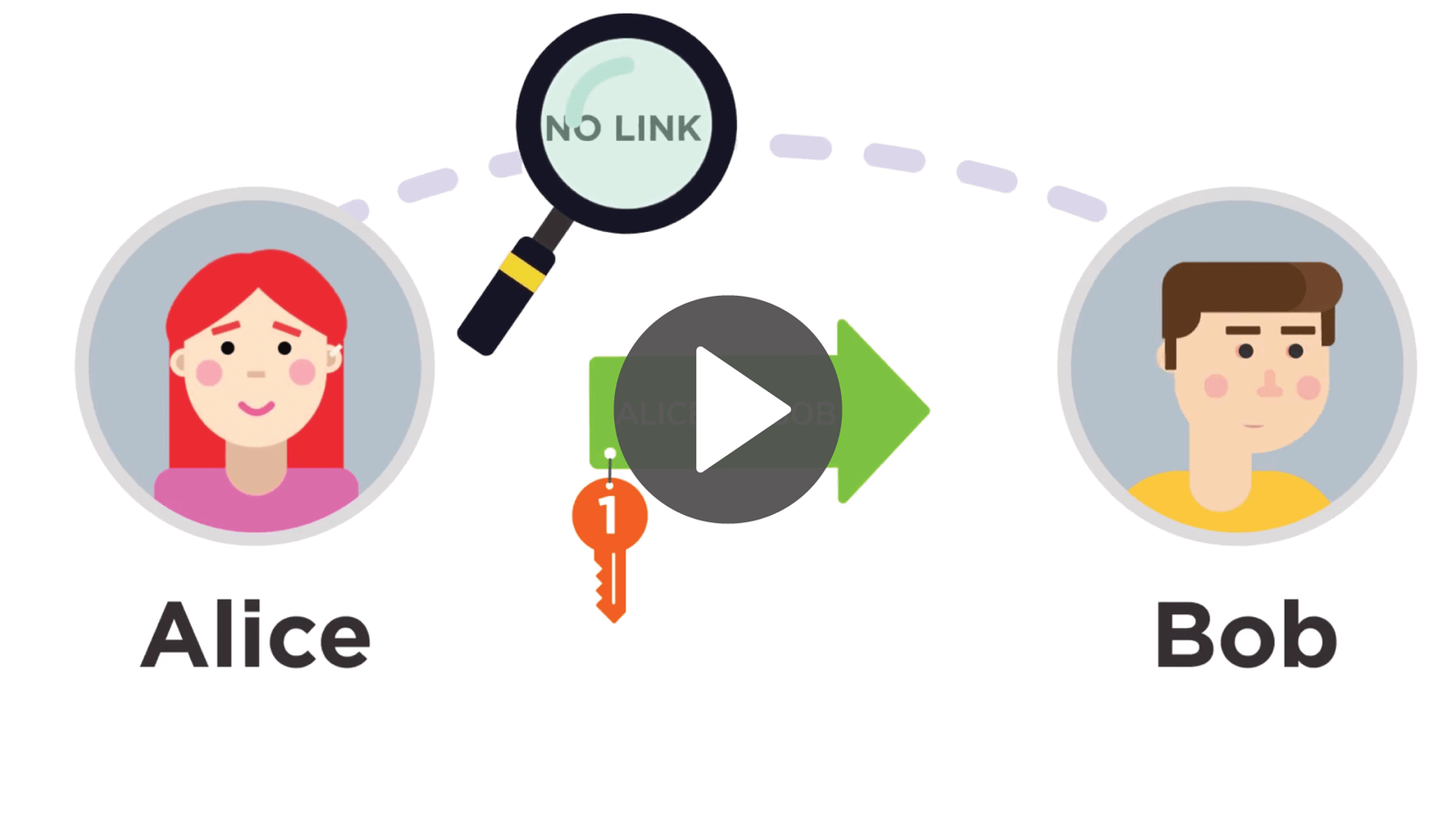
Repeated payments do not create an obvious public address cluster
On a transparent account chain, deposits to one address are trivially aggregated. Monero observers see one-time outputs without a public proof that they share one recipient.
Subaddresses improve operational separation
Wallets can create subaddresses for counterparties, invoices or identities, reducing the need to distribute one public address everywhere while preserving a common wallet hierarchy.
A subaddress is not an independent wallet-balance account
It is derived inside the same wallet key architecture. One owner can manage many subaddresses while retaining common view and spend capabilities.
Ring signatures and CLSAG hide which output is actually spent
When a Monero wallet spends an output, it does not expose that output as the sole source. It builds a ring containing the real member plus decoys sampled from historical outputs.
Current mainnet uses a fixed ring size of 16
Current Monero Core consensus after hard-fork version 15 enforces mixin 15: **15 decoys + 1 real input = ring size 16** for an ordinary RingCT spend. Older educational material can show smaller historical rings, so production code matters here.
CLSAG makes the linkable ring proof more compact than older constructions
The current transaction format uses CLSAG for signer ambiguity. A signer proves knowledge of one secret key in the ring without disclosing its index.
Every member is cryptographically plausible
An observer sees candidate outputs and a signature that verifies for the ring as a whole. There is no field containing the real-input index.
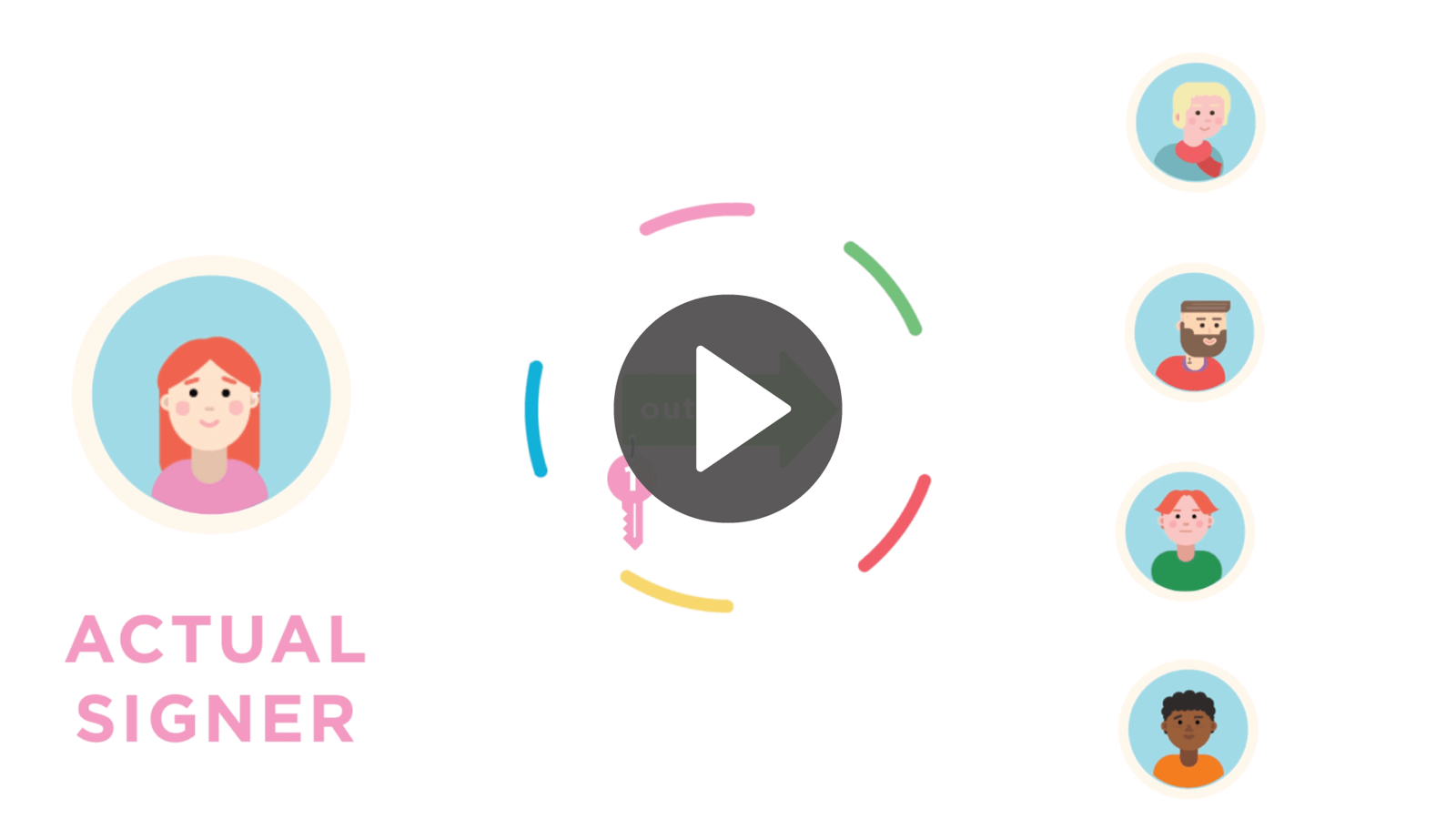
Decoy selection affects practical anonymity
If decoys have an obviously different age distribution from real spends, statistical analysis can assign unequal probabilities to ring members. Wallet sampling policy is therefore part of privacy engineering rather than a cosmetic setting.
Ring signatures alone do not solve double-spending
If the same real output could be used in two different rings without detection, ambiguity would break basic monetary integrity. The key image solves that exact problem.
Future privacy research should not be described as current mainnet
Monero Research Lab studies larger anonymity-set constructions including full-chain membership approaches. As of the current 2026 Monero Core v0.18.5.x production network, however, consensus still validates CLSAG ring-based spends and Bulletproof+ RingCT. A research roadmap is not the same as an activated hard fork.
Key images provide double-spend linkability without exposing the real input
A key image is a deterministic cryptographic value tied to the real spend key and output in a way that produces the same marker when the same coin is spent again.
Nodes enforce key-image uniqueness
If a transaction presents a key image already used by a confirmed spend, the new transaction is rejected. Monero therefore preserves the basic UTXO rule that one coin cannot be spent twice.
The marker does not point back to a specific ring member
Key images are linkable across duplicate spend attempts while remaining unlinkable to a particular public output in the ring.
Ring members can reappear as decoys
A historical output used as a decoy can appear in later rings. Public presence in a ring does not prove the output is actually spent or unspent in the transparent-Bitcoin sense.
An explorer cannot build the same spent/unspent graph as Bitcoin
Transparent UTXO explorers can mark an outpoint spent after one explicit input reference. A Monero observer knows that a key image has been spent but cannot identify the corresponding real candidate output.
A key image solves a narrow problem: **linking repeated spending attempts without deanonymizing the source output**. It is not a recipient address, amount commitment or network identity.
RingCT hides amounts while preserving conservation of value
Ring Confidential Transactions combine sender ambiguity with confidential amounts.
Pedersen commitments hide value
Instead of a public number, an output contains a commitment. Algebraic properties allow the network to verify that input value, output value and fees balance without learning every amount.
Range proofs show hidden values are valid
Without a range proof, a malicious sender could encode an invalid negative or overflow value inside a commitment and break monetary integrity. The proof constrains the hidden amount to an allowed range.
Current Monero uses Bulletproof+
Bulletproof+ reduces range-proof size and verification cost relative to earlier constructions. Current hard-fork version 15 includes Bulletproof+ as the standard modern RingCT path.
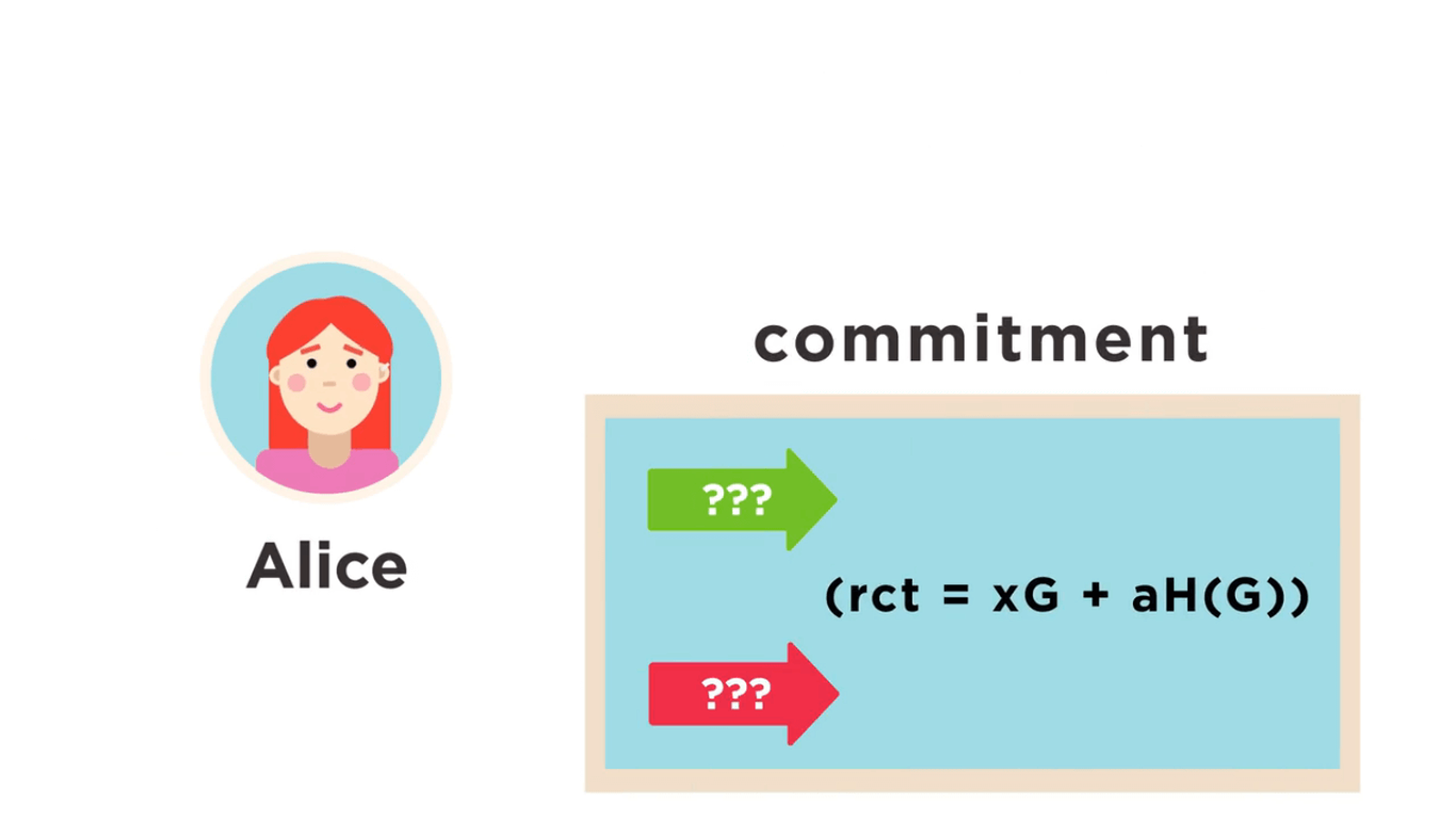
The fee remains protocol-visible
Miners and nodes need to verify fee and reward accounting. A privacy system does not need to hide every numerical field in order to protect transferred amounts.
Supply auditing becomes cryptographic rather than visual output summation
On a transparent chain an observer can add visible UTXOs. In a confidential system, integrity depends on valid commitments, range proofs, coinbase rules and consensus verification.
A confidential amount does not make the transaction disappear
Observers still see transaction objects, input and output counts, ring members, key images, fee-related fields, block inclusion and timing. Privacy removes semantic information rather than removing the ledger event itself.
View keys provide selective disclosure without making Monero a transparent account chain
A Monero wallet separates the private spend key from the private view key.
The private view key finds incoming outputs
A watch-only wallet can scan the blockchain and detect outputs addressed to its account or subaddresses without possessing spending authority.
View keys are useful for accounting and auditing
An organization can give an auditor incoming-payment visibility without transferring the private spend key. Privacy is therefore **selectively revealable** by the owner.
Outgoing history is more complicated than one view-key operation
Older Moneropedia documentation explicitly warns that a view-only state is not always sufficient for complete outgoing-spend tracking. Wallet accounting may require key images or additional exported spend metadata.
Transaction proofs offer narrower disclosure
For a specific payment, wallet proof mechanisms can demonstrate facts without handing over broad account scanning capability.
Selective disclosure is different from public transparency
On a transparent chain every observer receives roughly the same ledger visibility. In Monero, the owner chooses who receives view or proof material and what scope to expose.
A Monero explorer shows structure but cannot reconstruct an ordinary payment graph
An XMR block explorer appears less informative than a Bitcoin or Ethereum explorer because consensus intentionally does not reveal some data.
Height, block hash, time, fees and transaction identifiers remain visible
Users can verify inclusion, confirmation depth and structural block information.
Rings and key images are visible, but the real source is not
An explorer can list candidate outputs while honestly remaining unable to identify one as the actual spent member from public consensus data alone.
Output amounts are hidden by RingCT
Without wallet-specific keys, an observer does not learn the transferred XMR value of ordinary confidential outputs.
Static recipient addresses are absent from outputs
The on-chain destination is a one-time key rather than the user's published standard address or subaddress.
Public-address balances cannot be queried in the normal transparent way
If a business posts a Monero address publicly, an external analyst cannot paste it into an explorer and retrieve all deposits, withdrawals and current balance.
| Explorer question | Transparent Bitcoin-like UTXO | Monero |
|---|---|---|
| Which output was really spent? | Usually explicit | Hidden by ring ambiguity |
| Who owns the output? | Address/script often public | One-time stealth key |
| Output amount | Public | Hidden by RingCT |
| Double-spend marker | Outpoint reference | Key image |
| Public-address balance | Often computable | Not computable without view data |
Chain analysis is still not zero
Timing, ring composition, transaction shape, known exchange endpoints and external metadata can create probabilistic clues. A privacy system should be evaluated against statistical attacks, not only field visibility.
RandomX secures Proof of Work and is not a privacy primitive
Monero consensus uses RandomX Proof of Work. Its task is chain security and work selection, not hiding transactions.
RandomX is optimized around general-purpose CPUs
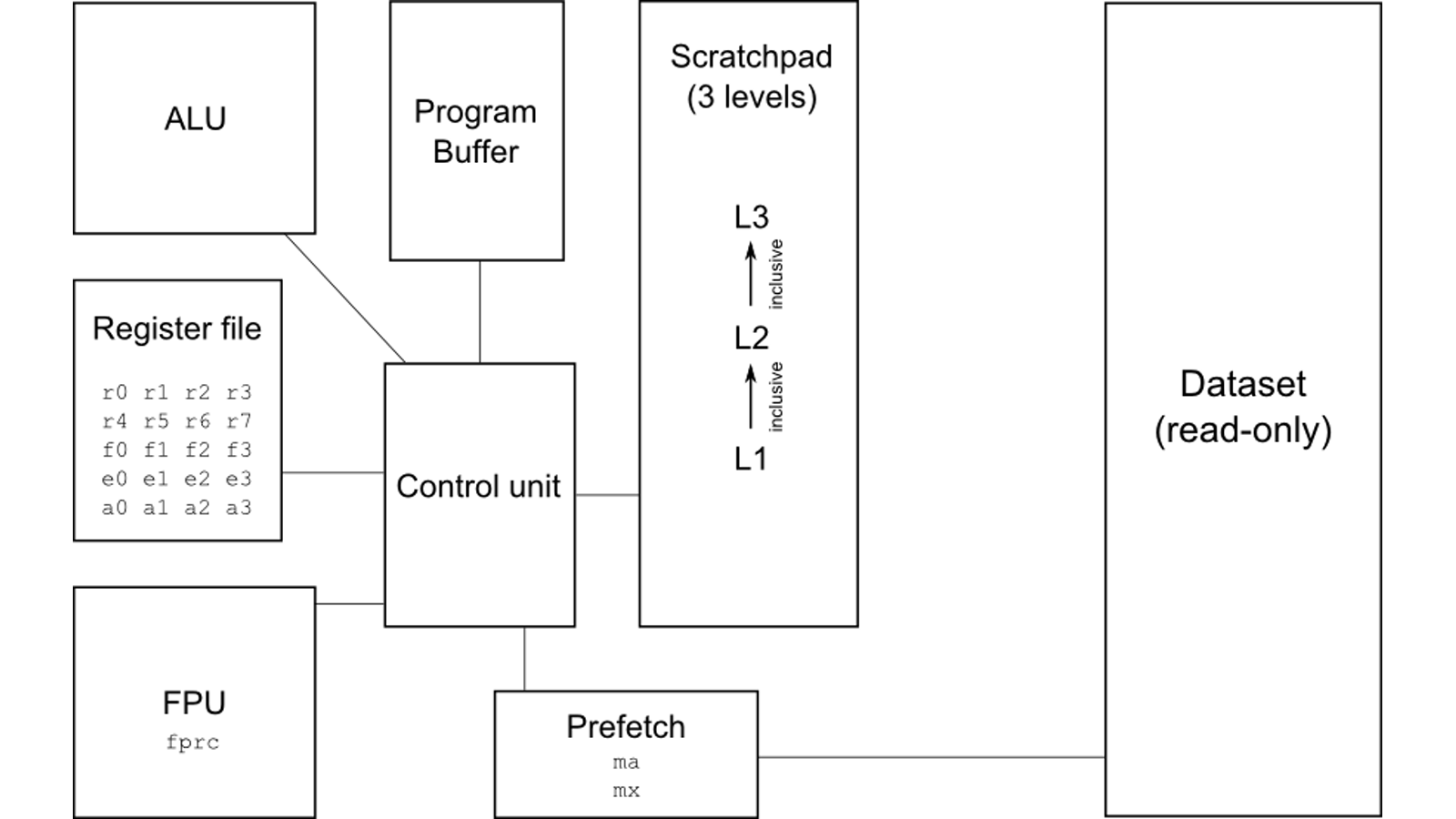
The algorithm executes pseudorandom programs in a virtual machine, combines integer and floating-point operations, AES-like functions and memory-heavy dataset access, making extreme specialized-hardware advantages harder to achieve.
Fast mode uses a dataset slightly above 2 GiB
The official RandomX specification defines a 2,147,483,648-byte base dataset plus roughly 33.5 MB of extra space. Cache and dataset construction use Argon2d and SuperscalarHash mechanics.
The VM uses a 2-MiB L3 scratchpad
The specification defines 2,097,152 bytes for L3, with nested 256-KiB L2 and 16-KiB L1 regions.
“ASIC-resistant” is better understood as an engineering objective
Any profitable Proof of Work can motivate custom hardware. RandomX aims to reduce the advantage of specialized silicon by exploiting features common in commodity CPUs.
Monero targets 120-second blocks
Current Core consensus uses DIFFICULTY_TARGET_V2 = **120 seconds**. It is a long-run target rather than a guarantee for any single next block.
Tail emission maintains a permanent subsidy floor
The reward formula defines a final subsidy of 0.3 XMR per minute. At a two-minute target this corresponds to **0.6 XMR per block** before block-weight penalty effects, so the security budget does not depend entirely on fees after subsidy reaches zero.
Mining decentralization and privacy decentralization are only indirectly related
Distributed hashpower helps resist censorship and reorganization, but it does not strengthen the ring's cryptographic anonymity. Strong RingCT likewise does not prevent a majority-hashrate consensus attack.
Threat model: privacy can weaken outside the cryptography
Monero hides far more transaction semantics than transparent chains, but operational privacy remains an end-to-end problem.
A remote node can observe wallet network behavior
A wallet using somebody else's daemon exposes some timing and query metadata to that operator. Recent Monero Core releases specifically include hardening against malicious remote nodes and spy-node behavior.
An exchange turns a private chain into an identified endpoint
A KYC exchange knows the user's identity and exact deposit or withdrawal actions inside its own systems. The chain can obscure subsequent graph relationships while endpoint metadata remains powerful.
Timing correlation does not require breaking a ring signature
An observer that sees network submission and a near-simultaneous exchange event can form probabilistic hypotheses without cryptographic deanonymization.
Decoy analysis is statistical
Ring-member history, age distributions and known-spend heuristics can change posterior probabilities among candidates. Decoy-selection algorithms therefore remain an active Monero research topic.
Fungibility is an economic consequence of default privacy
When observers cannot reliably label a specific output by its transaction history, discriminatory treatment of “tainted coins” becomes substantially harder than on fully transparent UTXO ledgers.
User disclosure can override ledger privacy
Sharing keys, screenshots, proofs, exchange records or invoice mappings can voluntarily reveal connections the blockchain itself hides. Cryptography cannot undo disclosure by the user.
The main conclusion
Monero privacy is a **composition of mechanisms with distinct responsibilities**. Stealth addresses hide recipient linkage by creating one-time outputs. CLSAG ring signatures mix the real spend with 15 decoys in the current fixed ring size of 16. Key images make duplicate spending detectable without exposing the real member. RingCT and Bulletproof+ hide amounts while preserving supply verification. A private view key lets an owner selectively expose incoming history without handing over spending authority.
RandomX sits on a different layer: it is CPU-oriented Proof of Work with a two-minute target block interval and a tail-emission floor of 0.6 XMR per target block. It protects consensus but does not create transaction anonymity.
The useful way to evaluate XMR is therefore not one question—“is it anonymous?”—but several: **can an output be linked to the recipient address, can the real input be selected from the ring, is the amount public, which keys allow selective audit, what metadata remains at remote nodes or exchanges, and how resilient is the mining layer?**
What to remember about current mainnet
As of the current Monero Core v0.18.5.x production network in 2026, Monero uses CLSAG ring-based spends, fixed ring size 16 and Bulletproof+ RingCT. Larger anonymity-set constructions remain research and development directions and should not be described as already activated mainnet consensus.
FAQ
How many members are in a current Monero ring signature?
For a normal current RingCT spend, consensus requires 15 decoys plus one real member, producing ring size 16.
Can an explorer see exactly where an XMR input came from?
It sees candidate ring members and a key image, but public data does not identify the real member. Analysis can assign probabilities, not recover a transparent Bitcoin-style spent-outpoint mapping directly.
What does a stealth address hide?
It hides the link between a published recipient address and a specific on-chain output. Each payment derives a unique one-time destination key.
What does RingCT hide?
Transferred amounts. Commitments allow balance verification and Bulletproof+ range proofs show hidden values are valid without publishing the amounts themselves.
What does a private view key provide?
It lets a wallet scan incoming outputs and supports limited monitoring or auditing without the right to spend funds. Complete outgoing accounting can require additional wallet metadata.
Does RandomX make transactions private?
No. RandomX is the Proof-of-Work algorithm. Transaction privacy comes from stealth addresses, ring signatures, key images and RingCT.
Why does Monero have tail emission?
The current reward formula does not fall to zero. Its final subsidy corresponds to 0.6 XMR per two-minute target block, maintaining a permanent baseline miner incentive alongside fees.
This material is educational and does not constitute financial advice.