USDT looks like an ordinary token balance, but its economics live in two systems at once. On-chain contracts know balances, transfers, minting, burning and administrative restrictions. Off-chain, the issuer manages reserves, onboards verified customers, receives eligible funds, issues USD₮ and processes redemptions. Serious USDT analysis therefore has to look at the blockchain, Tether Treasury and the issuer balance-sheet layer together. A mint transaction or market-cap number on its own captures only part of the system.
USDT is an issuer-backed token using blockchains as transport and settlement layers
USD₮ is not an algorithmic stablecoin trying to maintain a dollar price through market incentives alone. Tether describes each issued token as pegged one-to-one to the relevant fiat currency and backed by issuer Reserves.
That gives “one USDT” two different meanings. On-chain it is one unit in a specific token contract or token program. In the issuer model it represents an obligation that eligible verified customers can redeem under Tether Terms and operational procedures.
A market peg and direct redemption are not the same thing
USDT trades on secondary markets where price can temporarily move above or below one dollar because of liquidity, demand, market stress and venue fragmentation. Direct redemption is a primary-market relationship with the issuer, governed by eligibility, KYC and Terms; it is not an automatic bank withdrawal available to every anonymous wallet holder.
Several layers support the price relationship
- issuer reserves and solvency;
- issuance and redemption by eligible customers;
- arbitrage between primary and secondary markets;
- deep exchange liquidity;
- availability across multiple chains;
- confidence in operational and compliance controls.
A blockchain cannot inspect an issuer's bank asset by itself
Ethereum or Tron can prove how many tokens sit at addresses and whether a contract transfer executed. They cannot independently inspect a bank deposit, Treasury bill or other off-chain reserve asset. That requires a separate reporting, assurance and audit layer.
A mint is not always an issuance: the four-stage USD₮ lifecycle
Tether officially separates the token lifecycle into **Authorized, Issued, Redeemed and Destroyed** states. This is one of the most important concepts for reading on-chain alerts correctly.
Authorized tokens already exist on-chain but remain in Tether Treasury and have not entered circulation. Issued tokens have left Treasury and been delivered to a customer. Redeemed tokens return to Tether during redemption. Destroyed tokens are removed from authorized supply.
Authorized but not issued means inventory, not circulating market cap
Tether's FAQ explains that new tokens can be created through multi-signature authorization keys and initially sit in Treasury as authorized-but-not-issued inventory. They are not treated as circulating supply and should not be added mechanically to market capitalization.
This inventory approach reduces how often the most sensitive authorization keys need to be accessed. A batch can be prepared in advance and actual issuance can occur after new customer funds arrive.
Issuance begins when tokens leave Treasury
The economically important transition is not merely a contract mint. It is the transfer out of Treasury into circulation. Under Tether's model, issued tokens are the ones that require Reserve backing.
Redeemed tokens do not have to be burned immediately
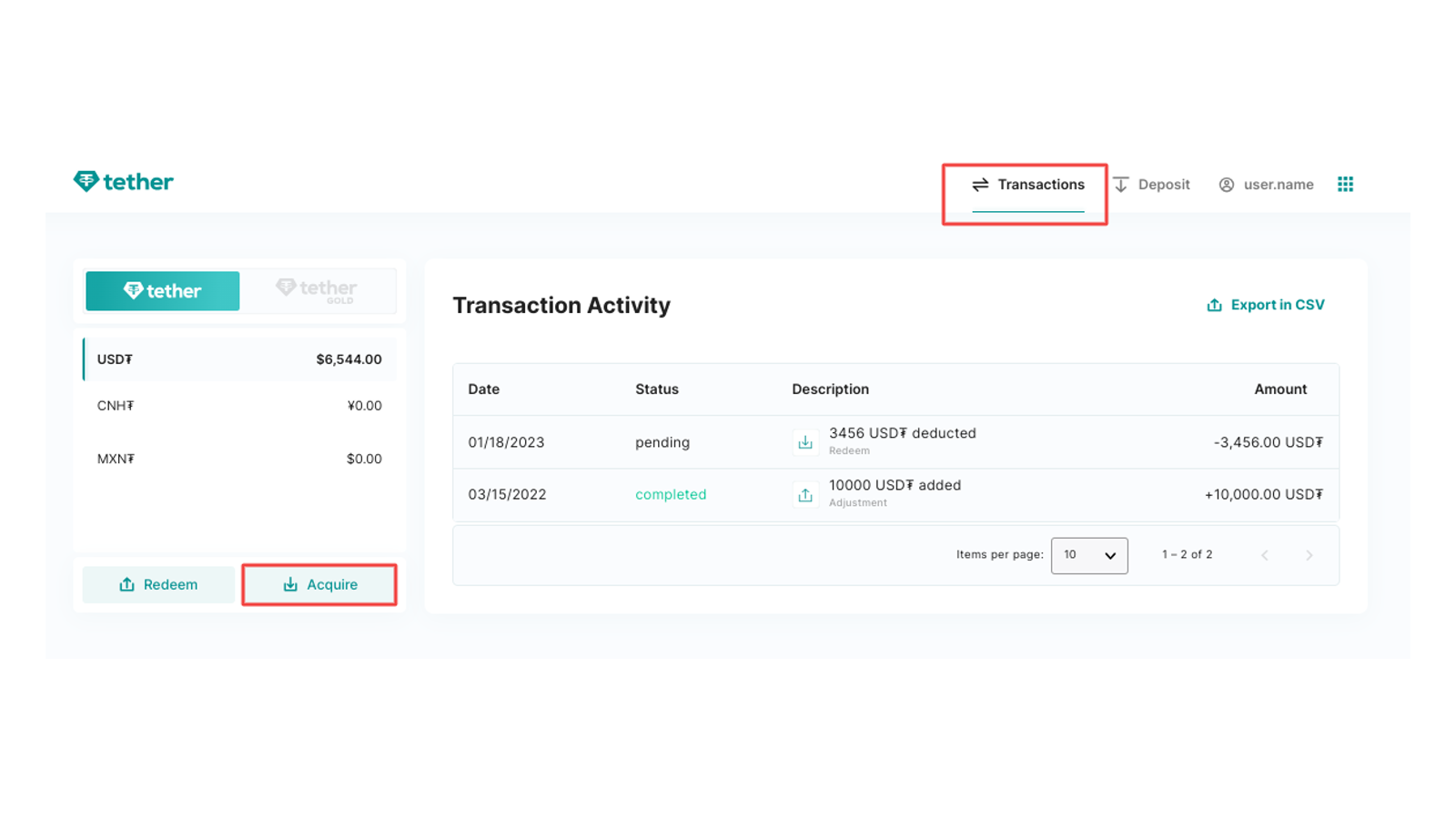
When a customer returns USD₮ to the issuer for redemption, the tokens can remain in Treasury outside circulation and later be reissued after new backing arrives, or they can be destroyed.
On-chain alerts are easy to misread without Treasury context
A large mint can represent inventory replenishment, a chain swap or preparation of authorized stock. A large Treasury transfer outward can represent actual issuance. A burn can finalize a redemption or housekeeping after a chain swap. One event does not define the full lifecycle.
Treasury and chain swaps distribute supply across several networks
USDT exists on multiple transport protocols. There is no single global smart contract simultaneously native to Ethereum, Tron, TON, Solana and Aptos. Each supported network has its own token representation and execution model.
As demand shifts across ecosystems, Tether can perform a chain swap: reduce available supply on one chain and increase it on another while keeping aggregate economic issuance neutral.
A chain swap does not have to change total USD₮ supply
Imagine an exchange needs to move $500 million of USD₮ liquidity from chain A to chain B. Tether can receive tokens into Treasury on A and release an equivalent amount on B. If B lacks enough authorized inventory, an additional authorized batch can be created first.
An observer watching only chain B might see a $500 million mint and conclude aggregate USDT supply increased by that amount. If it is paired with supply removal on chain A, total issuance did not change.
A Treasury wallet is an operational boundary
“Treasury” should not be assumed to mean one eternal address across all networks. Chain analysis should use current official addresses and labels for the exact protocol. Explorer labels help but do not replace issuer documentation.
Blockchain support can be discontinued
The current Supported Protocols page explicitly warns that Tether no longer issues or is obligated to redeem tokens on several legacy networks, including Kusama, Bitcoin Cash SLP, Omni Layer, EOS and Algorand. Historical contracts can still exist on-chain while issuer support has changed.
A multi-chain stablecoin is not “one token everywhere.” It is several transport implementations tied together by issuer accounting and redemption policy.
Reserves: compare the actual portfolio with circulating liabilities
Tether defines a fully reserved condition as Reserve value being at least sufficient to redeem issued tokens. Those reserves do not have to consist entirely of physical dollars sitting in one bank account.
Official materials describe categories including cash and cash equivalents, short-term instruments and other assets; depending on the reporting period, disclosures have also included Treasury bills, secured loans, bitcoin, precious metals and additional positions.
Reserve composition matters more than the sentence “assets exceed liabilities”
Two portfolios with the same nominal value can have very different liquidity and market risk. A bank deposit, short-term U.S. Treasury bill, long-duration security, secured loan and bitcoin behave very differently under stress.
The useful question is not only whether assets cover liabilities at a reporting snapshot, but how quickly those assets could meet a large redemption wave without material loss.
A quarterly reserve report is not the same as a full financial-statement audit
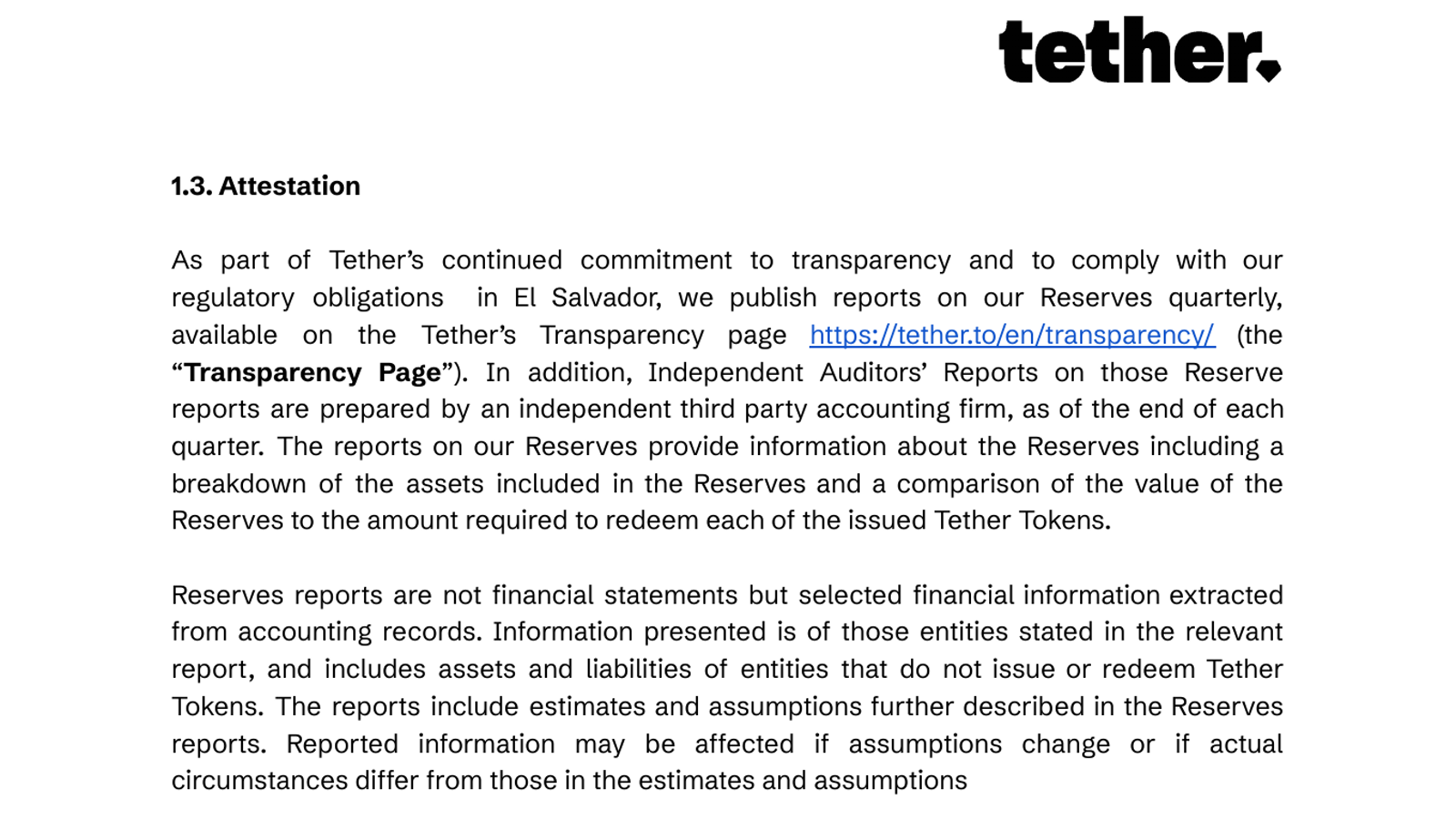
Tether's 2026 Relevant Information Document explicitly says quarterly Reserve reports contain selected financial information and are not financial statements. Independent auditor reports are prepared around those quarter-end Reserve reports.
Separately, in August 2026 Tether announced that KPMG U.S. completed a full audit of Tether International's 2025 financial statements with an unqualified opinion. These are related but distinct assurance products: reserve snapshots and full-year audited financial statements answer different questions.
A point-in-time snapshot ages quickly
Even a well-prepared quarter-end report describes one date. Circulation, reserve composition, rates and market prices can change between reporting dates. Evergreen analysis should focus on methodology and retrieve current numbers from the latest disclosure when needed.
Excess reserves are a balance-sheet buffer, not an on-chain collateral vault
When assets exceed liabilities, the difference creates an equity or excess-reserve cushion that can absorb some valuation changes. It remains an off-chain balance-sheet concept rather than a smart-contract collateral pool directly visible to Ethereum users.
ERC-20 and TRC-20 USDT share a unit of account but use different transaction paths
Users often say “send USDT” without naming a network. Wallet software cannot afford that ambiguity. ERC-20 USDT on Ethereum and TRC-20 USDT on Tron are different implementations with different addresses, resource models, finality and explorers.
The Ethereum ERC-20 path
An Ethereum sender signs an EVM transaction calling transfer on the official USD₮ contract. Gas is paid in ETH. Tether's Supported Protocols page specifically warns that the current Ethereum USD₮ contract is based on an older ERC-20 implementation whose transfer function does not return a Boolean in the way some modern integrations expect. Contract integrations should use defensive wrappers such as SafeERC20.
The Tron TRC-20 path
On Tron the sender calls a TRC-20 token contract. Transaction cost follows Tron's Bandwidth and Energy resource model with TRX burn or staking mechanics. Sending the same nominal 1,000 USDT can therefore have completely different network-fee economics from Ethereum.
Matching tickers are not enough for routing
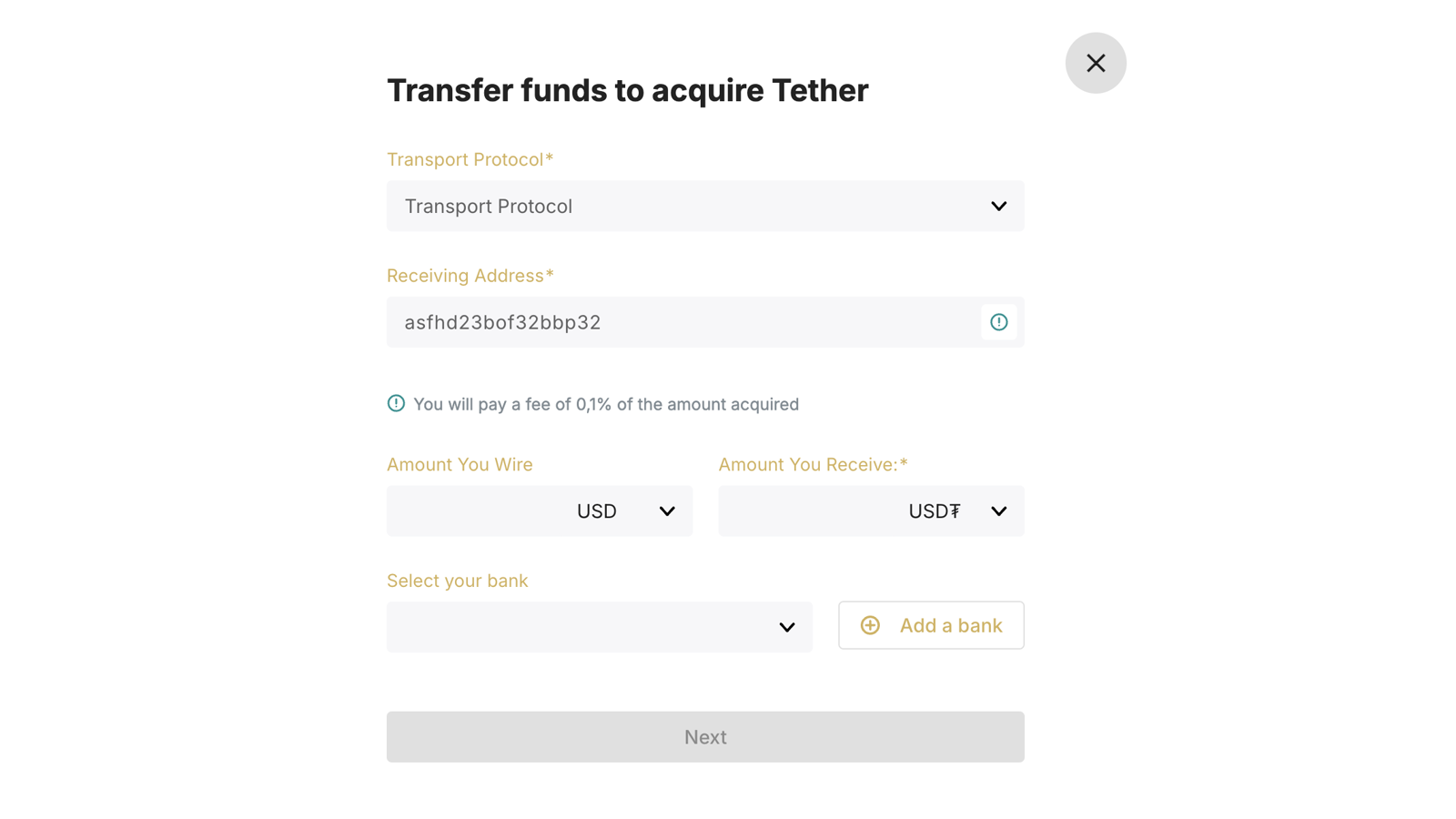
An exchange deposit screen can expose USDT-ERC20 and USDT-TRC20 as separate routes. Sending the wrong network into an unsupported deposit path is a common cause of loss or costly manual recovery.
Finality comes from the underlying chain
USDT has no universal block time. Ethereum finality, Tron confirmation policies, TON execution and Solana finality differ. Exchanges can add their own confirmation requirements before crediting a balance.
Freeze and blacklist authority is part of the asset's technical model
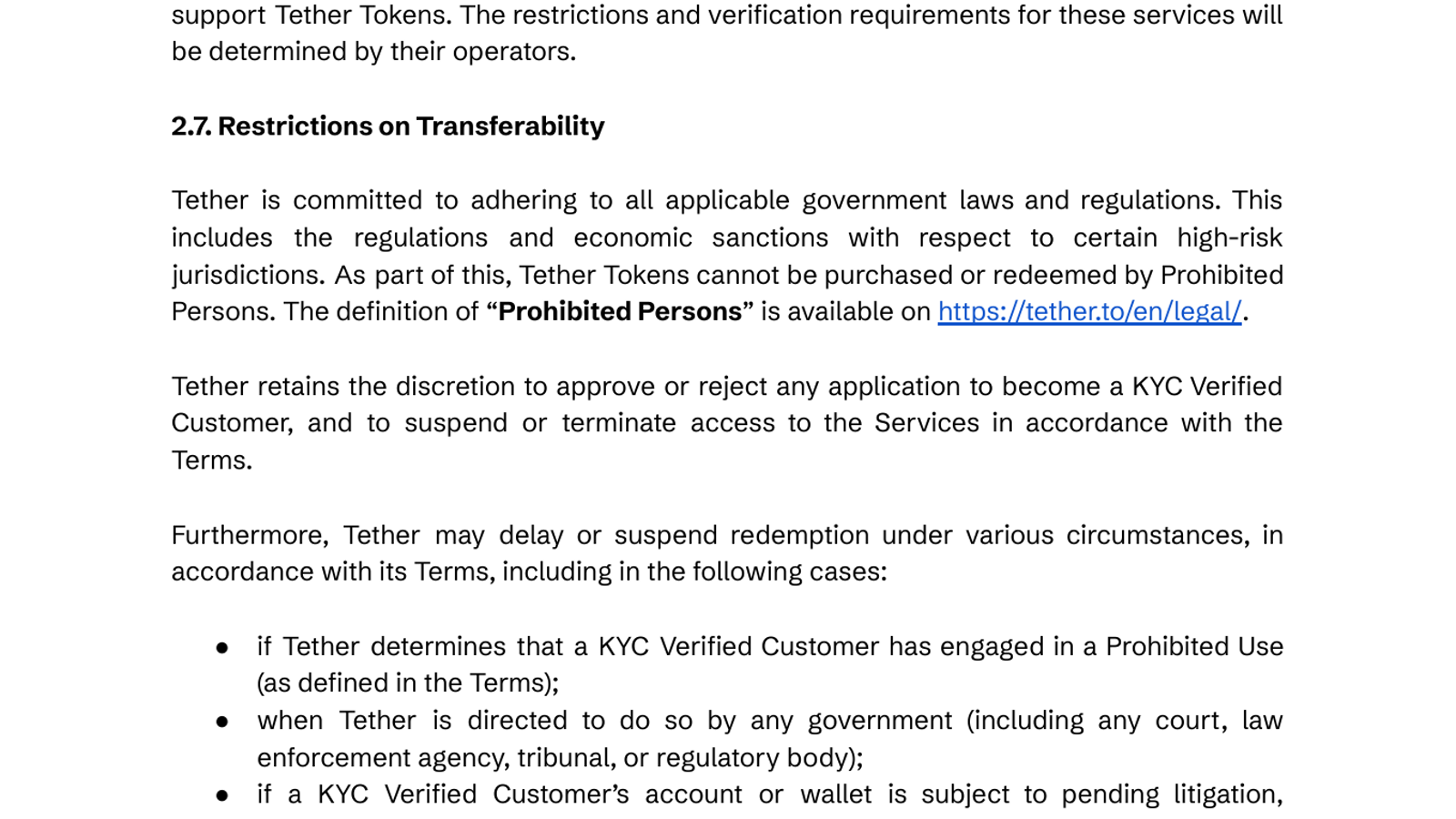
USDT is not a permissionless bearer asset in exactly the same sense as native BTC. Tether Terms and public compliance policies provide for freezing or blacklisting addresses under specified circumstances, including sanctions and law-enforcement actions.
In 2023 Tether announced a voluntary wallet-freezing policy covering addresses associated with the OFAC SDN list. Its 2026 Relevant Information Document also describes circumstances in which Tether can attempt to freeze tokens held at external wallets.
A freeze does not rewrite blockchain history
The issuer does not erase an old block. Administrative capabilities in a token implementation change whether an address can move specific Tether tokens in the future or apply another contract control. Prior transactions remain in chain history.
Self-custody does not remove issuer authority over the token contract
Owning a wallet private key and controlling every rule of the asset are different things. A private key authorizes wallet transactions; the token contract can still contain issuer-admin mechanisms.
This is both a compliance feature and a counterparty risk
A regulated venue can view the ability to freeze stolen funds as beneficial. A holder should also recognize it as a centralized policy boundary. A technically accurate analysis should acknowledge both properties.
The same business policy can have different implementations across chains
Administrative controls depend on each transport's token implementation. An Ethereum function name should not be assumed to exist identically on Tron, TON or Solana even when the issuer policy is the same.
Explorer verification: distinguishing mint, issuance, redemption, chain swap and ordinary transfers
A large USDT transfer looks dramatic only without context. A useful on-chain investigation classifies participants and flow direction.
Treasury to exchange or customer
If a known Treasury address sends tokens to a verified exchange wallet, the movement can be consistent with issuance or liquidity distribution. Without off-chain customer information, however, an analyst still cannot know the final beneficial owner or exact commercial purpose.
Exchange or customer back to Treasury
This can indicate redemption, chain-swap inventory rebalancing or another operational flow. A later burn strengthens a supply-reduction interpretation, while paired issuance on another chain can instead indicate a neutral chain swap.
Chain swaps require looking at both explorers
For an ERC20-to-TRC20 rebalance, inspect both Ethereum and Tron around the same operational window. Watching one side in isolation systematically creates false conclusions.
| Observation | Possible interpretation | What to check next |
|---|---|---|
| Contract mint into Treasury | Authorized inventory | Did the tokens leave Treasury? |
| Treasury → customer/exchange | Issuance | Aggregate circulation and context |
| Customer/exchange → Treasury | Redemption or rebalance | Burn and paired chain activity |
| Treasury burn | Destroyed supply | Redemption or chain swap? |
| Mint on chain B + Treasury inflow on chain A | Chain swap | Compare amounts and timing |
| Blacklist/freeze event | Compliance/admin action | Official policy and address status |
Explorer labels are clues, not proof of beneficial ownership
An address can be correctly labeled as an exchange treasury while the exchange's omnibus internal ledger hides the actual owner. Blockchain data shows custody movement, not necessarily an economic ownership transfer.
The USDT risk matrix: stable price does not mean zero risk
A stablecoin removes much of the directional volatility against USD and replaces it with a different set of risks.
- **Issuer/solvency risk:** value and liquidity of Reserves.
- **Redemption risk:** operational, legal and KYC access to the primary market.
- **Liquidity/depeg risk:** secondary-market price can move away from $1.
- **Chain risk:** congestion, reorgs or protocol failures in the underlying network.
- **Smart-contract risk:** bugs or compromise of administrative authority.
- **Compliance risk:** freezing, blacklisting and sanctions controls.
- **Custody risk:** exchange or wallet operators create separate failure points.
- **Bridge/wrapped risk:** third-party representations add another collateral or messaging layer.
Native issuer tokens and wrapped USDT have different risk stacks
If a DeFi bridge creates its own wrapped USDT on a network Tether does not directly support, the user additionally trusts the bridge. The ticker and logo can look familiar while the redemption path is fundamentally different.
A depeg should be diagnosed by cause
A price of 0.995 can arise from local exchange liquidity, banking-hour friction, broad market panic or changed estimates of issuer risk. The same price deviation does not identify one mechanism automatically.
USDT stability is produced by an issuer balance sheet, redemption arbitrage, exchange liquidity and multiple blockchain transports at the same time. A problem in one layer does not necessarily break all others, but it can affect the combined peg.
The main conclusion
USDT is best understood as a distributed settlement token with a centralized issuer layer. A blockchain guarantees transaction history and contract execution for one transport. Tether Treasury manages authorized inventory, issuance, redeemed tokens and cross-chain rebalancing. Reserves live off-chain and are evaluated through a separate disclosure and audit infrastructure. Primary-market redemption links the token to a dollar-denominated obligation, while secondary-market arbitrage helps keep price near one dollar.
Three practical rules follow. First, **mint does not equal issuance** while tokens remain authorized Treasury inventory. Second, **USDT-ERC20 and USDT-TRC20 are different technical paths**, even if issuer accounting seeks economic interchangeability. Third, **self-custody USDT does not eliminate issuer authority**: freezing, blacklisting and redemption policy are part of the design.
Professional USD₮ analysis therefore reads explorers, Treasury flows, Supported Protocol documentation and Reserve disclosures together instead of treating any one layer as the complete source of truth.
FAQ
Does creating one billion USDT on-chain immediately increase circulating supply by one billion?
No. The tokens can be authorized but not issued and remain in Tether Treasury outside circulation. Check whether they left Treasury and whether aggregate issued supply changed.
How is redemption different from burning?
Redemption is the economic process of returning USD₮ to the issuer for underlying value under Tether rules. Burning is an on-chain destruction operation. Redeemed tokens can remain in Treasury inventory for some time instead of being burned immediately.
Are ERC20 USDT and TRC20 USDT the same contract?
No. They are different implementations on different blockchains with different addresses, fees, finality and explorers, although the issuer aims to maintain the same dollar unit-of-account relationship.
Why can Ethereum USDT require special integration handling?
Tether's Supported Protocols page warns that the current Ethereum USD₮ contract is based on an older ERC-20 implementation whose transfer function does not return a Boolean as some modern contracts expect. Defensive wrappers such as SafeERC20 are commonly used.
Can Tether freeze USDT in a self-custody wallet?
Under specified circumstances, yes. Public Terms, the Relevant Information Document and the wallet-freezing policy provide for blacklist or freeze controls, including sanctions and law-enforcement actions.
Is a Reserve report the same thing as an audit?
No. Quarterly Reserve reporting is point-in-time disclosure of Reserves and liabilities with an associated independent report. A full financial-statement audit examines broader financial statements over a reporting period. In 2026 Tether separately announced a KPMG audit of its 2025 financial statements.
This material is educational and does not constitute financial advice or a guarantee of any issuer's solvency.