
A smart contract must be deterministic: if two Ethereum nodes execute the same block, they must reach the same result. A contract therefore cannot simply open an exchange API and ask for ETH/USD—the nodes could receive different responses, timeouts or millisecond snapshots. An oracle does not merely “find a number.” It turns an external observation into an input that deterministic blockchain execution can safely consume.
The oracle problem: a blockchain cannot trust an arbitrary HTTP response
Blockchain consensus verifies data already inside the protocol: transactions, signatures and state transitions. Oil prices, weather, sports results and exchange rates exist outside that state. A separate mechanism is required to bring those facts on-chain.
If one centralized server writes the price, the smart contract is only as reliable as that server. A compromised API key, operator error, stale cache or malicious update creates a hidden single point of failure inside otherwise decentralized finance.
An oracle is a pipeline, not one website
A useful decomposition has four layers:
- **Data sources:** exchanges, market-data vendors, weather services, banking rails and other external systems.
- **Oracle nodes:** independent operators that fetch and normalize observations.
- **Aggregation:** logic that combines observations and limits the influence of outliers.
- **On-chain contract:** publishes or stores the result used by consumer contracts.
Blockchain consensus and an oracle network solve different problems
Ethereum validators agree on ordering and blockchain state. An oracle network aggregates a fact that did not originally exist inside that state. Perfect Ethereum consensus still cannot discover the external dollar price of ETH on its own.
Chainlink Data Feeds use multiple aggregation layers instead of one price API
Chainlink Data Feeds are built around decentralized oracle networks (DONs). Oracle nodes obtain market observations from multiple professional data sources, produce reports, and the network aggregates them into values available to on-chain consumer contracts.
The design goal is not simply “take the median of Binance.” A robust architecture reduces both single-source and single-node dependency: market-source aggregation occurs across data providers, while node aggregation occurs across the DON.
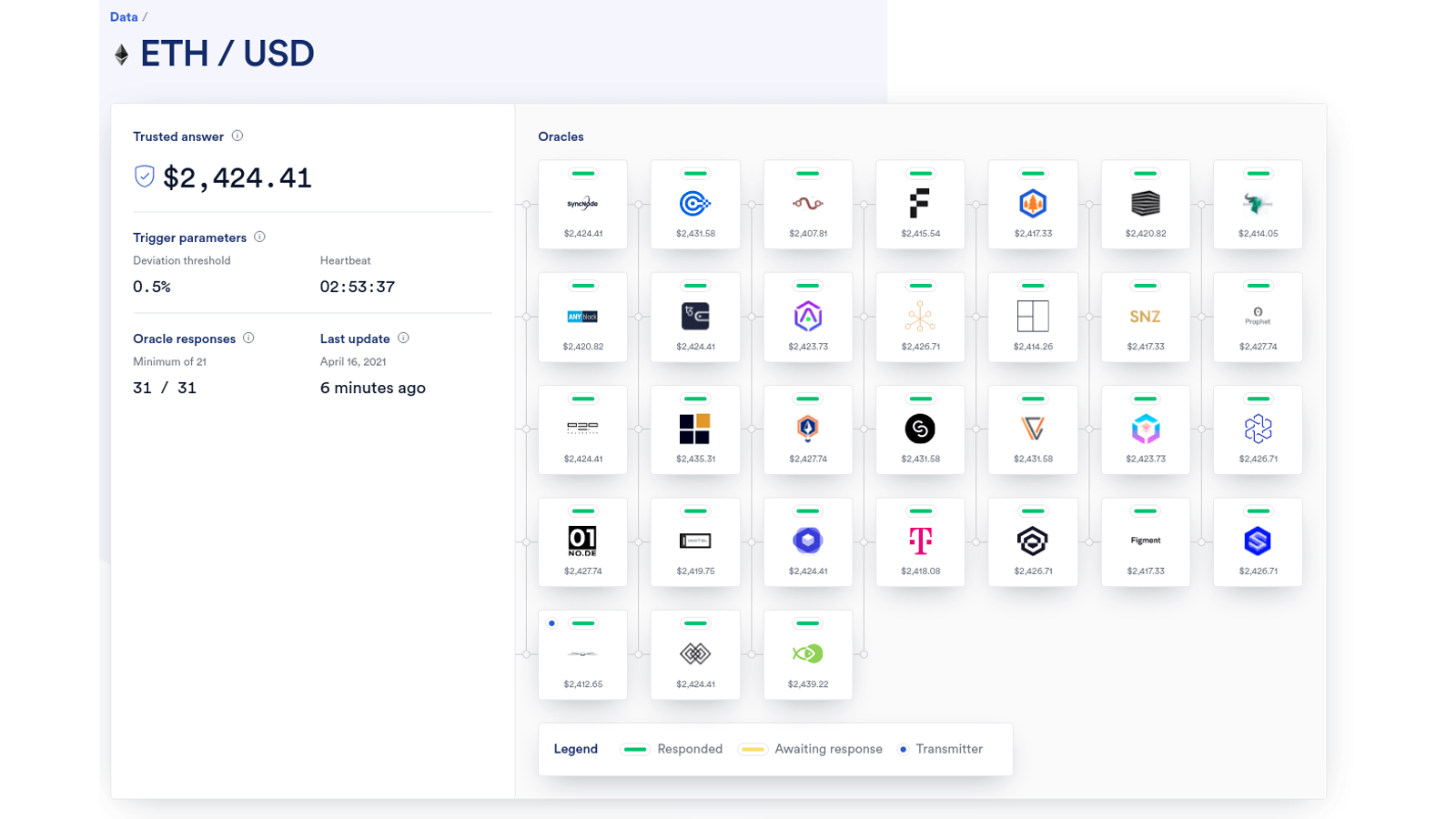
Why a median can resist one bad observation
If one node reports a wildly incorrect price, the median does not move as much as a simple arithmetic mean might. This resilience only holds while a sufficient portion of observations remains honest and representative.
Data-source diversity and node diversity are separate properties
Ten oracle nodes all reading one upstream API do not create genuine source diversity. One node reading ten exchanges still remains one operator. Strong designs try to diversify both layers.
Oracle decentralization is not a count of logos. You need to know who produces the underlying data, who runs the nodes and what quorum is required to publish a report.
How a price feed reaches a smart contract
A consumer contract usually does not query external websites. It calls an on-chain feed contract/interface and reads the latest published answer plus metadata such as update time.
At the application layer this looks simple: a lending protocol reads ETH/USD, calculates collateral ratio and decides whether a position is healthy. Reliability depends on the entire pipeline upstream of that call.
Decimals and units cause deceptively simple failures
A feed can return an integer with a fixed decimal scale. The consumer must read the decimals and normalize correctly. A factor-of-10⁸ mistake can turn a correct oracle report into catastrophic application logic.
Timestamp should be checked with price
A value can have been correctly published yet become stale. Consumer protocols therefore need stale-data rules: inspect the update timestamp and refuse to act when data exceeds an acceptable age.
“Latest” does not mean fresh at this instant
Latest means the most recently published report. If market movement has not crossed a deviation threshold and the heartbeat interval has not elapsed, the feed can retain its previous answer. Risk systems care about maximum acceptable age, not the word latest.
Heartbeats and deviation thresholds control update frequency
A price feed does not need to write an on-chain transaction every millisecond. That would be expensive and often unnecessary. A common model publishes when price moves beyond a configured deviation threshold or when a maximum heartbeat interval elapses.
These parameters trade freshness against cost. A tighter deviation threshold creates more updates and higher reporting cost. A longer heartbeat reduces cost while allowing older data during quiet markets.
One threshold does not fit every asset
A volatile token, stablecoin and commodity index have different dynamics. Consumer protocols also operate at different risk speeds: a perpetual exchange and monthly treasury report do not require identical freshness.
Feed configuration is part of integration
Developers need to verify the exact feed address, chain, decimals, heartbeat/deviation expectations and documentation. Parameters from one network or feed should not be copied to another just because the pair name looks identical.
A stale price is dangerous in the context of business logic
Imagine a lending protocol. ETH falls sharply on external markets while the on-chain oracle still shows an older high price. The borrower appears more collateralized than reality and may borrow or withdraw too much value before the feed updates.
The opposite can also hurt: a stale low price after a fast recovery can trigger unnecessary liquidations.
| Failure mode | What happened | Consumer risk |
|---|---|---|
| Stale data | Feed has not updated recently | Incorrect collateral or settlement decision |
| Single-source failure | Upstream price breaks | Biased report if diversity is weak |
| Node outage | Some operators are offline | Loss of liveness / delayed update |
| Bad decimals | Consumer scales the answer incorrectly | Catastrophically wrong value |
| Wrong feed address | Different asset/network selected | Valid data with the wrong meaning |
| Market dislocation | Venues diverge sharply | Aggregation lag / ambiguous reference price |
Circuit breakers belong in the consumer protocol
The oracle cannot know every application's business risk. A lending protocol might stop new borrowing on stale data; a derivatives system might enter guarded mode; a dashboard might only show a warning. Fail-safe policy belongs to the consumer architecture.
Manipulation risk comes from measuring a market that is too thin
If a protocol uses the instantaneous spot price of one low-liquidity DEX pool, an attacker can temporarily move reserves with a large swap, make the contract read the manipulated price, and extract value from lending or liquidation logic.
Flash loans made this class of attack especially visible: large temporary capital can be borrowed inside one transaction, used to manipulate a thin market, and repaid before atomic execution completes.
Market coverage quality matters more than venue count
Ten tiny exchanges do not automatically provide a better reference price than a smaller set of high-quality liquid venues. Oracle methodology needs to consider liquidity, market quality, outlier treatment and wash-trading risk.
An on-chain TWAP is an alternative with different assumptions
Uniswap-style TWAP uses accumulated on-chain price history. Manipulating a time-weighted price can be more expensive than moving one instantaneous spot because the distortion must persist through time or blocks.
A TWAP still represents a specific on-chain market. Thin liquidity or a major divergence from external markets does not magically turn it into ground truth.

A Decentralized Oracle Network is a separate fault domain
A DON exists because blockchain validators should not make arbitrary web requests themselves. Oracle nodes perform external-data work separately, sign or contribute observations, and produce a report that the blockchain can process deterministically according to oracle contract rules.
This separates fault domains but does not eliminate trust. Review node operators, reporting quorum, cryptographic signing, upgrade controls and economic incentives.
Liveness and correctness are different properties
A network can remain honest yet fail to publish temporarily because operators are offline. That is a liveness failure. Or it can publish promptly but with incorrect data because sources or quorum were corrupted. That is a correctness failure.
Consumer protocols need plans for both.
The oracle contract is software too
Proxy configuration, access-control bugs, upgrades and consumer-integration errors occur after aggregation. Excellent source data cannot fix a wrong contract address or a decimal-scaling bug.
CCIP is not a price oracle, but it extends the independent messaging-layer idea
Chainlink CCIP transports messages and tokens between blockchains. It is not a “price feed between chains,” but architecturally it shows a broader oracle/network model: decentralized networks observe a source chain, produce attestations/messages and deliver results to a destination chain.
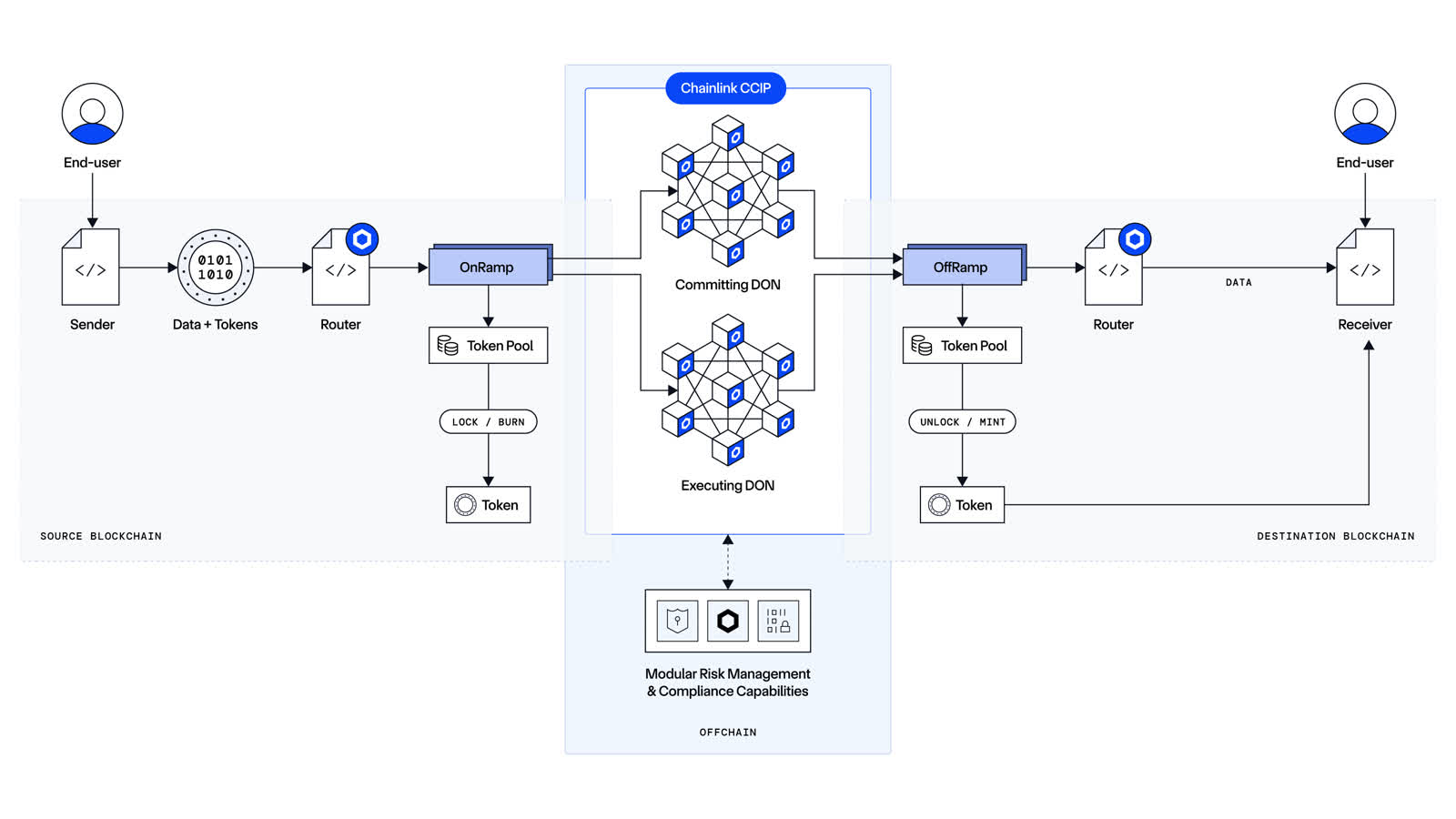
Cross-chain communication adds another failure surface
The consumer now depends on source-chain finality, messaging infrastructure, destination execution and token-pool or bridge logic. “Chainlink is used” does not mean every part of the application inherits the same security profile.
Price Feeds and CCIP belong in different risk buckets
A Price Feed answers “what external value should be published?” CCIP answers “what message or token instruction was confirmed between chains?” They share related infrastructure ideas but have different failure models.
How to integrate an oracle into a DeFi protocol
Good integration begins with a threat model and official registry/documentation, not a contract address copied from a random gist.
- Verify network and feed contract address.
- Verify decimals and units.
- Read update timestamps and define maximum staleness.
- Define fail-closed or fail-safe behavior.
- Bound actions during extreme price movements.
- Check sequencer-uptime feeds where L2 architecture requires them.
- Do not treat one oracle as the only risk control.
- Test zero, negative or invalid-data cases where technically possible.
- Monitor feed health and consumer events.
- Document upgrades and emergency governance.
Oracle integration is only as safe as the application's response to bad, late or temporarily unavailable data.
Compare independent reference paths
Large risk systems can benefit from a secondary sanity check such as another oracle, an on-chain TWAP or bounded-deviation logic. It does not have to replace the primary feed to stop an obviously anomalous action.
The main conclusion
An oracle bridges deterministic blockchain execution and the nondeterministic external world. Chainlink Data Feeds reduce single-point risk through source aggregation, independent oracle nodes and DON reporting. Consumer contracts receive an on-chain answer but must still validate freshness, units and failure conditions.
The key mistake is treating an oracle as an abstract “source of truth.” It is a measurement system with methodology, latency and failure modes. A robust DeFi protocol knows where its data came from, how fresh it is, what happens during an outage and which safe mode activates when markets or the oracle pipeline stop behaving normally.
FAQ
Why can an Ethereum smart contract not call a REST API directly?
All validating nodes need deterministic inputs. HTTP responses can vary by time, region, timeout and content, so they cannot be treated as native consensus data.
What is a DON?
A Decentralized Oracle Network is a set of independent oracle nodes that observe external data sources and jointly produce a report for an on-chain contract.
What is a stale price?
It is the most recently published value whose age exceeds what the consumer protocol considers acceptable. It may have been correct when published but unsafe for a current decision.
Are heartbeat and deviation threshold the same thing?
No. A deviation trigger causes an update after sufficient price movement; a heartbeat sets the maximum update interval even when price movement is small.
Can Chainlink be replaced with a Uniswap TWAP?
A TWAP can suit specific use cases but has a different trust and liquidity model. It reflects a chosen on-chain market and depends on its depth and observation window.
Is CCIP a price feed?
No. CCIP is cross-chain messaging and token-transfer infrastructure. It is related to Chainlink's oracle-network architecture but solves a different problem with a different failure model.
This material is educational and informational. It is not financial advice or a trading signal.