A crypto wallet does not store bitcoins inside an app or a device. It stores—or can reconstruct—the secrets used to prove authority over on-chain state. Coins remain in the blockchain ledger; the wallet manages keys, addresses, derivation paths, transaction construction and signatures. This distinction sounds semantic until someone loses a seed phrase or signs a transaction they did not understand.
A wallet manages keys and intent, not a box of coins
When an app shows a balance, it derives that balance from blockchain state: UTXOs, account balances, token contracts and transaction history. Labels, address books and cached metadata can exist locally, but economic authority comes from a private key or a policy involving several keys.
In Bitcoin, the right to spend an output is checked against script conditions and signatures. In Ethereum, an externally owned account authorizes transactions with a cryptographic signature. The network does not care which wallet brand was used. It verifies cryptographic evidence.
A private key is a secret number
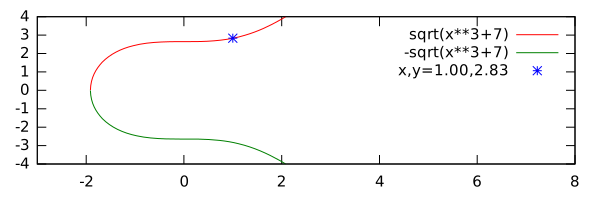
In elliptic-curve systems, a private key is a number in a valid range. A public key is mathematically derived from it. Recovering the private key from a properly generated public key is considered computationally infeasible under current assumptions and parameters.
Bitcoin and Ethereum both use secp256k1. A private key is commonly represented as a 256-bit value, although not every possible 256-bit integer is valid; it must fall within the group order.
Randomness matters more than formatting
Private-key security depends first on entropy. If a human invents a key or a generator produces predictable randomness, elliptic-curve cryptography cannot rescue the setup. An attacker does not need to break secp256k1 if they can guess the seed.
A seed phrase is human-readable recovery material derived from entropy
BIP39 defines a mnemonic code: entropy is converted into words with a checksum, and the mnemonic plus an optional passphrase is processed with PBKDF2-HMAC-SHA512 to produce a binary seed. An HD wallet can then derive a master extended key from that seed.
Terminology matters. People often call the 12 or 24 words “the seed phrase.” Technically the words form a mnemonic sentence from which a binary seed is derived. The HD system then builds its key tree from that seed.
Why words are easier than hexadecimal strings
Humans can copy a controlled list of words more reliably than a long hexadecimal value. A checksum catches some mistakes. This is a usability layer around entropy, not extra cryptographic magic.
Twelve words do not mean twelve keys
The mnemonic is one root recovery secret. It can deterministically produce an enormous tree of account and address keys. Losing one phrase can mean losing every account under that tree; leaking one phrase can compromise every derived account unless another independent secret or policy protects them.
A seed phrase should be protected like the root secret of the entire wallet tree. A cloud photo of the words can reduce a sophisticated hardware wallet to an expensive display—the attacker no longer needs the device.
An HD wallet turns one seed into a key tree
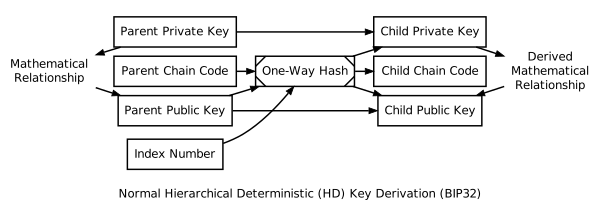
BIP32 introduced Hierarchical Deterministic wallets. A master seed produces an extended private key containing private-key material and a chain code. Child keys are derived from that extended key through defined functions.
The main practical benefit is backup simplicity: one root secret can restore many future addresses. A wallet can generate a new receive address for every payment without requiring a fresh backup every time.
An extended key contains more than one ordinary key
An extended private or public key includes the key plus a chain code and derivation metadata. An xpub is therefore not simply one public key. It can generate a whole branch of non-hardened child public keys.
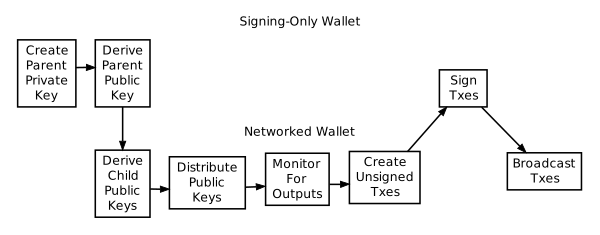
That makes watch-only wallets possible: a server can generate deposit addresses without holding spending keys. But xpub leakage is a privacy problem because an observer can link a large branch of addresses and balances.
Hardened derivation changes the compromise boundary
BIP32 provides hardened children that cannot be derived from the parent extended public key alone. This reduces certain cross-generational compromise risks.
An xpub is still sensitive information
An xpub normally cannot spend funds directly, but it can expose balances, history and future address structure. In a financial privacy model it is sensitive even though it is not a private key.
BIP44 gives the HD tree a standard structure
BIP44 proposed paths of the form m / purpose' / coin_type' / account' / change / address_index. This lets different implementations discover accounts and addresses consistently.
After recovery, software needs more than the mnemonic. It also needs to know the derivation convention and script type. A user can restore the correct seed and temporarily see a zero balance simply because the wallet is scanning a different path.
An address is not simply the public key in another font
Bitcoin addresses generally encode hashes or script-related destinations rather than a raw public key. Legacy, SegWit and Taproot addresses reflect different script/witness constructions. Ethereum addresses are derived from public keys through another scheme.
One seed can serve several networks
HD standards allow different coin-type branches beneath one root. That is convenient, but it enlarges the blast radius: a compromised seed can affect every network derived from it, not just one Bitcoin account.
Digital signatures prove authorization without revealing the private key
When a wallet signs a transaction, it does not send the private key to the network. It creates a signature over a protocol-defined message digest. Nodes use the public key and signature to verify that the signer possessed the corresponding private key and that the signed data were not altered.
Bitcoin historically uses ECDSA over secp256k1, while Taproot introduced BIP340 Schnorr signatures for relevant spending paths. Ethereum EOAs also use secp256k1 signatures, although serialization and signed payloads differ.
A signature is not an abstract “I agree” button
A signature is bound to a specific digest. Transaction-signing digests include protocol-defined fields such as inputs, outputs, amounts, nonces, chain IDs or other data depending on the network and signing mode.
This is why a hardware wallet must show the human **what is being signed**. Cryptography can prove that a device signed bytes; it cannot guarantee the person understood those bytes.
The signature nonce is not the Ethereum transaction nonce
ECDSA uses a per-signature secret nonce k. This is unrelated to an Ethereum account transaction nonce. Reusing or predictably generating k can reveal the private key from signatures. Modern implementations use deterministic nonce generation or strong randomness to avoid historically catastrophic failures.
A hardware wallet isolates the signing key from a general-purpose computer
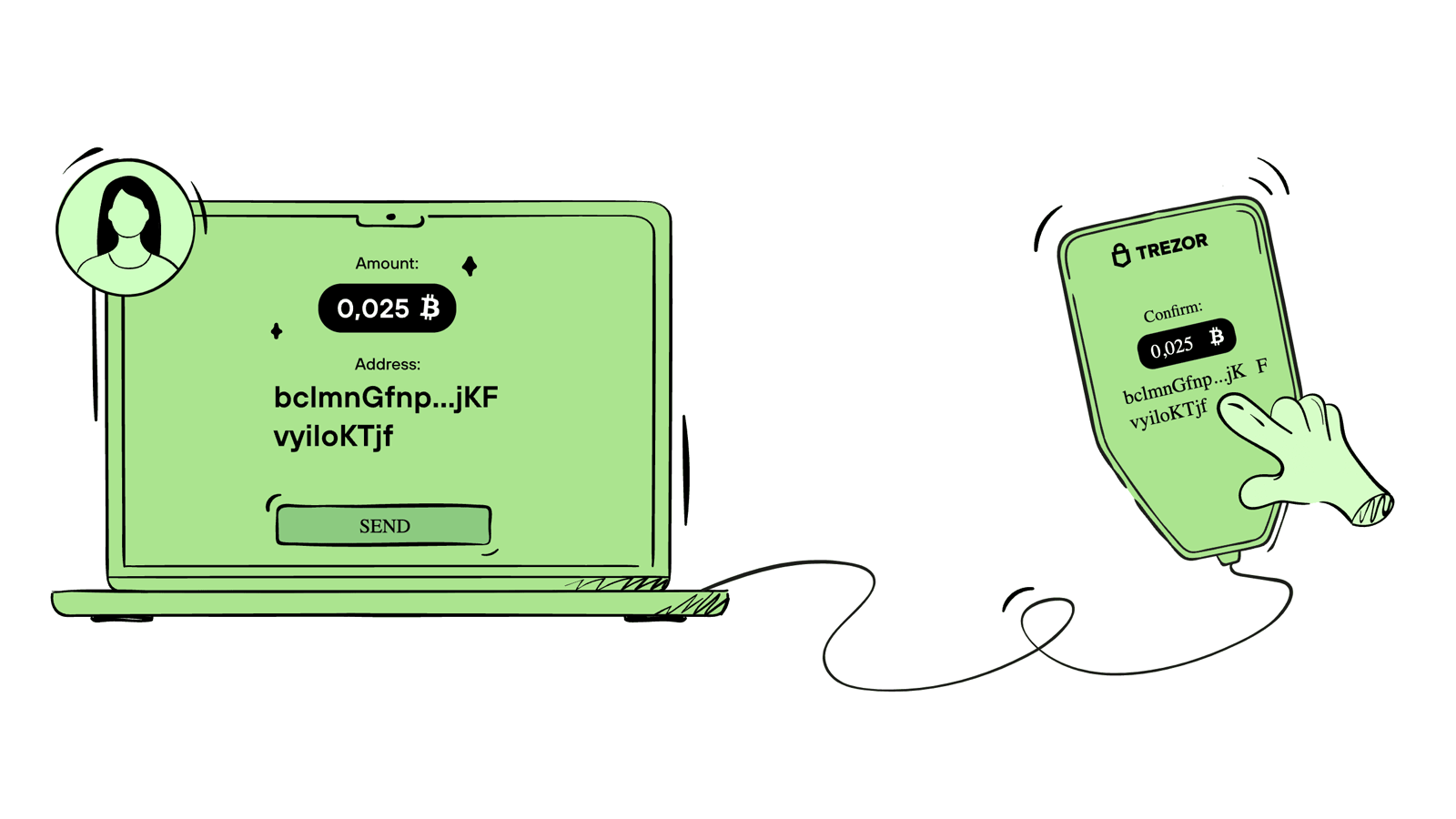
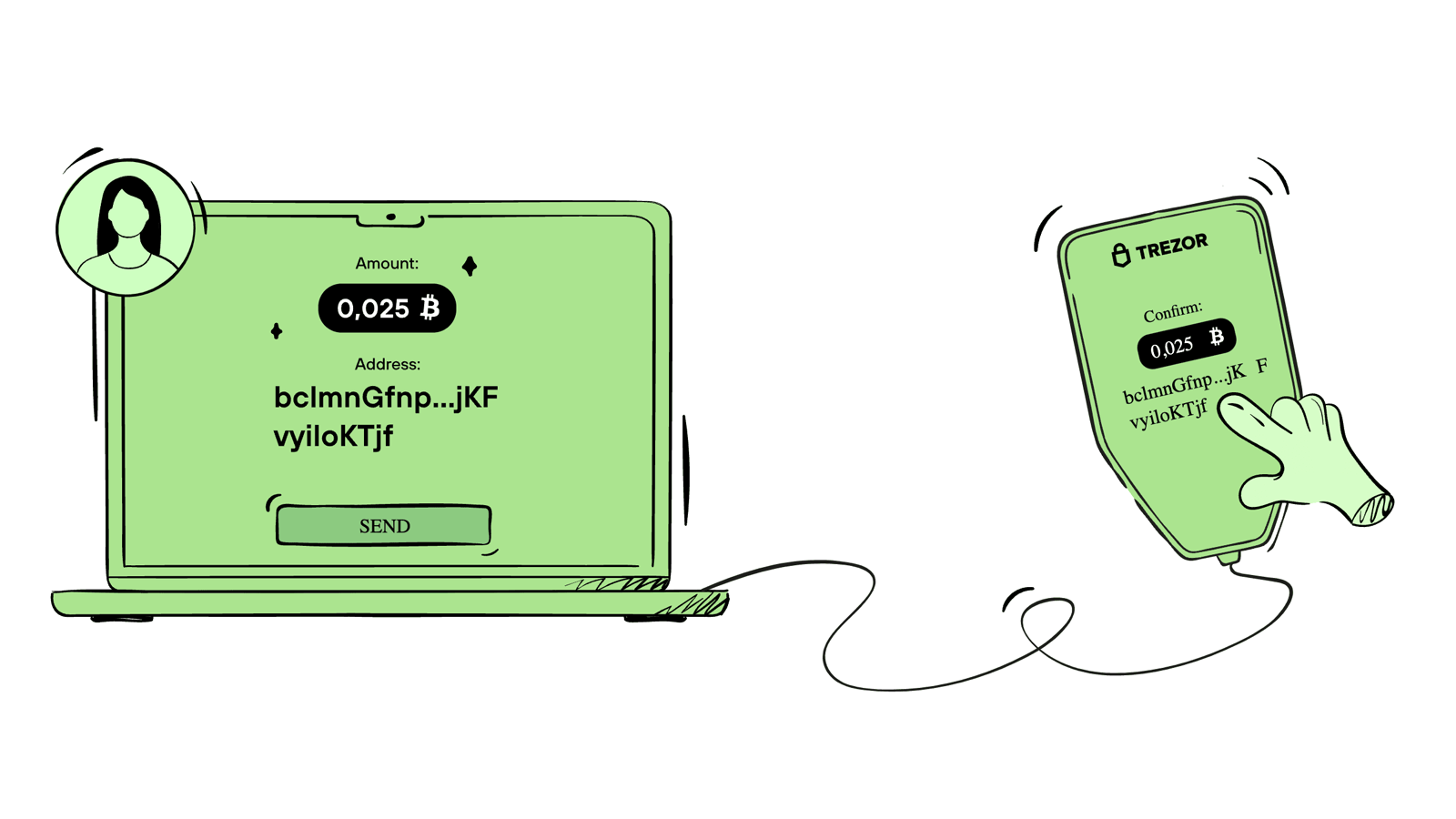
A hardware wallet is designed to keep private keys unavailable to the laptop or phone operating system. The host constructs an unsigned transaction, the device receives the data, the user confirms critical fields on a trusted display, and the device returns a signature.
Under normal operation the private key never leaves the hardware security boundary. This materially reduces risk from malware capable of reading files, clipboard contents or browser memory.
A hardware wallet does not make an infected computer trustworthy
Malware can replace the recipient address before the transaction reaches the device. Protection works only when the user compares address and amount on the trusted display. Clicking Confirm mechanically defeats an important part of the security model.
Secure elements and open hardware are different design choices
Some devices use secure elements to resist physical key extraction, others emphasize auditable commodity hardware, and some combine approaches. Security cannot be reduced to a single checkbox saying “secure element: yes/no.”
The critical boundary is the signing-verification path
A strong hardware wallet minimizes blind signing, displays understandable transaction details and protects firmware/update integrity. Users should be able to verify that the display represents the bytes the device is about to authorize.
Hot, cold, hardware and multisig address different risks
A cold wallet means the signing key is not continuously exposed to an online environment. A hardware wallet is a dedicated physical signer. The concepts overlap but are not identical.
| Model | Where the private key lives | Main advantage | Main risk |
|---|---|---|---|
| Hot software wallet | Online device | Convenience and speed | Malware / browser compromise |
| Hardware wallet | Dedicated signer | Key isolation + trusted display | Supply chain, blind signing, seed backup |
| Air-gapped signer | Offline device | Minimal online interface | Data-transfer mistakes / physical security |
| Multisig | Several independent keys | No single key failure | Backup complexity / coordination |
| Custodial wallet | Service-controlled keys | Simple recovery | Counterparty/custody risk |
Multisig changes the model from protecting one secret to protecting a quorum
Bitcoin scripts and Taproot can enforce spending policies requiring several signatures. A 2-of-3 setup can survive one lost key and one compromised key when the remaining keys are genuinely independent.
Multisig does not help if all three seed backups live in the same cloud account or every signer was acquired and initialized as one correlated setup.
Recovery is the most underrated part of wallet security
A daily-use device can be protected by a PIN, biometric gate or secure element, while disaster recovery collapses to a paper backup containing the seed. Anyone who obtains that mnemonic can generally reconstruct keys on another compatible wallet without knowing the original device PIN.
A seed backup must survive two opposite threats
It needs to remain available after fire, loss or device failure while remaining unavailable to an attacker. These goals conflict. More copies increase resilience and attack surface; fewer copies reduce exposure and increase irreversible-loss risk.
A passphrase creates a separate wallet namespace
An optional BIP39 passphrase participates in key stretching and produces a different seed. A wrong passphrase generally does not produce an error—it produces another valid wallet. That can protect a stolen mnemonic while adding another secret whose loss makes recovery impossible.
A passphrase the owner cannot recover five years later is not extra security; it is another failure mode.
Backup verification beats confidence
Recovery procedures should be tested safely before substantial value depends on them. A wrong word, derivation path, passphrase or multisig descriptor is much cheaper to discover early.
Threat models matter more than hardware-wallet rankings
The right wallet depends on the threat. A convenient mobile wallet may be rational for small daily spending. A corporate treasury should not rely on one person's single hardware device because insider risk and key-person dependency dominate.
A useful threat model asks:
- What happens if the phone is stolen?
- What happens if the laptop is infected?
- What happens if the seed backup leaks?
- Can one person steal all funds?
- How does recovery work after death or incapacity?
- How are firmware and transaction details verified?
- Is coercion or physical attack relevant?
- Does the design still work if the value grows 100×?
UX is part of security
Systems people do not understand encourage workarounds. Users photograph seeds because paper feels inconvenient, skip verification because a display is tiny, and store all multisig backups together because coordination is difficult.
Security engineering must account for real behavior, not an imaginary perfect operator.
The main conclusion
A crypto wallet is a chain of trust from entropy to a signed transaction. A seed phrase restores root material. HD derivation creates a key tree. Private keys produce public keys and signature authority. Addresses encode destinations. A hardware wallet isolates signing and moves critical verification onto a separate display.
The most dangerous mistake is assuming security is a property of the device alone. A hardware wallet cannot protect a leaked seed, blind signing, a broken backup plan or poorly designed multisig. Strong custody begins with a threat model: how secrets are created, where they live, what the signer shows, how transactions are verified and how control is recovered after a real failure.
FAQ
Are a seed phrase and a private key the same thing?
No. A mnemonic/seed is usually root recovery material from which an HD wallet derives many private keys. One specific private key controls a particular branch or address according to wallet rules.
Is the seed phrase stored on the blockchain?
No. The blockchain contains public state and transaction data. Seeds and private keys must remain secret with the owner or custodial system.
Can a hardware wallet sign without internet access?
Yes. Signing itself does not require network access. An unsigned transaction can be moved to an offline signer, signed there, and broadcast later from an online machine.
What can someone steal with only an xpub?
An xpub normally cannot spend funds, but it can reveal a large branch of addresses and balances. That is a major privacy leak and can matter in more complex derivation-compromise scenarios.
How is Schnorr different from ECDSA for an ordinary user?
Both let a network verify control of a private key without revealing it. Schnorr in Bitcoin Taproot has cleaner algebraic properties and supports efficient constructions such as key aggregation, while the wallet UX can still look similar.
If a hardware wallet is lost, are the coins gone?
Not necessarily. If recovery material and the wallet scheme are preserved, keys can be restored on compatible hardware or software. Losing both the device and the only recovery backup usually means irreversible loss of control.
This material is educational and informational. It is not financial advice or a trading signal.