
What to check before automating trading
Automated trading follows defined entry, management and exit rules. Preparation starts with the trade idea itself: are its levels current, how does the target compare with the stop, and does market context support the scenario?
Orenix connects this preparation through signal evaluation, the screener and demo/paper. Two retained demonstration reviews of BTC and ETH from 12 November 2026 illustrate the process.
Start with the original signal
Record the pair, market, direction, entry, Stop Loss and Take Profit. Compare entered or extracted values with the source message. Preserve entry-range boundaries and identify which target is being assessed when several are supplied.
| Field | Practical question |
|---|---|
| Pair and market | Do the instrument and reference quote match? |
| Direction | Which scenario is being evaluated? |
| Entry | Is it still available, and when was the idea published? |
| Stop | What invalidates the idea? |
| Target | Which expected move supports the plan? |
| Risk | What are quantity, allowed cash loss and costs? |
A Telegram signal can provide the initial idea; Orenix then reviews its parameters. If entry changes after price moves, recalculate the distances and retain a new plan version.
Two reviews, different reasons to wait
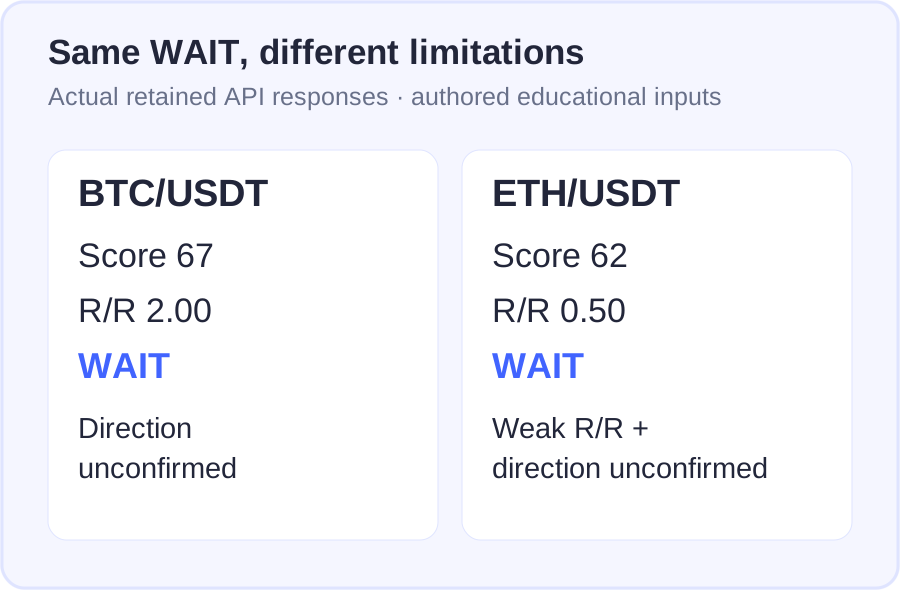
The demonstration BTC/USDT LONG setup used entry 73,577.10, stop 72,841.33 and target 75,048.64 USDT, giving potential reward divided by risk near 2:1. Orenix suggested waiting for directional confirmation.
The ETH/USDT LONG example used entry 2,045.52, stop 2,004.61 and target 2,065.98 USDT, producing about 0.5:1: the target was approximately half the stop distance.
| Measure | BTC/USDT | ETH/USDT |
|---|---|---|
| Score | 67 | 62 |
| Target distance / stop distance | approximately 2.00 | approximately 0.50 |
| Decision | WAIT | WAIT |
| Main question | Is direction confirmed? | Is the target/risk relationship justified? |
The checks began on 12 November 2026 at 06:42:30 and 06:42:34 UTC. These are retained responses to editorially prepared parameters; a current idea needs current data.
How to read the Orenix assessment
Read the reasoning, then compare it with the levels and market background. Score summarizes the scenario assessment. It is not a measured probability of profit on the trade.
The reason matters: unconfirmed direction, a nearby target, a late entry and stale data call for different responses. The same WAIT decision can lead to waiting for new conditions, revising parameters or selecting another idea.

Evaluate execution conditions
Price-distance reward/risk differs from cash exposure. The latter requires quantity and applicable expenses. Consider fees, possible slippage and funding for relevant contracts.
A complete automated scenario also needs cancellation, management and exit rules, plus a response to connectivity loss. These require separate checks before using real funds. The retained examples in this article concern idea evaluation.
Prepare a demo observation
- Retain the original parameters and assessment time.
- Read the Orenix explanation alongside market context.
- Define cash risk and execution assumptions.
- Open the terminal and confirm demo/paper mode.
- Observe the rules recorded in advance.
- Compare the action history with the initial plan.
Demo helps explore the process and find inconsistent rules. When applying observations to exchange trading, account for differences in liquidity, execution and financial risk.
Frequently asked questions
Does checking a signal start trading?
The review evaluates parameters and context. Using the terminal and choosing an execution mode are separate steps.
Is a high Score enough for automation?
Read Score together with the reasoning, levels, costs and execution rules. One scenario assessment does not validate the entire sequence.
Where should I start in Orenix?
Use one clearly defined idea: review the signal, assess risk, then prepare a demo observation and journal entry.
Data and further reading
Prepared by the Orenix.net editorial team using retained BTC/ETH assessment requests and responses from 12 November 2026. Binance USD-M supplied reference prices. Detailed cases, signal review and demo resources are linked below.