
What a trading journal gives you
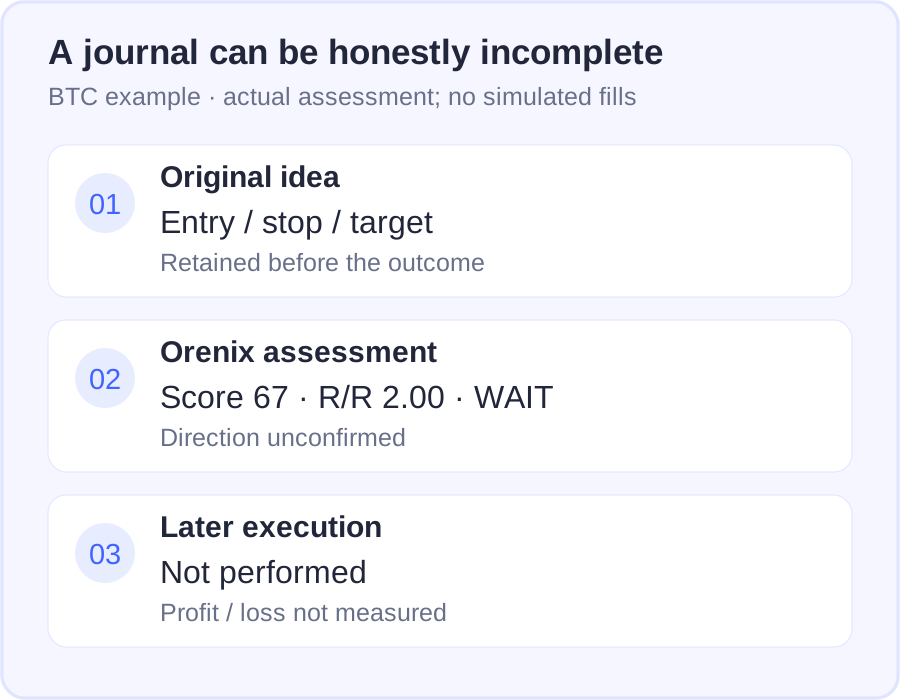
A trading journal connects the original idea, the decision and the later outcome. Its main value is reconstructing the analysis: why a coin was selected, where entry was planned, what the signal review showed and how the plan changed.
In Orenix, you can organize this process around signal evaluation and demo observation. Your own spreadsheet or document can hold the notes. Below is a practical record structure and an example based on the retained BTC assessment from 12 November 2026.
What to record before entry
Start with the parameters that define the trade. Record the idea source, pair, market, direction, time, entry, stop and target. Preserve a complete entry range when one is supplied. Add the asset-selection reason and the condition that invalidates the idea.
| Stage | Record |
|---|---|
| Original plan | Source, time, pair, direction, entry, stop and target |
| Orenix review | Assessment time, R/R, Score, decision and explanation |
| Action | Wait, observe in demo or create a revised plan |
| Observation | Entry, exit, changes, costs and reason for completion |
| Conclusion | What matched the plan and what to examine next |
Record quantity and cash risk separately. The same price levels create different account exposure at different position sizes.
Example: recording a BTC assessment
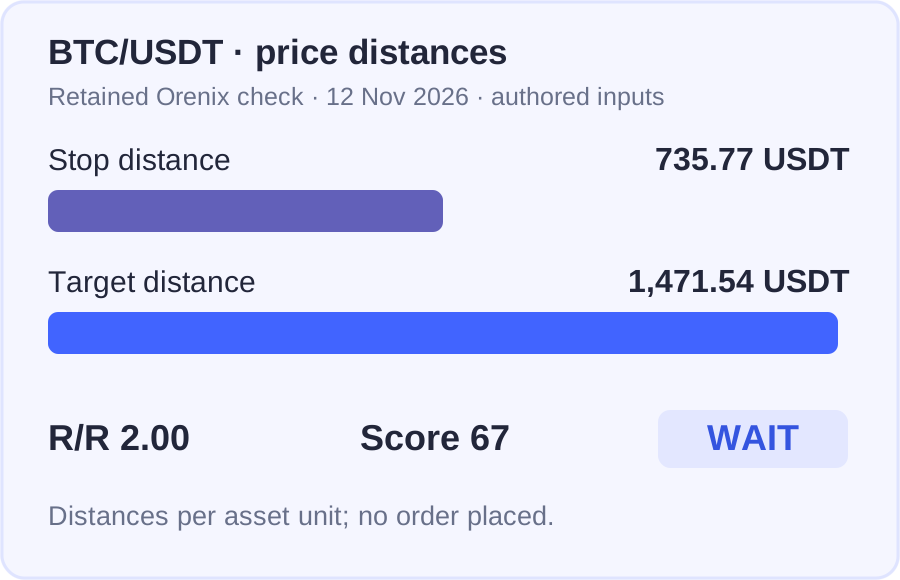
The editorial team used a public Binance USD-M quote to define a demonstration BTC/USDT LONG setup. The Orenix assessment began on 12 November 2026 at 06:42:30 UTC; its inputs and response were retained.
| Field | Value |
|---|---|
| Instrument and direction | BTCUSDT, LONG |
| Entry | 73,577.10 USDT |
| Stop Loss | 72,841.33 USDT |
| Take Profit | 75,048.64 USDT |
| R/R | approximately 2.00 |
| Score | 67 |
| Decision | WAIT for confirmation |
| Explanation | Market direction did not support the idea |
| Record stage | Idea review; no trade was executed |
The journal retains a useful analytical result even when the decision is to wait. A later entry can compare changes in the market, entry and reasons for revisiting the scenario. Further observation receives its own timestamp.
How to keep a paper-trading journal
Before starting, confirm that the terminal is in demo mode. Retain the initial plan and management rules: what constitutes entry, what cancels the idea and which conditions trigger an exit.
Record actions in sequence. Moving a stop, changing a target or entering again should appear as a revision rather than overwrite the original. Compare the terminal history with your notes on the reasoning.
Keep fees, slippage and applicable contract funding in separate fields. When comparing demo with exchange trading, identify which execution conditions were modeled. If the order of level touches cannot be determined, retain that fact for further review.
How to review completed records
Compare actions with the original plan before focusing on the final amount. Ask:
- Did entry follow the initial conditions or come after a price move?
- Were stop and target changes governed by predefined rules?
- Which Orenix observations influenced the decision?
- Are quantity and expenses included?
- Which conditions recur in later records?
A consistent series helps identify recurring process errors. Assessing strategy robustness also requires an adequate sample and consistent result-calculation rules.
Frequently asked questions
Do I need a separate journaling app?
Your own spreadsheet or notes are sufficient for this method. Use the Orenix signal review and terminal history, and record decision reasons in a format that suits you.
What should I record after choosing to wait?
Keep the parameters, timestamp, WAIT decision and reason. That is a complete record of the analysis stage; later actions are added separately.
How does a journal differ from a profit-and-loss list?
A journal connects the outcome with the initial plan, changes and costs. A final amount alone does not show that sequence.
Example data and further reading
This article is prepared by the Orenix.net editorial team. Values come from the retained BTC assessment request and response dated 12 November 2026. The links below lead to the detailed BTC case, signal-to-demo walkthrough and risk guide.